

1. I first met Ms. Dang Thi Phuong Thao in 2004 when the People's Army Newspaper, in coordination with the Central Committee of the Ho Chi Minh Communist Youth Union, organized a competition to learn about the 50th anniversary of the Dien Bien Phu Victory. At that time, I was very impressed with the sharp and insightful way the female Head of the Propaganda Department of the Central Committee of the Youth Union spoke when she proposed measures to make the competition less formal and more effective. In early 2008, I took on the role of Editor-in-Chief of the Hanoi Moi Newspaper. With Ms. Phuong Thao's connection, the Central Committee of the Youth Union and the Hanoi Moi Newspaper signed a cooperation program, focusing on jointly organizing a competition to learn about the 1000th anniversary of Thang Long - Hanoi. These were two competitions with profound political and social significance, creating a great impact and receiving enthusiastic participation from all sectors of the population, especially from youth union members nationwide. Dang Thi Phuong Thao, Head of the Central Propaganda Department of the Youth Union, made active, creative, and very dedicated contributions to the success of these two competitions.
Through our work, we grew to appreciate each other even more. Feeling that Ms. Phuong Thao was very knowledgeable about journalism, I occasionally sent her some of my articles to read before publication, and I often received frank and insightful comments and suggestions. I jokingly said, "With such talent, it would be a waste not to work in journalism." Then, in 2009, as if by divine providence, she was appointed Deputy Editor-in-Chief of Thanh Nien newspaper. I secretly thought that the leaders certainly had a keen eye for making such a decision. As for myself, at the beginning of 2010, while working at Hanoi Moi , I was transferred to become Head of the Propaganda Department of the Hanoi City Party Committee. Meeting her, I jokingly said, "So, we've switched roles: you're moving from propaganda to journalism, and I'm moving from journalism to propaganda."
During her 13 years as Deputy Editor-in-Chief of Thanh Nien newspaper, Ms. Phuong Thao made many outstanding contributions, helping the newspaper to be both accurate and fresh, with a youthful spirit and integrity. It was one of the newspapers with the largest circulation, at times reaching over 400,000 copies per day. Not only strong in print, Thanh Nien was also one of the most successful newspapers in Vietnam in digital transformation, with its journalistic products on digital platforms having strong appeal and ranking among the top in terms of traffic. There's one more thing I'd like to add: during my more than six years as the Standing Vice President of the Vietnam Journalists Association, and while co-chairing press briefings with leaders of the Central Propaganda Department (now the Central Propaganda and Mass Mobilization Department) and the Ministry of Information and Communications (now the Ministry of Culture, Sports and Tourism), I noticed that one of the leaders of media organizations who often offered insightful, appropriate, and constructive opinions at these briefings was Deputy Editor-in-Chief of Thanh Nien newspaper, Dang Thi Phuong Thao. This was especially true when the press faced hot, sensitive issues; leaders of media organizations were under considerable pressure to find ways to handle them in a manner consistent with the general requirements of ideological work, while still ensuring independence, uncompromising stance, and accountability to wrongdoing and wrongdoing, in accordance with the law governing the press.
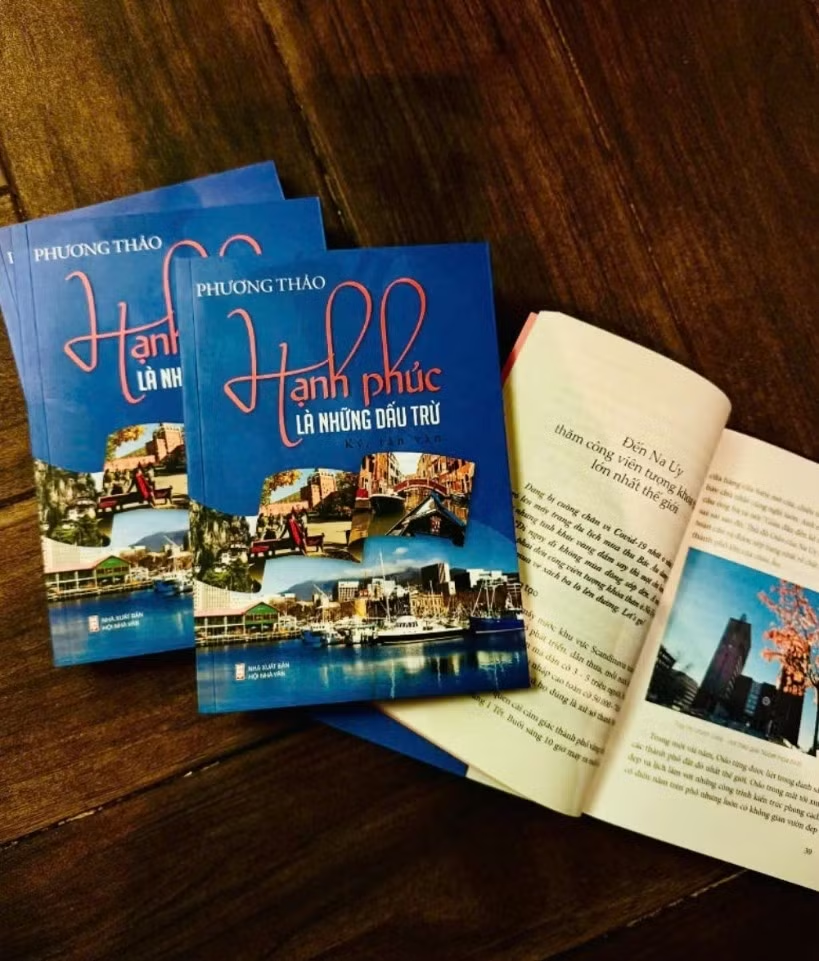
2. I begin by saying that I wasn't entirely surprised to receive the PDF of the book " Happiness from Minus Signs," which was presented quite comprehensively. Perhaps, however, I was increasingly amazed by how beautifully Phuong Thao wrote. It's smooth, gentle, yet profound. Overflowing with emotion, yet deeply moving. Radiant yet tender. Melancholy yet full of light. A sky full of longing and overflowing with hope.
Journalism is a unique profession. It's dangerous when considering the challenges and risks faced by writers. But from another perspective, it can be considered a rich profession. Rich, first and foremost, in information, rich in life experience and knowledge. Representing a reputable newspaper, Ms. Phuong Thao has had the opportunity to visit many countries. In the first part of her book, with its evocative and youthful title, " Long Journeys in the Blue Eyes, " I noticed that through her essays from Cambodia, Bhutan, North Korea, Japan, Russia, Ukraine, Norway, France, Germany, Italy, Switzerland, England, and then Cuba and the United States… to every land in a diverse, complex world, still full of conflicts and intense upheaval, her pen, naturally, still finds peaceful and soothing corners for the soul to relax and rest. Here, we get to read beautiful, emotionally charged passages from a soul always yearning for light and goodness.
Taking a leisurely walk by Lake Léman, where the border between France and Switzerland runs across its surface, she wrote: “This lake has a crescent or comma shape, formed by the Rhône glacier…. The water is clear and azure, flocks of pure white swans glide around, feeding on seeds from tourists. On the surface of the lake is the Jet d'Eau fountain, a magnificent spectacle of enormous streams of water reaching 140m high. At its peak, the fountain's speed can reach 220km/h, creating a column of water up to 150m high with 7 tons of water. From miles away, in the afternoon sunlight falling drop by drop on the lake's surface, the thin, shimmering water reflects the image of a beautiful seven-colored rainbow, like a delicate silk ribbon fluttering in the blue sky.”
During a visit to the paradise of Bhutan, a small country of 700,000 people nestled in the majestic Himalayas, sandwiched between China and India, she shared some interesting information: In Bhutan, women can have multiple husbands, but only the first husband has a marriage certificate. Men can live with their wives after marriage, and if they separate for any reason, they must compensate the woman. In Bhutan, marriages are not based on wedding ceremonies; couples simply live together, so there is no divorce. And here's something not everyone knows about this "fairytale-like peaceful place": Marrying a foreigner in Bhutan is very difficult because Bhutan does not want cultural and religious mixing. Even after marriage, foreigners are not granted Bhutanese citizenship but only annual visas. Then she reflected: “During my days in Bhutan, living slowly amidst the fluffy clouds drifting past my window, listening to the clear river murmuring, sipping a bottle of Red Panda beer, watching the Bhutanese people spinning prayer wheels, their faces gentle, happy, and content with life, I realized how my own life needs to be rearranged. I took a deep breath to contemplate what I am searching for in this life.”
In many of her writings, Phuong Thao demonstrates a keen observational ability combined with the provision of selective information in a format that makes readers suddenly realize, "Ah, so that's how it is." While in Norway, visiting the Nobel Peace Prize awarding ceremony, she wrote: “Born on October 21, 1833, in Stockholm (Sweden), Alfred Nobel invented the precursor to explosives. Due to a single detail—the death of his brother Ludvig in 1888—many obituaries mistakenly reported Alfred Nobel's death while he was still alive. An obituary in a French newspaper read: “Le marchand de la mort est mort” (The merchant of death is dead) and continued: “Dr. Alfred Nobel, who became rich after inventing a way to kill people faster than ever before, died yesterday.” These words awakened Nobel and made him concerned about how he would be remembered after his death, so he decided to use his entire fortune to award prizes to inventions that benefit humanity. All Nobel Prizes are awarded in Stockholm, except for the Nobel Peace Prize, which is awarded in Oslo.” Nobel's blessing, and no one has yet explained why. Oslo City Hall, the venue for the Nobel Peace Prize ceremony every October, is one of the capital's most famous buildings.
I want to bring up the topic of the Nobel Peace Prize because right now, the world is facing a major catastrophe, suffering from two devastating military conflicts in Ukraine and the Middle East. Just recently, US President Donald Trump boasted that he had ended nine conflicts and was doing everything he could to end the war in Ukraine. Yet, on February 28th, he ordered the US military, in coordination with Israel, to launch a fierce attack on Iran, killing the Supreme Leader and other Iranian leaders, and causing the deaths of thousands of innocent civilians, many of whom were women and children. Given the uncertain end and nature of the war with Iran, when asked by a journalist, "Do you think they will still consider awarding you the Nobel Peace Prize?", Trump replied, "I don't know, and I don't care anymore."
In the history of the Nobel Peace Prize, only one person has ever refused this prestigious award: Mr. Le Duc Tho of Vietnam, when it was presented to him alongside Dr. Henry Kissinger of the United States after the Paris Peace Accords ending the Vietnam War were signed in 1973. Mr. Le Duc Tho's statement at the time shocked the world: "It is impossible to equate those who resist aggression with the aggressors, especially when my compatriots are still dying from bombs and bullets on Vietnamese soil." Indeed, with what is happening in the world today, it is increasingly clear that war and peace are the most valuable and vital lessons for humanity, yet they are also the most difficult lessons to learn.
Speaking about the "legendary broken chair" in the article "Geneva: A Message of Peace," she said: "The Broken Chair is a wooden sculpture by Swiss artist Daniel Berset, crafted by carpenter Louis in Geneva. It's a giant chair with one leg broken. It has been on display in the Place de la Nations, Geneva, since 1997. The broken chair is made from 5.5 tons of wood, is 12 meters high to the seat and about 24 meters including the backrest. It symbolizes the opposition to the use of landmines and cluster bombs, and is also a call from civil society to state leaders when they signed the Convention d'Ottawa in December 1997 in Ottawa (Canada)."
Vietnam is one of the countries that has suffered the most severe consequences from bombs and landmines. The aspiration for peace and the elimination of the devastating suffering caused by war and conflict is the powerful message conveyed in this book.
Few people have had the chance to visit North Korea, so what Phuong Thao recounted about her trip to Pyongyang was quite interesting: The Pyongyang subway serves as both a means of transportation and a military structure, built in the 1960s. From the surface, it takes 5 minutes up a steep escalator about 100 meters to reach the subway stations. Trains run every 4-5 minutes, and the fare is very cheap, 5 won per person. The Juche Tower is built from 225,000 blocks of white stone, with a height of 170 meters, and the flame alone weighs 45 tons. The Pyongyang Triumphal Arch, inaugurated in 1982, is 80 meters high, 10 meters taller than the Arc de Triomphe in Paris. Amidst countless hardships, the North Korean people patiently work and maintain a remarkable spiritual life. The large public learning building, the National Library, is built on a grand scale and occupies a prominent location in the city. The symphony theater is lit up weekly and is always full. All North Korean children are taught music and play a musical instrument. This is information about North Korea that is almost never seen in the Western press.
Visiting Windsor Castle, the British Royal Palace with its 628 rooms of varying sizes, currently holding the record as the world's largest inhabited castle, attracting approximately 25-30 million visitors from around the world each year, what particularly interested her were the 400 clocks of various types hanging there, the oldest of which is nearly 200 years old. Each clock possesses its own unique elegance and sophistication. She wrote: "In the solemn silence of the castle, the ticking of time seems to connect the past, present, and future of the British monarchy."
3. Currently, there are over 5 million Vietnamese people living and working in countries around the world. As a journalist, wherever Ms. Phuong Thao goes, she always tries to meet the Vietnamese community. In this book, she has dedicated warm and affectionate words to writing about them. These are vivid accounts of the lives of Vietnamese people at the INCENTRA Center in the suburbs of Moscow, Russia – a symbol of the close friendship and cooperation between the two capitals, Hanoi and Moscow – and the Modern Village in Kharkiv, Ukraine. I was fortunate to attend the groundbreaking ceremony for INCENTRA in the autumn of 2028 during the visit of the Hanoi leadership delegation to Moscow, and I was delighted to read about the wonderful things concerning this center.
I was deeply moved when you wrote about your meeting with poet Nguyen Huy Hoang, a father who has dedicated his life to Russia solely to finding his beloved daughter who went missing more than 20 years ago. Both I and Mr. Nguyen Huy Hoang are former students of the famous Phan Boi Chau High School in Nghe An province. The story of him losing his little daughter on a Russian beach has caused pain and heartbreak for generations of Phan Boi Chau students and Vietnamese people in Russia for many years. Ms. Phuong Thao said that even though his hair has turned white, Mr. Huy Hoang remains a bridge for writers between Vietnam and Russia. Mr. Hoang recently published a book titled "Making a Living," recounting the lives of people in a foreign land, and is still passionately working on translating the Tale of Kieu into Russian. Mr. Hoang believes that one day he will find his daughter, as prophesied by the prophet Vanga.
Moved by the plight of Vietnamese people living abroad, she recounted a fleeting encounter that I will never forget. That day, she went to a small Chinese restaurant on Dijon Street, about 310km from Paris. She had barely settled down when she heard the melodious voice of a man from Nghe An province. It was two young men from Dien Chau, who had arrived four months earlier. At that time, the whole world was shocked by the tragedy of the 39 Vietnamese who died in a container truck traveling from France to England. One of them, named N., said that he had borrowed 400 million dong to pay a middleman to get here, after being persuaded by villagers. Two of the 39 victims were acquaintances of his. Sharing a piece of burnt rice she had brought from home, she encouraged the two young men from Nghe An to stay and work hard here. She wrote: "It was a fleeting encounter, yet it left my heart feeling restless. As we parted ways, seeing the faces of the two boys standing at the door to see us off, I only hoped they would be safe there and not venture down the unstable and treacherous path of migration for a living."
4. In the second part , "The Changing Seasons," I particularly enjoyed the pages she wrote about her beloved father and mother, and about Nguyen Du Street where her family lived in Hai Duong. The memories were like a film reel replaying her childhood days in a poor, struggling civil servant family, yet filled with warmth and love.
Her father was an official at the Department of Information and Propaganda, a renowned writer, playwright, and author of traditional Vietnamese opera (cheo), with some of his plays staged by the Voice of Vietnam Radio or the Cheo Theatre, such as "On the Road to Save the Country" and "The Coin of Wanli." His song "Entering Hai Duong" was used as the theme song for Hai Duong Radio. Her writings about those cold winter nights when the whole family huddled under one bed, covered with a mat for warmth, are so similar to the scene at my house in the 1960s, when my father suddenly passed away after a severe illness. Then there's the scene of the four sisters clinging to their father, listening to him quizze them about countries and their capitals, about national and world heroes. She remembers the times her father took her on work trips to various localities, and how her mother would pack her a handful of rice and some salty fried shrimp – that gave them the confidence that they could travel the world together.
Her mother was a beautiful girl from Co village, "with an oval face, a high nose, smooth white skin, neatly combed hair, a purple ao dai dress, gold earrings, and a delicate necklace." Read the following passage to better understand our country and village during the war years and the subsidy period: “My mother went to the town to work at Hiep Thanh Printing Company (private), which later became Hai Duong Printing Enterprise, as a typesetter, proofreader, and then in the bookbinding team. The work was hard for a woman with four children and an artist husband… My mother did all sorts of jobs to earn extra money. We always kept a few big, fat, pinkish-white pigs. Every afternoon, my mother would carry a bucket around the neighborhood to ask for rice water and leftover food, then chop up some vegetables to cook for the pigs. I would often sit next to them, scratching their bellies as they lay there, their little pinkish bellies exposed. Every time we sold a pig, I would cry loudly because I missed them, my ‘big friends,’ meaning the pigs we sold. The most stressful time was making star-shaped lanterns to sell during the Mid-Autumn Festival. The campaign usually lasted about two months of hard work for the whole family. My mother would split bamboo strips all night from the pile of bamboo we bought, dye jute for the handles, dye paper… the whole family produced, during the day.” "My mother went around delivering goods to shops. Then she painted, made paper flowers, glued boxes, shelled peanuts... there was no shortage of work, never a moment's rest from her factory work. Yet, we still only had enough to eat. I remember my mother measuring out rice every day because we didn't have enough money to buy a lot at once. On days when we had half a bucket of rice and a bowl of lard and cracklings in the kitchen cupboard, we felt warm and secure."
Stories like begging for rice water and leftover food to feed pigs, or the whole family crawling out to make star-shaped lanterns to earn a little extra money… reading them brings tears to my eyes because they are almost identical to the story of my small family in Nghia Do in the 1980s (instead of making star-shaped lanterns, my family would crawl out to glue calendar blocks together; sometimes many blocks weren't glued properly and were returned, causing constant worry).
5. The most heartfelt, romantic, and profound passages in this book are those that express Phương Thảo's feelings about Hanoi – the place where she spent her student years, where she cherished her first love, where she dedicated her working life, and where life was filled with longing for love and giving.
A gentle, serene atmosphere unfolds in Gentle March, Tet Fragrance, The Bridge of Nostalgia, Hanoi Night, Long, Wide Afternoons, Lotus Season, Mid-Autumn Festival Returns, Mother and Daughter Na…
In "Rain After the Storm ," I sensed the interplay and blending of personal feelings and worldly experiences as she wrote about a nostalgic farewell of her own and the struggles of women making a living on a rainy Hanoi night: “I stood under the awning of a familiar café, where I had once seen someone off on a rainy afternoon many years ago. The music played softly: 'Oh Hanoi, whenever my heart is desolate…' That day was also after a storm, and the rain was strangely gentle. The farewell was so light, as if there had never been days of holding hands walking along the riverbank, never a date over a small cup of coffee in a corner of the old town. Only I remained, with my old, faded umbrella, with memories seeping in like moisture permeating an old wall. Perhaps, love affairs in Hanoi are often like that, arriving on a breezy afternoon and departing after a late rain.”
The rain today weighed heavily on my heart. Amidst the flooded streets, I saw women silently eking out a living. A street vendor pushed a cart overflowing with soaking wet chrysanthemums, her nylon raincoat clinging to her body. Her hair was wet, her hands wrinkled, but her eyes still lit up when someone stopped to buy something. In a small corner of the market, another woman meticulously picked through bunches of vegetables, shielding them from the raindrops. They weren't afraid of getting wet, only of unsold goods, of their children going hungry at home. For them, the rain wasn't a memory or an emotion, but a challenge. Looking at them, my heart suddenly sank. Broken love, after all, is just a beautiful sadness. But the sadness of these women struggling to make a living – it has no name, no tears, only thin shoulders wet with rain.
The last thing I want to say to conclude this article is the title of the book, "Happiness is a series of minus signs." At first, I was a little confused, but it wasn't until I read the last sentence in the interview with Tri Thuc newspaper in Part Three that I understood the author's intention.
Question: " What is your formula for happiness?" Answer: " I think there's no formula for happiness! Everyone has their own sense of happiness. Everyone experiences joy, sadness, ups and downs in different ways. Many people believe that happiness is about adding this or that, but for me, happiness is about subtracting a little greed, selfishness, ambition, narrow-mindedness towards others... then you will be happy."
This answer encapsulates her philosophy of life. I think it is precisely by "subtracting a little greed, selfishness, ambition, and narrow-mindedness" that she found inner peace amidst a life full of challenges, pressures, and turmoil, allowing her to write such lighthearted and heartfelt pages in this lovely book.
In life, sometimes happiness isn't about a magnificent day, but about a gentle one.
Hanoi, March 26, 2026
Keywords:
Source: https://congluan.vn/cuon-sach-giau-cam-xuc-huong-ve-anh-sang-post347984.html


![[Image] Nearly 125,000 Hanoi students completed the Literature exam for the 10th grade entrance exam.](https://vphoto.vietnam.vn/thumb/1200x675/vietnam/resource/IMAGE/2026/05/30/1780117233041_ndo_br_thiet-ke-chua-co-ten-2-png.webp)


































































Comment (0)