

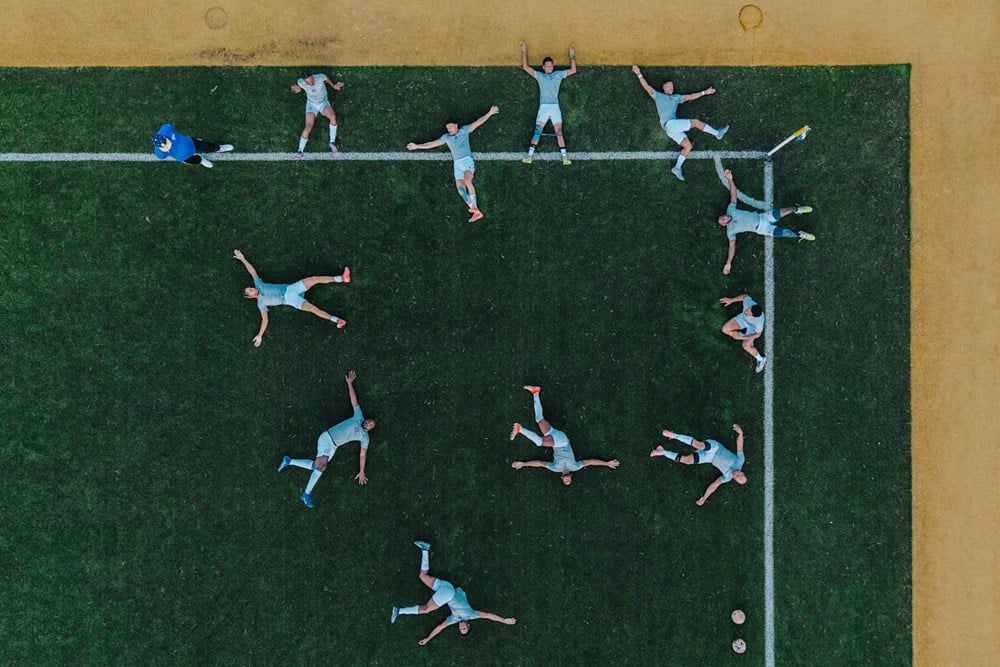
The island of baseball, slaves, and samba neighbors.
Curacao, located about 65 km off the coast of Venezuela in the Caribbean, has a population of 156,000 and… 28 men's football clubs. For 150 years, until 1815, the island was a center of the Dutch slave trade. It then joined the Dutch Antilles. In 2010, it became an autonomous state within the Kingdom of the Netherlands – but it is not yet a fully independent nation. And in previous World Cups, the people of Curacao would hang Brazilian, Argentinian, or Dutch flags outside their windows. They supported other teams because their own team wasn't participating.
In that context, the Curacao national football team was founded in 2011 with a mission that sounded simple but was actually quite complex: to find professional players of Curacao origin playing in the Netherlands and persuade them to represent their homeland. The problem was that the island's football federation at the time did not have enough money to buy plane tickets for the players to travel to the country.
In 2016, midfielder Leandro Bacuna was recruited into the national team by then-coach Patrick Kluivert – a former legendary Dutch striker whose mother was from Curacao. Bacuna recalled, "Back then, there weren't many top players." He and goalkeeper Eloy Room began recruiting fellow Dutch players already playing in the Netherlands.
But Eloy Room set a line: “I always tell the players that I won’t kneel down to convince anyone. You have to want to play for Curacao. You have to have the heart to play for this island.” The best names in the generation of players of Curacao origin – Jurrien Timber of Arsenal, his twin brother Quinten Timber of Olympique Marseille, Jorel Hato of Chelsea – all chose to represent the Netherlands. It was an understandable choice, though difficult to accept.
In 2023, while the national league was still suspended, local clubs approached Gilbert Martina and asked him to become president of the federation. Martina – then the CEO of the Curacao Medical Center – took the question home. “I discussed it with my ‘queen’ at home,” he recalled with a smile. “Initially, she said absolutely not. But I had a feeling that Curacao would qualify and we had to do everything to achieve that.”
He convinced his wife. Then he convinced Corendon – a major travel corporation – to become the main sponsor. And together, they came to the conclusion: They needed a big name on the coaching bench to attract both players and sponsors.
That name was Dick Advocaat – the 78-year-old Dutch "Little General" who had managed the Netherlands, Russia, Iraq, and Glasgow Rangers national teams. Martina used to tease him: "You're not my first choice." Louis van Gaal politely declined – he would only return to a team that could win the World Cup. Fred Rutten accepted the offer and then withdrew. Finally, Advocaat's agent called to offer him the job.
And Advocaat changed everything. Room said, “I think if Dick Advocaat called you, you would answer.” He painted a viable path to the World Cup: The tournament was expanded to 48 teams, the USA, Canada, and Mexico automatically qualified as hosts, and North and Central America and the Caribbean were less competitive than ever. Even before the qualifiers began, the players were saying to each other, “This is our destiny.”
A night in Kingston and tears on the way home.
The final qualifying match: Curacao faced Jamaica in Kingston. A draw would have been enough to secure their first-ever World Cup appearance. But just before the match, Advocaat received news that his daughter was seriously ill and flew back to the Netherlands. The players met and made a collective decision: to fight for their coach. Room stood in goal and kept a clean sheet for 90 minutes. Jamaica hit the crossbar three times. Jamaica were awarded a penalty in injury time – which was then overturned by VAR.
The final whistle blew. Curacao qualified for the World Cup. In the Netherlands, Advocaat sat in front of the TV and yelled in the quiet room. He later called it "the craziest thing I've ever achieved in my coaching career."
On the day the players returned to Curacao, people lined the streets from midday – even though the plane didn't land until late afternoon. Martina, who stood in that crowd, could only say one thing: "Tears. Tears. Tears of happiness."
On June 14, 2026, Curacao will take to the field at the 2026 World Cup – facing four-time world champions Germany in their opening match. This will be followed by Ecuador and Ivory Coast. Data analytics firm Opta estimates Curacao's probability of winning the World Cup at 0%. Not every fairy tale needs a golden trophy to become a fairy tale. Sometimes, simply stepping onto the stage – even just once, even just three group stage matches – is something that 156,000 people on a small island in the Caribbean will tell their grandchildren for the rest of their lives.
Bacuna, the 34-year-old captain who plays for a small club in Türkiye, said before the tournament: “There will be a lot of eyes watching. If fate is meant for you, it will come to you.”
Kluivert – a son of Curacao who once coached the national team and now watches his players step onto the big stage – honestly said: “Without the Netherlands, Curacao would never have reached the World Cup. But the best players will always choose to play for the Netherlands.” That’s true. But it’s also what makes this story even more beautiful – because Curacao achieved this miracle not thanks to the best players, but thanks to the people who are most passionate about this small island nation. And there, on that small island where children play barefoot football under the Caribbean sun, where people used to fly the flags of Argentina and Brazil every World Cup – this time, they will fly their own flag.
Source: https://baovanhoa.vn/the-thao/curacao-tu-hon-dao-buon-no-le-den-tam-ve-du-world-cup-233247.html












![[Photo] Reception to welcome General Secretary and President To Lam and his wife on their State visit to the Philippines](https://vphoto.vietnam.vn/thumb/1200x675/vietnam/resource/IMAGE/2026/06/01/1780295488620_vna-potal-chieu-dai-chao-mung-tong-bi-thu-chu-tich-nuoc-to-lam-va-phu-nhan-tham-cap-nha-nuoc-toi-philippines-8798060-7855-jpg.webp)







































Comment (0)