

 |
| Tea farmers transform themselves into "ambassadors of tea culture". |
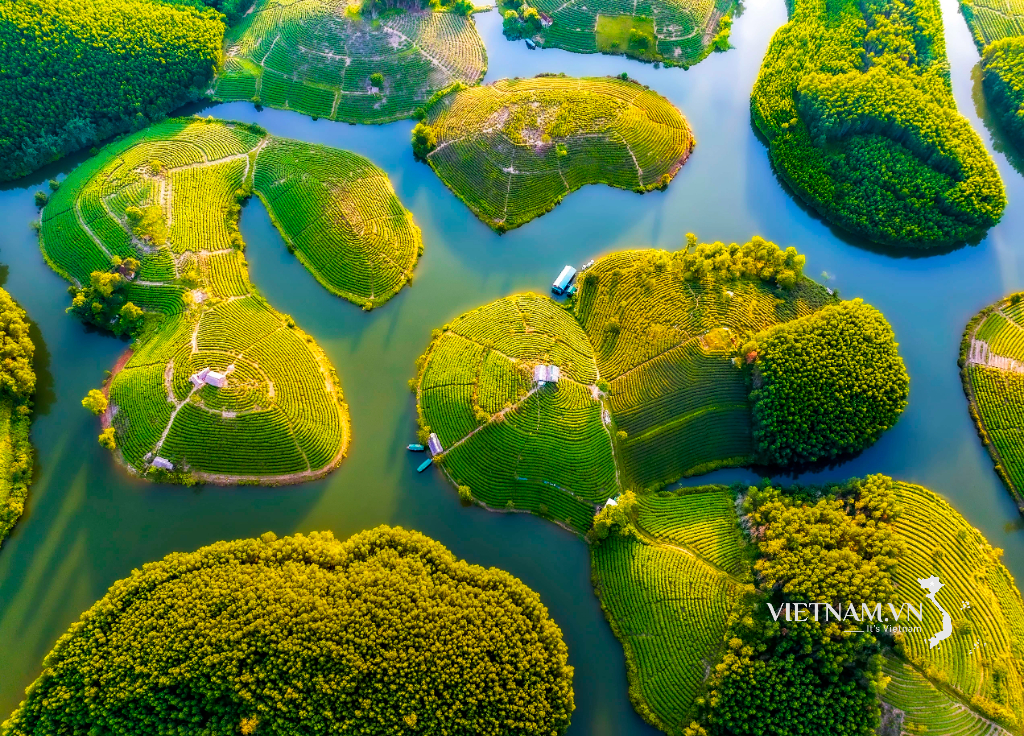
Currently, the province has nearly 24,000 hectares of tea plantations, with many tea-growing regions becoming attractive tourist destinations, especially the "Four Great Tea Regions" including Tan Cuong, La Bang, Dong Hy, and Vo Tranh. These are not only high-quality tea growing areas but also unique cultural spaces with great potential for developing tourism associated with experiencing, exploring, and enjoying tea.
Along with the "Four Great Famous Teas," Thai Nguyen also boasts clusters of centuries-old Shan Tuyet tea trees growing on the high peaks of the Phja Khao mountain range at the headwaters of the Cau River. Then there are clusters of centuries-old Mong Rong tea trees on the eastern slopes of the Tam Dao mountain range.
Currently, the cluster of ancient Shan Tuyet tea trees has been recognized as a Vietnamese Heritage Tree. The Mong Rong tea cluster is being surveyed and researched by scientists and preserved by the local people. However, these ancient tea clusters on the high mountain peaks are opening up a promising new tourist destination.
Tea culture spaces are opening up, and interconnected areas and destinations are creating new tourism products to welcome visitors. Many dynamic tea-growing regions are becoming cultural, ecological, and resort tourism destinations. A prime example in Thai Nguyen is the Tan Cuong tea region with its century-old brand, "The Best Tea."
Along with Tan Cang, people in many other tea-growing regions of the province have also invested in building tea culture spaces right on their family's land. These spaces then become destinations for tourists from all over.
While tourists enjoy tea, the farmer transforms into a cultural ambassador of the region, telling them the story of tea and Thai Nguyen tea, a journey spanning centuries. This includes the legendary tale of the faithful love between Princess Cong and Prince Coc.
 |
| It is projected that by 2030, Thai Nguyen will welcome over 1 million international tourists. |
From a simple agricultural product, tea has become a tool for cultural communication, a "spiritual specialty" through which Thai Nguyen tells the story of its land and people.
And even though tea has become a valuable commodity, and tea-growing regions have become cultural destinations and spaces, the people of Thai Nguyen have never been complacent. They have always determined that tourism development must go hand in hand with preserving cultural identity and protecting the ecological environment; preventing excessive commercialization of tourism from eroding traditional values that have been preserved and passed down for generations.
In the development of tourism in Thai Nguyen province, tea is truly the vibrant soul. This is evidenced by the fact that the province's main tourism products, such as community tourism, rural tourism; cultural, spiritual, and historical tourism; ecotourism and resort tourism; MICE tourism, sports tourism, and adventurous cave exploration, are all linked to tea culture.
The formation of service complexes combining tea culture experiences, the development of the "Green Conference - Clean Tourism" model, and the strengthening of regional linkages to build the brand "Thai Nguyen - Destination for Tea and Events" are opening up new directions for the province's tourism.
In this plan, the Tan Cuong tea growing area plays a pivotal role, serving as a key highlight in the province's overall tourism development plan, along with neighboring tea growing areas such as La Bang, Phu Luong, Dai Phuc, and Dong Hy.
Community-based tourism and agricultural tourism linked to tea culture continue to be identified as distinctive products of Thai Nguyen. The province prioritizes investment in developing eco-tourism tours in tea-growing regions; encourages tourism establishments to integrate tea-tasting spaces into their services, contributing to spreading the value of tea culture to domestic and international tourists, and gradually affirming Thai Nguyen's position as the tea culture community tourism capital of Vietnam.
Source: https://baothainguyen.vn/van-hoa/du-lich-thai-nguyen/202604/dam-da-ban-sac-du-lich-xu-tra-200749f/

![[Photo] General Secretary and President To Lam presides over a working session with the Central Policy and Strategy Committee on the development of the materials industry.](https://vphoto.vietnam.vn/thumb/1200x675/vietnam/resource/IMAGE/2026/05/21/1779359935432_a3-bnd-3129-1412-jpg.webp)
![[Photo] National Assembly Chairman Tran Thanh Man working with the Standing Committee of the Law and Justice Committee](https://vphoto.vietnam.vn/thumb/1200x675/vietnam/resource/IMAGE/2026/05/21/1779378929214_ndo_br_1-4610-jpg.webp)





















































Comment (0)