

When visiting a Mang village during the agricultural off-season, it's easy to spot women sewing and embroidering together. Mang women's clothing shares many similarities with Thai women's attire, featuring modernized blouses with open necklines and long skirts. Each blouse is adorned with silver buttons, creating unique and eye-catching patterns. However, what sets Mang women's clothing apart is the white shawl wrapped around their bodies, embellished with hand-embroidered red thread patterns.
Sharing with us, Ms. Lo Thi Chuong, from Nam Sao I village, Trung Chai commune, Nam Nhun district, said: "For Mang girls, clothing is not simply a distinguishing feature of their ethnic group, but more importantly, through each embroidered detail, people can assess the diligence and skill of that girl."
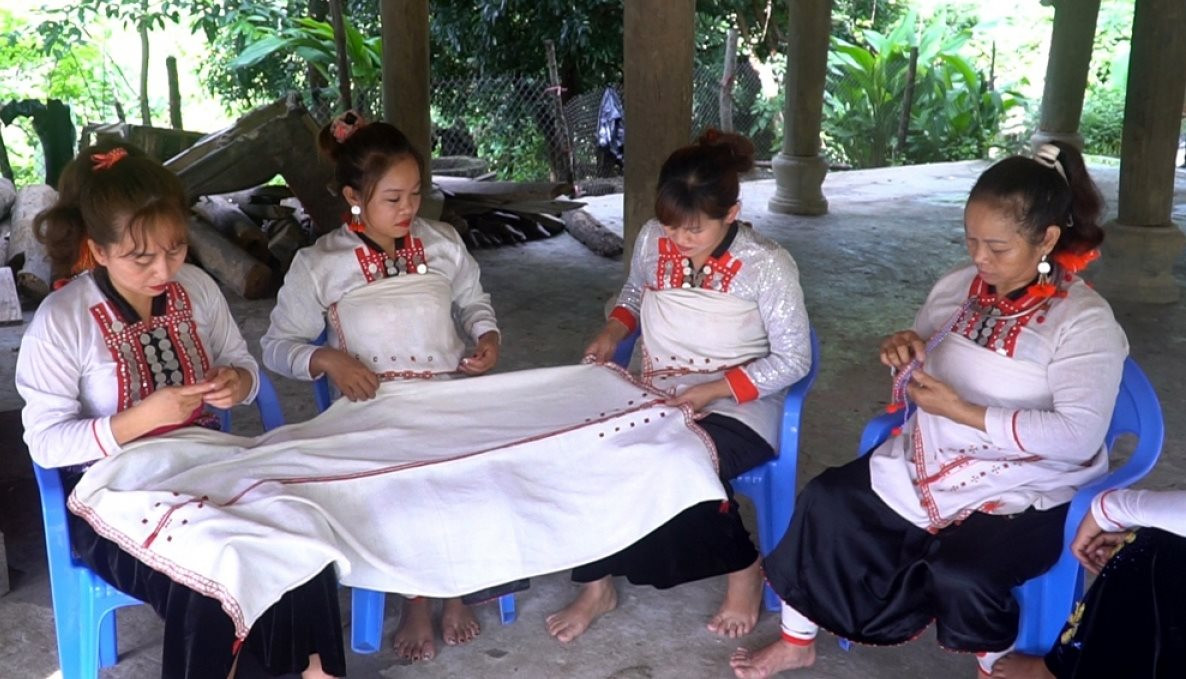
A Mảng woman must have a blouse, a skirt, a shawl, and a leg wrap. The blouse must also be decorated with silver and coins. There must be two or three different types of coins. The blouse is also cut and sewn by hand before the patterns are added to the back. To talk about traditional Mảng clothing without a shawl is to say one is not a true Mảng woman, Mrs. Chướng added.
The Mang ethnic group currently lives scattered throughout the Da River and Nam Na River basins, in the Nam Nhun and Muong Te districts of Lai Chau province. With their long-standing agricultural traditions, at the end of each harvest season or a year of hard work, they celebrate the New Rice Festival to give thanks to their ancestors and the heavens, and to welcome a peaceful new year.
Mr. Pan Van Dao, from Vang San commune, Muong Te district, a native Mang ethnic minority, said: The Mang people believe that heaven is the creator, and the two gods Mon Ten and Mon Ong are the highest deities. Therefore, along with ancestor worship, there are agricultural rituals related to the spirit of rice. From this, the New Rice Celebration was born, held at the end of the ninth lunar month every year and is an indispensable spiritual ritual of the Mang people.
When celebrating the new rice harvest, the Mang people invite the elders to talk to them about cultivating new fields so that the rice harvest will be abundant. They tell them not to lack anything, not to go hungry, and encourage their children and grandchildren to work hard in the fields. The Party leadership said they should come here to live together in villages and be happy, sharing a drink and eating together to make it joyful," Mr. Dao said.
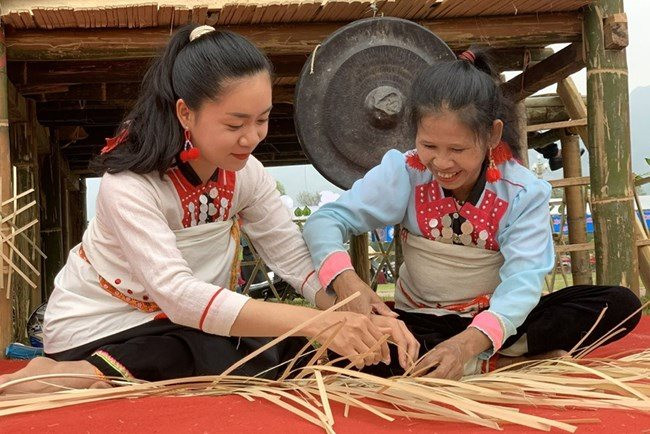
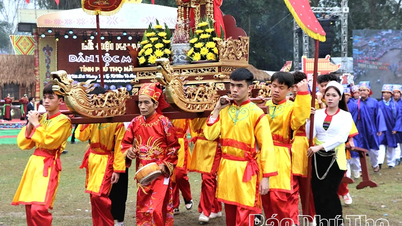
Currently, ethnic festivals such as the Mang festival receive financial support for their restoration and maintenance. The Mang people still regularly maintain and organize several unique festivals, such as the New Rice Festival, the New Housewarming Festival, and the Lunar New Year festival. Along with this, they preserve traditional crafts, particularly rattan and bamboo weaving, which are highly sophisticated and are still being preserved and developed by the community. The people are working together to maintain their ethnic cultural identity and unite to build a more prosperous and developed village and homeland.
According to Mr. Tran Manh Hung, Deputy Director of the Department of Culture, Sports and Tourism of Lai Chau province, the Mang people currently face the most difficult living conditions among ethnic minorities in Lai Chau, and many aspects of their culture have been lost. However, thanks to Resolution 04 of the Provincial Party Committee and Resolution 59 of the Provincial People's Council, which stipulate policies on preserving and promoting cultural identity associated with tourism development, the Mang people have now restored many annual festivals as well as traditional crafts.
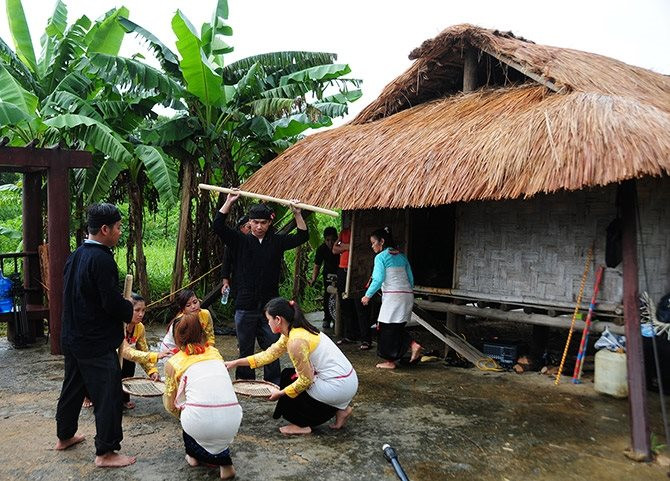
The Mang people live in the vast forests, immersing themselves in the plants, flowers, and birds every day, giving them the natural, free-spirited nature of the mountains and forests. It is from here that folk songs and dances are formed, becoming an indispensable part of their spiritual life, as essential as food and clothing. Amidst the mountain landscape, the sound of the drums marking the beginning of the Ta Nom dance makes anyone who hears it feel as if time has reversed, transporting them back to the time when the Mang people practiced shifting cultivation. The stylized movements of planting seeds and harvesting rice in the fields have now become a sacred memory for Mang women.
Ms. Vang Thi Thom, from Nam Sao I village, Trung Chai commune, Nam Nhun district, a member of the Mang ethnic group who regularly participates in cultural performances, said: "The dance performances of the Mang ethnic group are very diverse, clearly reflecting the identity of our people. For example, the 'Rice Pounding Dance of My Homeland' beautifully portrays the people working and harvesting rice in the fields. The dance recreates the life of the people working to produce rice and paddy to bring home."
Source
![[Photo] Prime Minister Pham Minh Chinh receives the Chinese Ambassador to Vietnam](https://vphoto.vietnam.vn/thumb/1200x675/vietnam/resource/IMAGE/2026/04/05/1775397481797_ndo_br_dsc-5512-jpg.webp)



































![[INFOGRAPHICS] Exploiting children's personal images for profit can result in fines of up to 50 million VND.](https://vphoto.vietnam.vn/thumb/402x226/vietnam/resource/IMAGE/2026/04/06/1775442200854_1775442148.webp)













Comment (0)