

 |
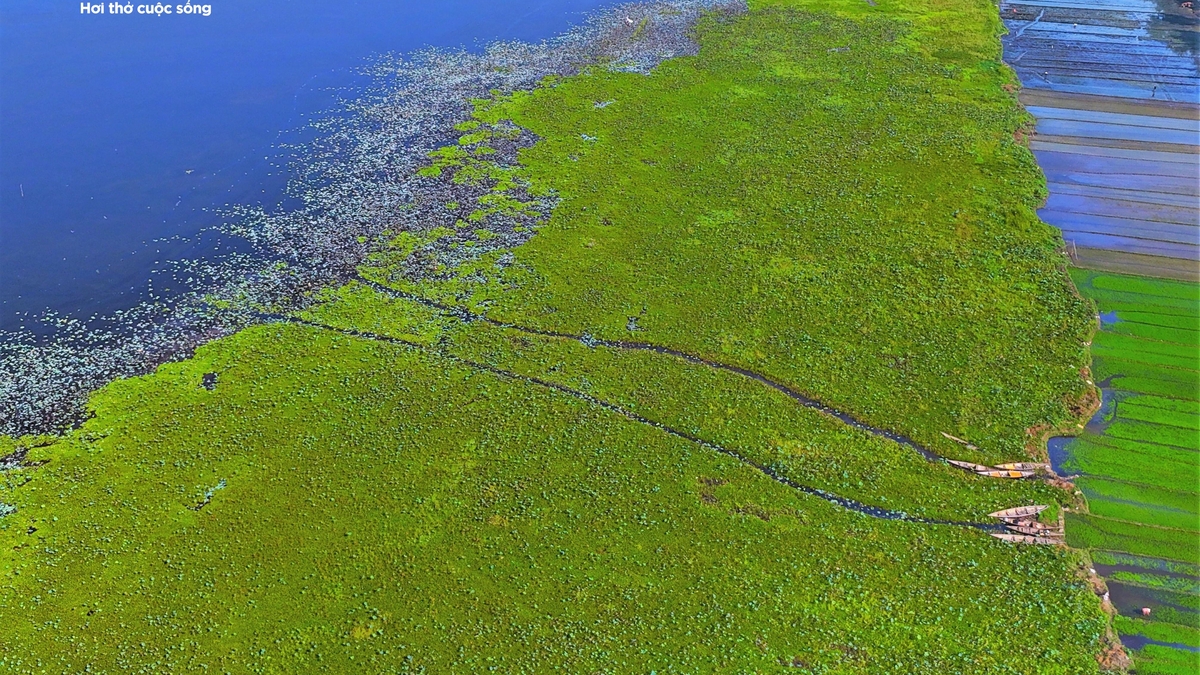
| Bo River. Photo: Phuoc Ly |
Like-minded people
In the late 1920s, amidst the fervent anti-colonial struggle against the French in Hue , a group of young people, close friends from school, gathered around the Bo River. They performed many chivalrous acts, fighting against oppression and protecting and helping the poor. Because they often met at Hien Si station – also known as "Bo River station," headed by Mr. Pham Oanh – the locals affectionately called them "The Bo River Youth Group."
Initially, the group consisted of only 3-4 people, including Hoang Anh, Pham Oanh, Pham Te, Tran Linh… Pham Oanh was an exception as he was no longer young and was the father of Pham Te. Later, more young people from Hien Si, Dong Da, Phu Ninh, and Thuong An joined, and by 1931, according to Huynh Thuc Khang's Tieng Dan newspaper, the group had 10 members.
After its formation, the group actively and enthusiastically participated in many patriotic activities, such as fighting against the French FIA Melaleuca Oil Company's attempt to monopolize the hills of Pho Ninh district to plant melaleuca trees; fighting against local tyrants who seized public land and unfairly distributed land to the military; participating in famine relief activities; fighting against backward customs and superstitions, and contributing to protecting the solidarity among relatives and clansmen.
Following other impactful activities, many young people in Phong Dien, Quang Dien, and Huong Tra sought them out to express their support, and through this, the group members had the opportunity to get acquainted with some prominent figures in the region. They met, shared their grievances and the people's struggles; discussed journalism, especially the Tieng Dan newspaper; and sought ways to join the revolutionary organization.
Around the end of 1934, the "Bo River Youth Group" formed a football team and a music group. Through expanding their social circle through football, music, martial arts training, etc., the group members met many young people with similar patriotic aspirations. However, the more people liked them, the more they attracted the attention of French secret agents and those who used their power to oppress them.
The Party comes right to your door.
From 1934, members of the "Bo River Youth Group" had the opportunity to access debates on "idealism vs. materialism" between Phan Khoi and Hai Trieu, and on "art for art's sake - art for life's sake" between Hai Trieu and Hoai Thanh. After learning that the Huong Giang bookstore belonged to Hai Trieu and the Quan Hai Tung bookstore belonged to Dao Duy Anh, both political prisoners, the group members pooled money to visit the two bookstores to buy new books and newspapers, hoping to meet the two owners and, through them, find their way to the revolutionary organization.
It wasn't until the end of 1935 that Hoang Anh and his friends met Hai Trieu. Hai Trieu introduced them to some French-language books and newspapers, but they couldn't get much information from him. At the end of 1936, the group managed to buy revolutionary newspapers such as Lao Dong, Tap Hop, and especially Nhanh Lua, published right in Hue. Thanks to this, they learned about the fervent revolutionary movement in the country. They shared the same thought: the leaders of those progressive newspapers must be staunch and talented revolutionaries; meeting them meant meeting the Party.
A group of five members from the "Bo River Youth Group"—Hoang Anh, Pham Te, Tran Luu, Hoang Thai, and Nguyen Cung—approached the editorial office of the Nhanh Lua Newspaper, requesting a meeting. They were warmly received by comrades Hai Trieu, Lam Mong Quang, Nguyen Xuan Lu, Hai Thanh, and others. Hearing for the first time from those who had been arrested and imprisoned for their patriotic activities the revolutionary work, the entire group believed they had found a Party organization and promised to follow its instructions.
On this occasion, the "Bo River Youth Group" also had the opportunity to meet Comrade Nguyen Chi Dieu, of the Central Committee of the Vietnam People's Army, to hear explanations about the revolution, and especially to be assigned the task of mobilizing the masses to contribute money to support the ongoing struggle of the Cam Pha coal miners. Later, in his memoir "Homeland and Revolution," Comrade Hoang Anh expressed his feelings: "We truly established contact with the Party. We didn't have to go far; the Party came to our homes to guide us."
Become a member of the Party
The "Bo River Youth Group" establishing contact with the Party coincided with the strong development of the Democratic Movement (1936-1939). This contact provided an opportunity to build a Party base. At that time, while Party organizations were expanding in many areas of Thua Thien province, there were still no Party bases in the north.
Following the fundraising campaign to support the coal miners of Cam Pha, the "Bo River Youth Group" was tasked with copying several secret Party documents, including resolutions of the Central Committee Conference. Particularly at the end of 1936, the group was assigned the task of mobilizing and organizing as many people as possible to go to Hue to welcome Goda, the Labor Inspector of the French Popular Front Government, who was coming to inspect Indochina.
Through tireless efforts, the "Bo River Youth Group" mobilized over 200 people to Hue, carrying petitions (many of whom had memorized them) expressing the hardships the people had suffered and their legitimate demands, such as the abolition of the poll tax and freedom of speech. However, things were not so simple. According to the plan, Goda was supposed to arrive in Hue on February 24th, but due to sabotage by colonial reactionaries, he only arrived in Hue on the afternoon of February 26th.
During those three days of waiting, together with the provincial campaign committee, the "Bo River Youth Group" sought to approach and enlist the help of the people of Hue to ensure that the mobilized individuals had proper food and accommodation. However, that delay was also valuable as it provided an opportunity for Comrade Nguyen Chi Dieu and the members of the provincial campaign committee to meet, gather forces, and intensify propaganda activities on communist ideology.
Notably, at the end of the campaign to welcome Goda, Hoang Anh, and later Pham Oanh and Pham Te, members of the "Bo River Youth Group," were admitted into the Party. From mid-1937, based on this, the Phong Dien South Party Branch was established with Comrade Pham Oanh as Secretary. Later, the branch added new members: Hoang Tien, Tran Luu, Hoang Thai, and Nguyen Thai; it was considered the provisional District Party Committee of Phong Dien.
Becoming Party members, the members of the "Bo River Youth Group" upheld the glorious tradition and excellently fulfilled their assigned tasks. Many comrades, such as Hoang Anh, later became a Central Committee Secretary and Deputy Prime Minister. Or Pham Te, a member of the Standing Committee of the Thua Thien Provincial Party Committee, bravely sacrificed his life in a colonial prison at the young age of 30. His remains were brought back and buried at the City Martyrs' Cemetery, not far from his hometown of Phong Thai, where he and his friends in the "Bo River Youth Group" had spent heroic days, full of dedication to the Party and the revolutionary struggle led by the Party.
Source: https://huengaynay.vn/chinh-polit-xa-hoi/xay-dung-dang/dang-khong-o-dau-xa-162411.html
![[Photo] National Assembly Chairman Tran Thanh Man arrives in Türkiye to attend IPU-152](https://vphoto.vietnam.vn/thumb/1200x675/vietnam/resource/IMAGE/2026/04/15/1776261003665_tnk10-jpg.webp)
![[Photo] My Son at night: A thousand-year-old heritage site amidst the Milky Way](https://vphoto.vietnam.vn/thumb/1200x675/vietnam/resource/IMAGE/2026/04/15/1776261039184_ndo_br_chon6-jpg.webp)
![[Photo] The General Secretary, President and his wife meet with Vietnamese-Chinese friendship leaders.](https://vphoto.vietnam.vn/thumb/1200x675/vietnam/resource/IMAGE/2026/04/15/1776264829725_vna-potal-tong-bi-thu-chu-tich-nuoc-to-lam-gap-mat-nhan-sy-huu-nghi-viet-nam-trung-quoc-8703641-3130-jpg.webp)
![[Photo] National Assembly Chairman Tran Thanh Man attends the opening session of IPU-152](https://vphoto.vietnam.vn/thumb/1200x675/vietnam/resource/IMAGE/2026/04/16/1776277863731_ctqh5-jpg.webp)
![[Photo] Mrs. Ngo Phuong Ly meets and exchanges views with Mrs. Peng Li Yuan](https://vphoto.vietnam.vn/thumb/1200x675/vietnam/resource/IMAGE/2026/04/16/1776277858080_phu-nhan-1-jpg.webp)




































Comment (0)