

 |
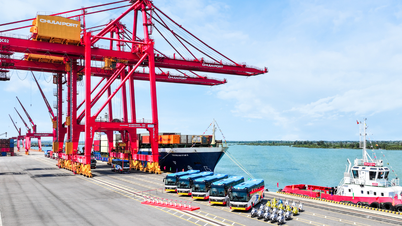
| Berth No. 3 at Chan May Port meets the needs for transshipment of goods by sea both domestically and internationally. |
The "key" to regional and international logistics chains.
It is no coincidence that at the 6th Regional Logistics Forum held in Hue with the theme "Cross-border Logistics," many experts and leaders from ministries and sectors mentioned Hue as a "strategic gateway" for the North-South connection and the East-West economic corridor. Things familiar to Hue residents, such as the world-renowned Lang Co Bay, the Chan May deep-water port, National Highway 1, the expressway, and Phu Bai International Airport, were viewed from a new perspective: a multimodal transport hub that modern logistics centers desperately need.
At the forum, Deputy Minister of Industry and Trade Nguyen Sinh Nhat Tan affirmed that cross-border logistics is becoming a new driving force for development in localities with gateway positions, and is no longer just a concern for major economic centers. This assessment shows that Hue possesses a special advantage in terms of geographical location and natural conditions, but this advantage has not been fully exploited until now.
Nearly two decades ago, while attending development orientation conferences for the Chan May - Lang Co Economic Zone, I learned that Hue had significant potential to benefit from the opening of the East-West Economic Corridor (EWEC), an initiative from the 8th Greater Mekong Subregion Ministerial Meeting, held in the Philippines in 1998. Analyzing the EWEC route in the region, Hue shares a border of over 80km with the provinces of Sekong and Salavan (Laos), connected via the A Dot and Hong Van border gates. From here, Hue plays a crucial role in connecting with Central and Lower Laos and Northeast Thailand along the western corridor to the East Sea, with the final destination being the Chan May and Thuan An ports. These are the final "stops" of the EWEC through Hue, facilitating two-way trade between Thailand and Laos and vice versa, creating a "strategic leverage" to help Hue become a dynamic logistics center, effectively connecting with international markets.
Now, "green logistics" is no longer just a slogan. It's a mandatory criterion in the global supply chain, not just in Hue, but relevant organizations, ministries, and localities need a new mindset to build a professional model that connects businesses, managers, and the community.
According to Mr. Tran Thanh Hai, Deputy Director of the Import-Export Department (Ministry of Industry and Trade), Vietnam's new logistics centers must be developed according to a green and smart model. Hue has many outstanding competitive advantages compared to many other localities, not only in terms of connecting transportation infrastructure, but also because its seaport is undergoing expansion and development, facilitating the arrangement of clean shipping routes, providing ample space for warehouses and automated logistics, coupled with a young workforce that is adaptable to technology.
Entering the global value chain.
Associate Professor Dr. Ho Thi Thu Hoa, Director of the Vietnam Logistics Research and Development Institute, shared that Hue possesses all the necessary conditions for developing green logistics, from the environment and climate to the strategy of developing a heritage city combined with a smart city. Besides exploiting the value of cultural identity and in-depth tourism, developing industry, green logistics and FTZ are suitable to open the path to integration and sustainable development for Hue.
Hue currently has the Chan May - Lang Co Economic Zone, covering over 27,000 hectares. The area's planning has been adjusted to 2045, transforming it into a zone with five functional areas, notably including a duty-free zone, laying the foundation for the formation of a national-scale Free Trade Zone (FTZ). This is something not all economic zones in Vietnam possess.
Mr. Dang Huu Phuc, Director of the Department of Industry and Trade, informed that the Prime Minister's Directive No. 47/CD-TTg, dated April 22, 2025, on the construction of free trade zones and "duty-free ports" is also an important legal basis paving the way for Hue to develop a modern FTZ. Developing Hue into a green logistics center and FTZ brings many benefits, such as creating new economic space to reduce pressure on Da Nang, Ho Chi Minh City, and Hai Phong – logistics hubs already nearing their capacity. In addition, it will help Vietnam seize the wave of supply chain shifts towards Southeast Asia; and help Hue become an international center for recycling, processing, and distribution of goods. Furthermore, it will attract a new generation of FDI, corporations requiring green logistics infrastructure, digital technology, modern management, and create tens of thousands of jobs for local people.
From an international perspective, experts recommend that Hue should build an image of a "green, smart, and transparent logistics center" to attract multinational corporations. This is a global trend and also a commitment of Vietnam in the process of green development.
Dr. Tran Thi Hong Minh, Director of the Central Institute for Policy and Strategy Research, emphasized that developing green logistics in conjunction with the Free Trade Zone (FTZ) in Hue should operate as a unified "seaport - logistics - industry - service" system. This model not only promotes local growth but also contributes to repositioning the role of Central Vietnam in the national economic linkage network and global value chains.
With the determination of the government, the cooperation of businesses, and policy support from the central government, Hue's green logistics center and modern Free Trade Zone (FTZ) are expected to become a reality in the near future. However, according to experts, in the process of realizing the FTZ dream, Hue needs to clarify its unique identity and advantages, avoiding duplication with other localities. One idea is to develop a green and smart FTZ, focusing on green logistics, low-carbon trade, combined with tourism, services, and seaports. This could become Hue's unique mark in the overall development picture of Central Vietnam. In addition, a proposal is also made to the Government for a pilot FTZ mechanism in the Chan May - Lang Co Economic Zone with a moderate initial scale, then gradually expanding according to needs. At the same time, inviting international corporations in logistics, trade, and supporting industries to participate will be a key factor in determining the success of this strategy.
| Free Trade Zones (FTZs) are areas where goods and services enjoy special preferential treatment regarding taxes, customs procedures, and trade mechanisms, aiming to create a favorable environment to attract investment and promote international trade. |
Source: https://huengaynay.vn/kinh-te/chia-khoa-cho-logistics-xanh-162427.html


![[Image] Nearly 125,000 Hanoi students completed the Literature exam for the 10th grade entrance exam.](https://vphoto.vietnam.vn/thumb/1200x675/vietnam/resource/IMAGE/2026/05/30/1780117233041_ndo_br_thiet-ke-chua-co-ten-2-png.webp)
































































Comment (0)