


 |
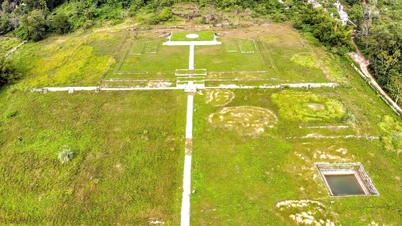
| A lush green garden at the foundation of the Nine Thoughts Pavilion. Photo: Thu Thủy |
"Unfortunately..."
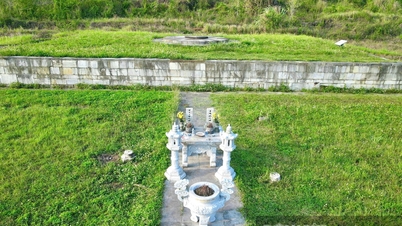
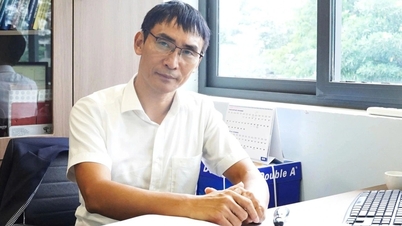
That feeling also led me to the remains of the foundation of the Cửu Tư Đài, now a garden of neatly arranged flowers and trees meticulously cared for by the Hue Imperial Citadel Conservation Center. To compensate for my clumsy attempt to "touch" the foundation of the Cửu Tư Đài, I was connected by Dr. Nguyễn Phước Hải Trung, Deputy Director of the Hue Imperial Citadel Conservation Center, with historical records about this monument, compiled by Hue cultural researcher Phan Thuận An in "Hue Past and Present - Monuments & Scenic Spots".
In this book published by the Information Publishing House, researcher Phan Thuan An clearly states: Built during the reign of King Khai Dinh (1916 - 1925), Cuu Tu Dai was one of the three famous royal theaters of that era in the capital city of Hue (the other two being Duyet Thi Duong - Imperial Citadel and Minh Khiem Duong - the tomb of King Tu Duc). Along with Khai Tuong Lau, Cuu Tu Dai was one of the two main architectural works of An Dinh Palace. The theater was built in the years 1922 - 1923.
The Cửu Tư Đài Theater was built of reinforced concrete, with a construction area of 1,150m², capable of accommodating more than 500 spectators. During the late Bảo Đại era (1926-1945), in addition to being used as a stage for performing traditional Huế court arts, Cửu Tư Đài was also a venue for performing outstanding cải lương (Vietnamese traditional opera) plays, with famous troupes from the South invited by Empress Nam Phương to perform. Leading cải lương artists of the time, such as Năm Phỉ and Phùng Há, had the opportunity to showcase their talents at this theater. Sadly, after 1947, due to various wartime events, Cửu Tư Đài became a ruin. Since then, it has only existed in fragmented memories, with extremely little documentary information available about the building…
At a bustling corner of Chu Van An Street in the Western Quarter, the story of Cuu Tu Dai was recounted by a young man from the 80s generation, Nguyen Tan Anh Phong, with overwhelming emotion. Phong is a member of the Tan Do Thanh Hieu Co group – a group of six people, each with different jobs and locations, but sharing a passion for exploring, collecting, analyzing, and digitizing photographic documentation. “Why are you interested in Cuu Tu Dai?” I asked. Phong replied, slowly but surely: “Because it’s so mysterious! For some reason, there is very little photographic documentation of Cuu Tu Dai. The only photographic documentation we have is a very distant aerial shot, taken from the direction of An Cuu, showing only the An Dinh Palace indistinctly. The less documentation there is for a historical site, the more mysterious it becomes, and the more it sparks the group’s curiosity. That’s why we always strive to search through photographic sources.”
 |
Documentary records about An Dinh Palace, including Cuu Tu Dai. |
In their efforts to find the most accurate information possible about a Nine-Consideration Pavilion that once existed on the surface, Phong's team tried every means to obtain archaeological drawings of the monument from the existing resources of the Hue Imperial City Relics Conservation Center. However, all the arguments the team could put forward about the structure were incorrect and further distanced them from what they already understood about the Nine-Consideration Pavilion and the architectural motifs of the Nguyen Dynasty.
A meeting halfway around the world.
“Unexpectedly, one fine day, Pham Nhat Tien, a member of the group studying in the US, coincidentally ‘came across’ the Cuu Tu Dai at the US Congressional Museum through a set of documents about Vietnam,” Phong recounted. He added that the document Pham Nhat Tien found at the US Congressional Museum didn’t specifically mention the Cuu Tu Dai, but rather the An Dinh Palace of the Nguyen Dynasty. The codes on that document indicate that all records about the An Dinh Palace are currently stored at the Saigon National Archives Center (now the National Archives Center II, Ho Chi Minh City). Based on this information, Nguyen Chi Thanh – another member of the Tan Do Thanh Hieu Co group – went directly to the National Archives Center II to verify the information and was delighted to find details about the Cuu Tu Dai documents there. From Hue, Phong contacted Mr. Hoang Viet Trung, Director of the Hue Imperial Citadel Conservation Center, directly to coordinate efforts to access documents at the National Archives Center II in Ho Chi Minh City. With the support of Mr. Hoang Viet Trung, in 2024, Nguyen Tan Anh Phong, along with staff from the Hue Imperial Citadel Conservation Center, was given access to the files by the National Archives Center II.
“When we turned the first page of the document, a feeling of nostalgia and emotion welled up as we saw a part of Hue in the years 1947, 1950, and then 1957… And when we reached the section on Cuu Tu Dai, we were all extremely moved – the entire Cuu Tu Dai was almost perfectly preserved in the photographic documents,” Phong said.
 |
| Concluding the document retrieval trip at the National Archives Center II - Ho Chi Minh City (Photo below. Photo: Bao Chau) |
Fortunately, through the process of digitizing photographic documents, Phong's team was able to clarify the interior structure. The maps drawn by ancient people showed incredibly detailed constructions of the floors of the Nine-Consideration Pavilion. From this data, we analyzed and compared it with previous failed arguments, and finally found the answer about a Nine-Consideration Pavilion that completely matched. This helped us confirm that the Nine-Consideration Pavilion – which previously only existed in memory – has now been convincingly deciphered with reliable scientific basis through photographic documents,” Phong said, his voice trembling with emotion.
Along with the archives on An Dinh Palace and Cuu Tu Dai, the National Archives Center II also stores a vast collection of documents on the Hue Imperial City's relics system. There is a cooperative relationship between the National Archives Center II and the Hue Imperial City Relics Conservation Center, providing mutual information support. However, due to the sheer size of the archive and the difficulties in digitizing it, the managing unit still faces many challenges, meaning this archive remains essentially a "hidden treasure" above ground.
Phong stated that all the digitized information about the Cửu Tư Đài that the team deciphered from photographic sources has been unconditionally transferred to the Hue Imperial City Relics Conservation Center. He firmly believes that the Cửu Tư Đài will reappear in some project in the not-too-distant future.
| Hoang Viet Trung, Director of the Hue Imperial City Relics Conservation Center, highly appreciates the scientific approach of photographic documentation in the restoration of Hue Imperial City relics. He stated that the center currently has no plans to restore the Cuu Tu Dai (Nine Pavilions). However, as soon as the necessary conditions are met, the center will develop a plan for this relic. |
Source: https://huengaynay.vn/van-hoa-nghe-thuat/tim-lai-cuu-tu-dai-162625.html

![[Photo] General Secretary To Lam attends the opening session of the Peace Council on Gaza.](https://vphoto.vietnam.vn/thumb/1200x675/vietnam/resource/IMAGE/2026/02/19/1771516865192_tbttolam5-jpg.webp)




















































Comment (0)