

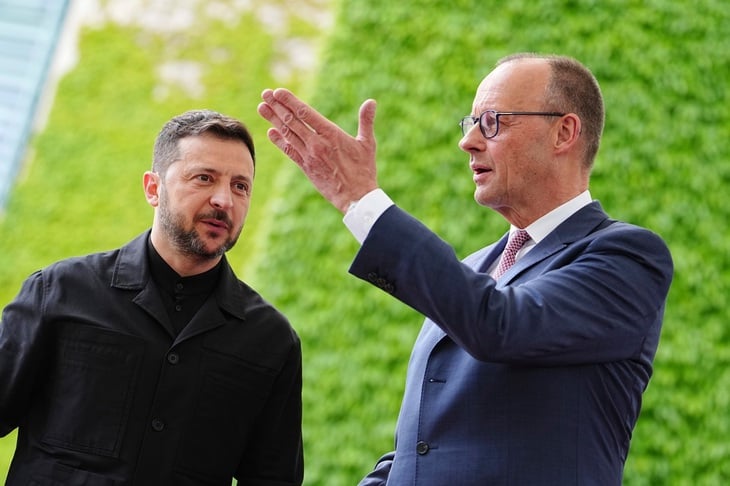
German Chancellor Friedrich Merz (right) meets with Ukrainian President Volydmyr Zelensky in 2025 - Photo: DPA
On May 21, German Chancellor Friedrich Merz sent a letter to EU leaders, acknowledging that Ukraine's accession to the bloc in the near future was "unrealistic" due to numerous obstacles and politically complex ratification procedures in many member states.
Instead, he proposed a special status: allowing Kyiv access to Brussels institutions and EU defense mechanisms without formally joining the bloc – but with clear conditions attached.
What are the special regulations?
Mr. Merz justified his initiative on two grounds: Ukraine's special status as a militarily active state, and significant progress in accession discussions. The proposal also aimed to facilitate peace talks with Russia initiated by US President Donald Trump.
Specifically, the "associate member" status includes: Ukraine being allowed to attend meetings of the Council of Europe and the European Parliament but without voting rights; gradual integration into the EU budget according to a schedule – initially neither contributing nor receiving direct funding, but EU-managed programs can be "gradually opened up"; and the right to appoint an associate judge to the European Court of Justice in the form of an "assistant rapporteur".
In terms of security, Ukraine would align its foreign and defense policies with the EU, in exchange for member states being obligated to apply the mutual assistance clause (Article 42.7) to Kyiv – described as a "significant security guarantee". A mechanism for suspending membership is also in place if Ukraine violates core EU values or makes significant setbacks in accession negotiations.
However, the Baltic news agency Baltnews exposed the true nature of this proposal: no political rights, no funding from the EU budget, and no substantive security guarantees – instead of NATO Article 5, Kyiv was only promised a "political commitment" under Article 42.7.
The news agency concluded: "It was a position in the EU meeting room where Zelensky was asked to adjust his defense policy to Brussels' standards, but in return he was only allowed to sit outside and listen."
The Svobodnaya Pressa newspaper offered a more blunt assessment: Merz had "poured cold water on Kyiv's EU membership."
Political scientist Volodymyr Fesenko likened this status to "a pre-wedding proposal," but noted that the core difficulty remains ensuring security without dragging the EU into war.
He also questioned the fairness of Zelensky's desire to expedite the accession process to 2027, while Albania and Montenegro – candidates who have waited for decades – remain outside the door.
Mixed reactions
Slovak Prime Minister Robert Fico declared that Merz's initiative "will not receive support in the EU," while reiterating that Montenegro, Albania, and Serbia need to be admitted as soon as possible.
Florian Philippot, leader of the French Patriots Party, called the proposal "crazy," warning that applying a mutual defense clause to Ukraine could lead to conflict with Russia.
Euronews quoted a diplomat as saying that this was "a rather hasty and poorly coordinated move, made at an unfortunate time."
This haste is all the more puzzling when looking at the internal EU landscape in recent weeks. On April 20, European leaders publicly acknowledged that there are no plans to admit Ukraine in the near future – the promised 2027 deadline has effectively been erased.
On May 8, the European Commission stated that Ukraine needs 10-15 years to fully meet the membership requirements, while Western Balkan countries such as Montenegro, Albania, North Macedonia, and Serbia – candidates who have been waiting for decades – continue to lag behind.
So why did Berlin suddenly take the initiative? The answer may lie in the new military strategy announced by the German Ministry of Defence at the end of April, which directly identifies Russia as the "greatest and most direct threat" to Germany, Europe, and the Atlantic community.
On the same day, May 21, German Foreign Minister Johann Wadephul declared that Germany was ready to assume a leadership role in NATO. RIA Novosti commented: "That is why Berlin will do everything to support Zelensky, including a nominal associate membership in the EU."
On Kyiv's side, President Zelensky has yet to give an official response to Mr. Merz's letter. Previously, he had firmly rejected any symbolic membership: "Ukraine is defending itself and resolutely defending Europe – not symbolically."
Associate Membership - a status not yet included in the EU treaty.
The "associate member" status proposed by Prime Minister Merz is not currently stipulated in any EU treaty – this is also one of the main reasons why the proposal is being opposed.
In comparison, Western Balkan countries like Montenegro and Albania underwent decades-long accession negotiations following standard procedures.
In his letter dated May 21, Mr. Merz also proposed "innovative solutions" for Albania, Montenegro, and Moldova, including preferential access to the single market, closer participation in the work of EU institutions, and observer status in relevant bodies of the bloc.
Source: https://tuoitre.vn/dang-sau-de-xuat-thanh-vien-lien-ket-cho-ukraine-20260522233246302.htm

![[Photo] General Secretary and President To Lam presides over a meeting on preparations for the review of one year of operation of the three-tiered government system.](https://vphoto.vietnam.vn/thumb/1200x675/vietnam/resource/IMAGE/2026/06/02/1780391821195_a1-bnd-4595-9717-jpg.webp)




















































































Comment (0)