

 |
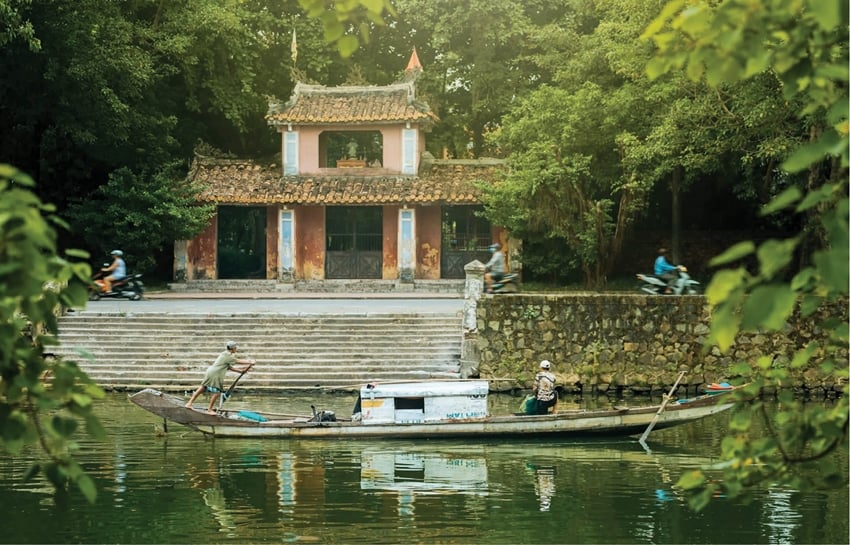
| Everyday life on the Dong Ba River. Photo: Nguyen Phong |
Back then, every summer afternoon, the kids in my neighborhood would excitedly gather at the riverbank near my house. From that waterfront, you could see Con Hen islet up and the Cho Dinh ferry landing down. Now, with the Cho Dinh bridge, the ferry landing has long since become a thing of the past, but I still remember when we'd grab our inflatable swimming rings and head out into the middle of the river, protected by my older brothers, looking towards the Cho Dinh ferry landing, we'd see the vast expanse of water "down there," a region of waterways holding so many mysteries in the minds of the kids in my neighborhood. "Down there" there were ghosts, crocodiles, and we believed it was the final destination of the Perfume River. Even just our imaginations sometimes led to arguments, tantrums, and abandoning our swimming trips, taking days off before returning to play and excitedly talking about the imagined things we'd encounter on our journey to explore the river downstream.
Now I'm sitting on a boat traveling from Gia Hoi Bridge to Bao Vinh along the Dong Ba River. I was surprised to find myself boarding the boat with Mr. Nghet and Ms. Hoa with a light and nimble jump. This "jump" onto the boat, undeniably a carefree childhood memory, made me think of my friends from long ago. If Anh, Bung, Luu, and Hue were on this trip with us, how much fun we would have had, perhaps arguing about something, or at least pondering, "Why haven't we finally found the answers to our childhood questions?" Although I didn't have my childhood friends, that day I was accompanied by two older friends who frequently appear on television programs about Hue , speaking with an incredibly insightful and profound love and understanding of Hue: one is the older sister from "Hang Duong" - Bach Dang Street, Professor Dr. Thai Kim Lan, and the other is the older brother from the Citadel, researcher Pham Duc Thanh Dung.
Along the 3km stretch from Dong Ba Bridge to Bao Vinh, the boat glides between streets and gardens on either side, evoking a delightful feeling that it's like cruising on the beautiful Tuber River in Rome or the Amstel River in the Netherlands, as I've seen on travel programs on television. Looking up from the Dong Ba River, the clouds and the rows of Bodhi trees on both banks are reflected in the green water – a scene so beautiful and peaceful. In 2008, the Dong Ba River's floating boats were moved ashore, and the riverbanks were reinforced with stone, revealing the original beauty of the canal, dug 220 years ago, now clear and tranquil. I could see the happiness and radiance on the face of Professor Thai Kim Lan as she enjoyed her childhood swimming in the river. Hue's Dong Ba River is so beautiful, it's more than enough for a fascinating tourist tour. My two older friends enthusiastically discussed the potential of this tour.
There are so many interesting things to tell along the 6km round trip of this tour, all fascinating stories like the history of the Dong Ba canal, closely linked to the construction of the Hue Citadel when King Gia Long ordered the digging of the Dong Ba canal in 1805 as a moat; the story of The Lai Thuong village, The Long pagoda, Thuan Hoa pagoda, the village temple and shrine of The Lai Thuong, Dieu De pagoda, the pagoda that was once the residence of Emperor Thieu Tri, immortalized in folk songs with the line "Dong Ba - Gia Hoi, two bridges / Looking across to Dieu De, four towers, two bells"; and also the mansions of the emperors and empresses, whose moss-covered gates, seen from the river, evoke a sense of solemnity and evoke images of a time when horses and carriages passed through this place.
Along Huynh Thuc Khang Street, there are also many stories connected to the not-so-distant modern era, such as the editorial office of the Tieng Dan newspaper of Mr. Huynh Thuc Khang at 123 Dong Ba Street, Hang Be Street, now 193 Huynh Thuc Khang Street; or the introduction to a famous Hue specialty, sesame candy, with the first shop, still maintaining the family tradition, such as Nam Thuan and Hong Thuan, which since 1950 have exported Hue sesame candy to Paris and Hong Kong (China)...
All rivers flow into the sea, and at the end of the Dong Ba River is Bao Vinh. This stretch of river is truly vast, and further on you will reach the Sinh Junction, where the Perfume River and the Bo River meet before flowing into the sea. Looking up from the river, the backs of the old houses in Bao Vinh, repainted in many colors, are as beautiful as a painting, evoking excitement when recounting the story of Thanh Ha trading port - the ancient town of Bao Vinh, a story of a riverside port city closely linked to the history of commerce in Dang Trong (Southern Vietnam), which flourished from 1636 when Lord Nguyen Phuc Lan established the Thanh Ha trading port.
As the boat docks and visitors disembark on the Tien Non or Bao Vinh side, they can continue sharing their stories about the villages downstream of the Perfume River. A boat tour on the Dong Ba River like this is incredibly appealing. My two older friends couldn't hide their eager anticipation of one day experiencing the Dong Ba River through a boat tour on the river.
As for me, I want to send a message to my friends: "Ánh, Bụng, Lựu, Huệ, the scenery at the end of the Perfume River is so beautiful! Let's make a trip down the Đông Ba River together to see for ourselves, 'Where is the end of the Perfume River, guys?'" - my neighborhood friends.
Source: https://huengaynay.vn/van-hoa-nghe-thuat/danh-thuc-dong-dong-ba-152489.html


![[Photo] Prime Minister Pham Minh Chinh attends the Conference on the Implementation of Tasks for 2026 of the Industry and Trade Sector](/_next/image?url=https%3A%2F%2Fvphoto.vietnam.vn%2Fthumb%2F1200x675%2Fvietnam%2Fresource%2FIMAGE%2F2025%2F12%2F19%2F1766159500458_ndo_br_shared31-jpg.webp&w=3840&q=75)

















































Comment (0)