


Beneath the dense canopy of trees, along damp paths, many precious medicinal plants still grow quietly, but are being treated like roadside weeds. The crucial question is how to prevent this treasure trove of medicinal plants hidden within the forest from being forgotten or indiscriminately cut down, and instead ensure its identification, preservation, and transformation into a sustainable resource for local economic development.
Medicinal herbs were left neglected right on the pathway.
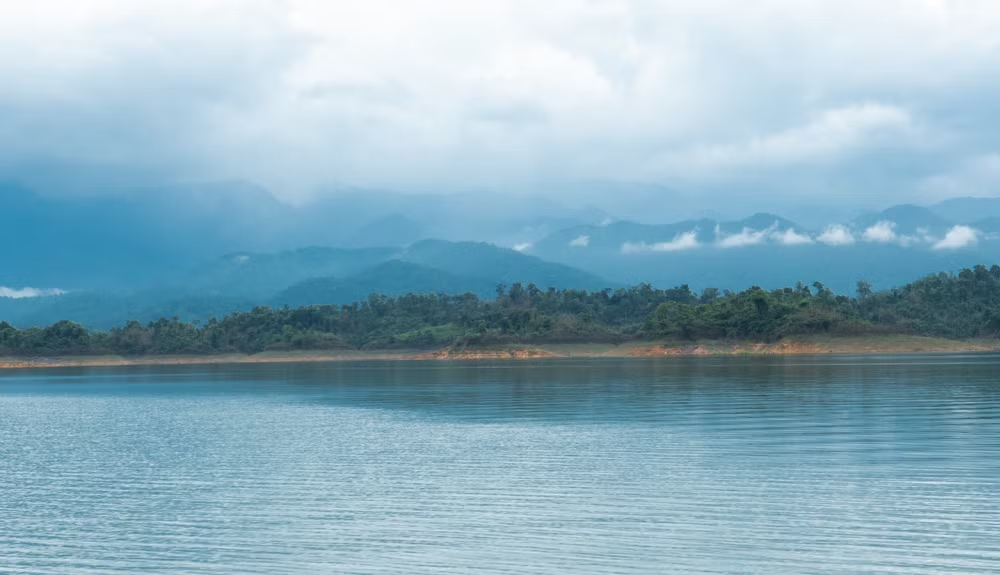
Together with the forest rangers, we crossed Ngan Truoi Lake to venture deep into Vu Quang National Park on a misty morning. The lake stretched wide, nestled within the embrace of the mountains, with rows of lush green forests reflected in the calm water. The small boat cut through the waves, taking the delegation to the Co Forest Protection Area, where the remains of Phan Dinh Phung's citadel lie silently amidst the vast forest.
There, history and nature coexist under a single forest canopy, opening up before us not only a journey of exploration, but also an encounter with medicinal values still hidden deep within the green landscape of Vu Quang.
The deeper we went into the forest, the more the trip felt like an "unraveling" of the hidden values beneath the canopy. On the damp, rain-soaked trail, while many were preoccupied with avoiding slippery rocks and thorns, the staff of the Institute of Medicinal Materials had a different habit. Their eyes didn't linger on the path ahead, but constantly scanned the sides, up and down, past every bush, vine, patch of grass, and root. Each person held a camera or phone. Those lenses weren't focused on taking souvenir photos. They stopped at an unusual branch, a small cluster of plants, a bush growing at the edge of the forest path. Each captured image served as initial data, a trace that could be used later to identify, compare, research, and add to the medicinal plant records of Vu Quang.
"This is also a medicinal plant."
"This plant can be sampled to identify its active ingredients."
"Gynostemma pentaphyllum can be found in many places, but it's probably different in Vu Quang."
Such statements echoed constantly through the forest. To those without expertise, many trees were merely vines, weeds, or roadside plants. But in the eyes of researchers, each species could be an ecological indicator, a genetic resource, a medicinal remedy, or a future healthcare product.
At the edge of the path, amidst the dense bushes that had grown after the rain, Hieu – a specialist from the Institute of Medicinal Materials – stood before a single-leafed locust tree. To many, it was just a roadside plant, with thorny stems and green leaves, growing so abundantly that it could easily be considered a nuisance. But in the eyes of a medicinal plant practitioner, the plant held a different kind of value.
He gently explained that, in folk medicine, the locust tree plant is used in several remedies to help treat bone and joint diseases, and pain related to herniated discs; it is also known for its anti-inflammatory and detoxifying effects. At that moment, a forest ranger accompanying them casually remarked, " Oh, this plant grows abundantly along the roadside, obstructing the path, so we often cut it down. I didn't realize it had so many uses !"
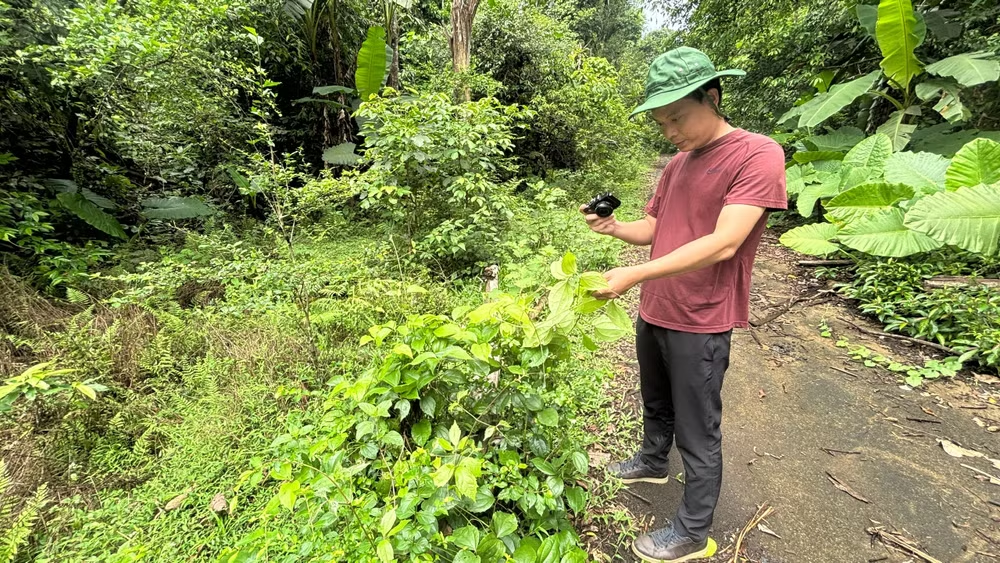
That statement wasn't meant to deny the value of medicinal plants. It merely inadvertently highlighted a thought-provoking reality: a medicinal plant, currently considered a wild weed, could quietly disappear right next to a forest patrol if not properly identified in time. And from here, the story of developing medicinal plants in Vu Quang is no longer a distant dream. It begins with knowing what plants are in the forest, which need protection, which can be propagated, and which can be developed into a source of raw materials.
Livelihood potential of medicinal plants
Vu Quang National Park has long been recognized as one of the most important biodiversity hotspots in Vietnam and the region.
According to Mr. Nguyen Danh Ky, Director of Vu Quang National Park, this area is located in a globally prioritized ecological zone, which is of special significance for biodiversity conservation. In 2018, Vu Quang was recognized as an ASEAN Heritage Park. Regarding plant resources alone, the park has recorded more than 1,800 species of higher plants belonging to 202 families, not including fungi; among them, recent studies have cataloged more than 600 plant species with medicinal and herbal value, including many rare and endangered species with conservation and utilization value.
Those figures are enough to suggest the richness of the forest. However, the leaders of Vu Quang National Park also acknowledge that the current results do not fully reflect the level of medicinal plant diversity in this area and require further research. Therefore, for Vu Quang, the issue is not just how many medicinal plant species there are, but how to ensure that these species are not neglected in the natural abundance of the forest.
For the leaders of Vu Quang National Park, this has also been a long-standing concern. Developing and sustainably utilizing medicinal plant resources, creating raw material areas, developing products from medicinal plants, and linking them to sustainable livelihoods for people in the buffer zone are the goals the Park aims to promote.
According to a report by the Institute of Medicinal Materials ( Ministry of Health ), Vietnam is one of the countries with abundant medicinal material resources, with domestic demand for medicinal materials at approximately 80,000-100,000 tons per year; these resources include more than 5,000 species of medicinal plants, animals, minerals, fungi, seaweed, and algae used in medicine; and the 54 ethnic groups have extensive experience in using and cultivating medicinal plants.
These resources are both an advantage and a challenge. The more valuable a medicinal plant is, the more vulnerable it is to overexploitation if not properly managed. The more market attention it receives, the more essential it is for medicinal herbs to have standards, traceability, specific growing areas, harvesting and processing procedures, and quality control.
In this context, Vu Quang could become an important model, combining biodiversity conservation with the development of medicinal plants in a scientific , controlled, and responsible manner.
From a policy perspective, the path to developing medicinal plants in Vu Quang has many advantages. The necessary legal frameworks already in place support Vu Quang's long-term development.
At the healthcare level, the Project for the Development of Traditional Medicine Services and Products for Tourists by 2030 has opened up a path to connect medicinal plants, traditional medicine, healthcare, and experiential tourism.
Furthermore, the ecotourism, resort, and entertainment project for Vu Quang National Park for the period 2025-2030 has also been approved. Based on this foundation, Vu Quang could not only be a destination for pristine forests, the Ngan Truoi lake, or historical relics amidst the vast wilderness. It could also become a unique medicinal herb experience space, where visitors can wander through gardens of medicinal plants, learn about traditional medicine, and discover health care products based on local resources.
Associate Professor, Dr. Pham Thanh Huyen, Director of the Center for Medicinal Plant Resources, believes that to unlock the potential of medicinal plants in Vu Quang, the first step is not exploitation, but understanding what the forest already contains. Initially, it is necessary to investigate, survey, and complete the list of medicinal plants in Vu Quang National Park; build a collection of specimens and samples of medicinal plants for valuable species; and assess the distribution and reserves of some medicinal plants with potential for exploitation and development. This will provide a scientific foundation to determine which species need strict conservation, which can be propagated, and which are suitable for further research into their chemical composition, quality, and potential for development into products.
According to her, the long-term plan is to build a medicinal plant conservation garden in Vu Quang covering an area of about 50 hectares, with 100-200 species of medicinal plants that are propagated, cultivated, preserved, and grown well, and have nameplates with QR codes for identification and reference.
At that time, the garden was not only a place for preserving genetic resources, but also a space for education, research, and experience, helping forest rangers, local people, students, and tourists better understand the value of each tree species under the forest canopy.
From that conservation garden, 30-50 plant species with potential for exploitation can be selected, their chemical composition and quality assessed preliminarily, and then some promising species proposed for development into raw material areas. Furthermore, the goal is not only conservation but also research and development of products, potentially creating OCOP products bearing the Vu Quang medicinal plant brand.
Meanwhile, Mr. Le Hung Tien, Director of the North Central Medicinal Plant Center, said that developing medicinal plants on a large scale cannot rely solely on the efforts of a single unit. It requires selecting the right plant species with specific values; combining them with traditional medicine services; and simultaneously addressing obstacles related to land, infrastructure, and especially connecting with businesses to create markets for the products.
According to Dr. Phan Thuy Hien, Deputy Director of the Institute of Medicinal Materials, the profound significance of establishing these medicinal plant gardens lies not only in preserving genetic resources but also in safeguarding traditional medicine. Each identified plant species, each documented remedy, and each verified and developed indigenous experience is a continuation of this heritage.
In fact, over the past period, the Institute of Medicinal Materials has investigated and collected traditional knowledge and indigenous knowledge in the use of medicinal plants and remedies from many ethnic communities; this result contributes to the conservation of medicinal plant biodiversity, preserves national cultural values, and opens up prospects for research and development of products serving community health care.
Leaving Vu Quang, the image that comes to mind is the sacks of medicinal plants carefully brought back by the staff of the Institute of Medicinal Materials after their survey trip. These sacks contain not only small plant samples recently identified under the forest canopy, but also the materials for further research, classification, cultivation, and conservation efforts.
For them, the forest will no longer be silent. The forest is speaking through its leaves, roots, scents, and the trees growing silently beneath its green canopy. What is needed now is sufficient mechanisms and practical coordination to awaken the potential of the medicinal plant reserves under the Vu Quang forest canopy into a sustainable resource.
Source: https://nhandan.vn/danh-thuc-kho-duoc-lieu-giua-dai-ngan-vu-quang-post964252.html
![[Image] Hanoi's urban life under the challenge of a "scorching hot" environment](https://vphoto.vietnam.vn/thumb/1200x675/vietnam/resource/IMAGE/2026/05/25/1779706979265_nang-nong-t5-2026-minh-duy-7-4636-jpg.webp)
![[Image] Close-up view of the interchange connecting the two expressways and Long Thanh Airport.](https://vphoto.vietnam.vn/thumb/1200x675/vietnam/resource/IMAGE/2026/05/25/1779703378210_ndo_br_z7863716673926-224453a31600126cce10622af6290afd-4549-jpg.webp)



![[GALLERY] 3 "dead games" that gamers regret the most](https://vphoto.vietnam.vn/thumb/402x226/vietnam/resource/IMAGE/2026/05/25/1779718386120_de-2-png.webp)



![[GALLERY] How it works reveals why operating Patriot is extremely expensive.](https://vphoto.vietnam.vn/thumb/402x226/vietnam/resource/IMAGE/2026/05/25/1779713284469_61-patriot-missile-system-how-it-works-air-defence-missiles-5.gif)


![[GALLERY] Shocking: Vietnamese youth spend 7 hours online every day](https://vphoto.vietnam.vn/thumb/402x226/vietnam/resource/IMAGE/2026/05/25/1779712983331_dien-1-png.webp)





![[Video] Weather forecast for tonight and tomorrow, May 26, 2026: Northern and Central Vietnam continue to experience intense heat, with some areas experiencing exceptionally severe heat.](https://vphoto.vietnam.vn/thumb/402x226/vietnam/resource/IMAGE/2026/05/25/1779714198949_dem-25-png.webp)





















































Comment (0)