

As soon as the glass doors of the Kunstpalast Museum closed behind them, a group of German schoolchildren chuckled softly when they discovered that what they saw before them was not paintings or sculptures, but… a small tube emitting an indescribable, pungent odor.
That brief moment served as a greeting to the sensational exhibition in Düsseldorf, where history, art, and human memory are brought to life not through color or sound, but through scent – an invisible language powerful enough to stir pages of the past that seemed to have fallen asleep. From here, the emotional journey unfolds in a way that visual art can hardly compete with, for each scent is a memory, and each memory is a story that draws viewers deep into the layers of European culture.
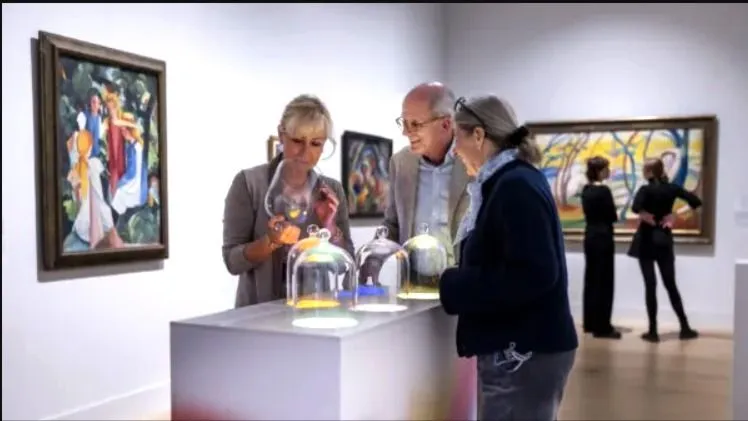
The exhibition "The Secret Power of Scents" at the Kunstpalast Museum brings together 81 scents representing 1,000 years of history, arranged in 37 rooms spanning religion, rituals, warfare, feminism, and love. Viewers begin with the subtle scent of incense in a medieval setting, as if transported to ancient European churches, where faith and incense smoke intertwined to symbolize spiritual power.
Just a few steps later, that dignified scent is instantly "blown away" by the smell of medieval Parisian streets—a mixture of waste, dampness, and unwashed bodies—recalling the raw reality of European urban life in the past. Such abrupt shifts in scent allow the viewer not only to inhale but also to "relive" the context, something that photos, text, or videos cannot fully convey.
Then, unexpectedly, the space darkened, the room filled with the smell of gunpowder and metallic fumes, recreating war with such realism that many instinctively recoiled. This tension was eased upon entering the feminist room, where the scent of leather, tobacco, and vanilla transported viewers back to the 1920s – a period when European women entered public life, shedding traditional images to seek freedom. Here, art curator Robert Müller-Grünow explains that scent is the most powerful emotional conduit because it goes directly into the brain's emotional nervous system, bypassing the "rational filter," allowing memories to resurface in a single breath.
The olfactory journey concludes with a chapter on love, where Kunstpalast recreates the 17th-century "sensual scent" from Rubens' paintings: roses mixed with civet – a fragrance once considered rare. To modern people, it might seem a bit… too strong, but the discomfort is precisely what the exhibition aims to evoke: the honest feeling of a different era, when the standards of attraction were completely opposite to today's. Thus, love, a universal emotion, becomes a historical thread that can be perceived through the nose, not just the eyes.
The exhibition not only creates a unique visual and olfactory effect but also raises questions about how humans preserve culture. As modern art increasingly expands into multi-sensory experiences, Kunstpalast's project is like a successful experiment, proving that history can be "awakened" through intangible materials.
Visitors leave the museum not with specific images, but with a certain scent lingering in their memory. And it is these lingering scents that make the exhibition a unique cultural exploration , both entertaining and profound, opening up a new way of storytelling in contemporary European art.
Source: https://www.sggp.org.vn/danh-thuc-lich-su-bang-mui-huong-post823686.html

![[Image] A brilliant symphony and explosive power in the skies of Da Nang.](https://vphoto.vietnam.vn/thumb/1200x675/vietnam/resource/IMAGE/2026/05/31/1780196945787_anh-man-hinh-2026-05-31-luc-10-08-51.png)












![[Video] Sunset at Lap An Lagoon – Where the sun sets over the fishing nets](https://vphoto.vietnam.vn/thumb/340x192/vietnam/resource/IMAGE/2026/05/31/1780192137701_beach-landscape-sea-water-nature-grass-745871-pxhere-com.jpeg)




























































Comment (0)