


Developing Can Gio's tourism economy goes hand in hand with ensuring sustainable development - Photo: QUANG DINH
With the goal of attracting approximately 18 million international tourists and 65 million domestic tourists by 2030, generating estimated revenue of 650,000 billion VND and contributing about 22% to the city's GRDP, promoting the development of the Can Gio coastal area is considered one of the key drivers helping tourists extend their stay and increase spending in Ho Chi Minh City.
Not yet developed to its full potential.
"With proper investment and planning, Can Gio has the potential to become a tourism and resort center combined with a vibrant night-time economy in Ho Chi Minh City," commented Mr. Nguyen Huu Huong, Head of the Tourism - Restaurant - Hotel Department (FPT Polytechnic Ho Chi Minh City).
According to Mr. Huong, Can Gio possesses enormous potential for tourism development but has not been exploited to its full potential. For many years, traveling from the center of Ho Chi Minh City to Can Gio has taken a considerable amount of time, averaging about 2-2.5 hours, or even longer on weekends due to having to cross the Binh Khanh ferry.
Limited transportation connectivity has hampered the attraction of tourists, especially the development of resort tourism and nighttime economic activities. "If we exclude this 'bottleneck,' considering natural conditions, 'it's difficult to find any locality in the South that possesses such unique advantages as Can Gio,'" the expert affirmed.
According to tourism experts, Can Gio possesses many favorable conditions for the formation of a diverse and unique tourism ecosystem, including a mangrove forest system rich in biodiversity, the Bat Lagoon ecological zone, and the pristine beauty of Thanh An Island and Thieng Lieng hamlet, which preserve the ecological space and community life characteristic of the coastal and forest regions.
Furthermore, Can Gio possesses a rich cultural and historical heritage with traditional salt-making villages, coastal fishing villages, renowned seafood resources, and a system of historical and revolutionary relics, creating an important foundation for developing unique tourism products.
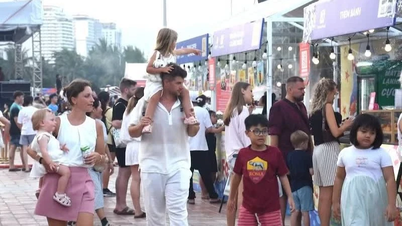
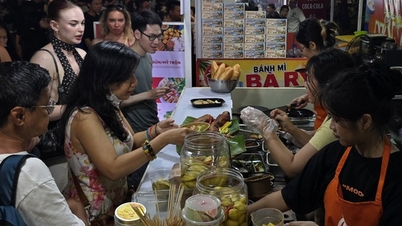
This area has an abundant supply of fresh seafood, making it ideal for developing night-time food streets to serve tourists, thereby contributing to longer stays and increased spending.
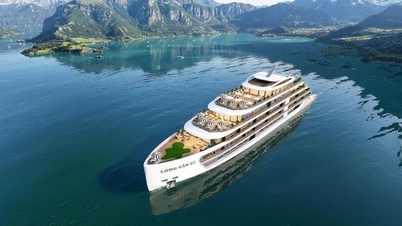
This locality also possesses a complex network of canals and waterways, facilitating waterborne connections with ports in central Ho Chi Minh City and Vung Tau. This creates favorable conditions for developing river cruise routes, similar to the successful models implemented by many major tourist cities around the world.
"With its pristine beaches, unspoiled island hamlets, isolated mangrove forests, and quick access to urban centers, Can Gio is an ideal location for developing resort tourism projects, especially in the high-end resort segment, targeting tourists seeking rest, rejuvenation, and healing," a specialist emphasized.
We will not sacrifice the environment for economic growth.
According to Mr. Dang Manh Phuoc, General Director of Outbox, a market research firm specializing in tourism and hotels in Vietnam, Can Gio should not and cannot develop in a way that sacrifices the environment for short-term growth.
"If a good balance is struck between conservation and development, Can Gio will not only be a weekend getaway but can also contribute to shaping Ho Chi Minh City's green tourism brand on the international map," Mr. Phuoc assessed.
According to Mr. Phuoc, during the development process, it is very difficult to find an international model that can be applied perfectly to Can Gio. Mechanically copying existing models from around the world can easily lead to a disconnect with the local reality.
In fact, many destinations once considered successful around the world have revealed their downsides when entering a period of rapid development. Cases like Bali (Indonesia), Phuket (Thailand), and Phu Quoc show that tourism development is not just about investment and growth, but also has long-term consequences for the environment and the lives of local residents.
As tourist and population numbers increase rapidly, pressure on infrastructure and ecosystems is inevitable. Many destinations, despite significant investment, still face overcrowding, flooding, and environmental degradation, forcing authorities to implement measures to restrict visitor numbers or increase tourism taxes to control the flow of people.
In ecologically sensitive areas like Can Gio, this risk is even more apparent if a long-term vision is lacking. Essentially, Can Gio, like many other destinations in Vietnam, possesses a valuable ecosystem. The issue isn't whether or not these resources exist, but rather how to transform them into concrete tourism products capable of creating experiences and retaining visitors.
Because tourists don't "consume" in an abstract way, but rather through well-designed services, activities, and spaces. In reality, over the years, the mangrove forests and brackish water ecosystem of Can Gio have been impressively depicted in images, but they lack products compelling enough to retain tourists, resulting in low motivation to return.
In this context, large-scale investment projects, if properly planned, can add appeal to a destination. However, it is crucial that these projects integrate into the overall ecological space rather than overshadowing or disrupting it.
"Nature only truly becomes an advantage when it is transformed into experiences that meet market demands," Mr. Phuoc emphasized.
Large-scale transportation and urban development projects "open the way" for Can Gio.
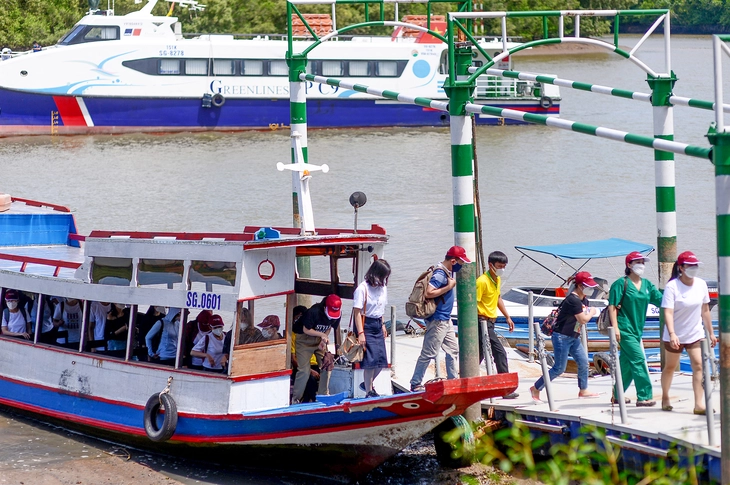
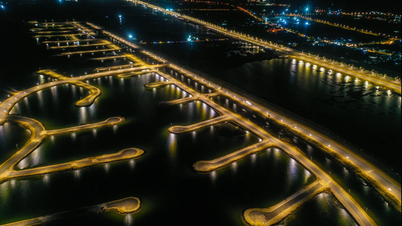
Can Gio is investing in transportation infrastructure to improve inter-regional connectivity instead of relying on ferries and boats - Photo: QUANG DINH
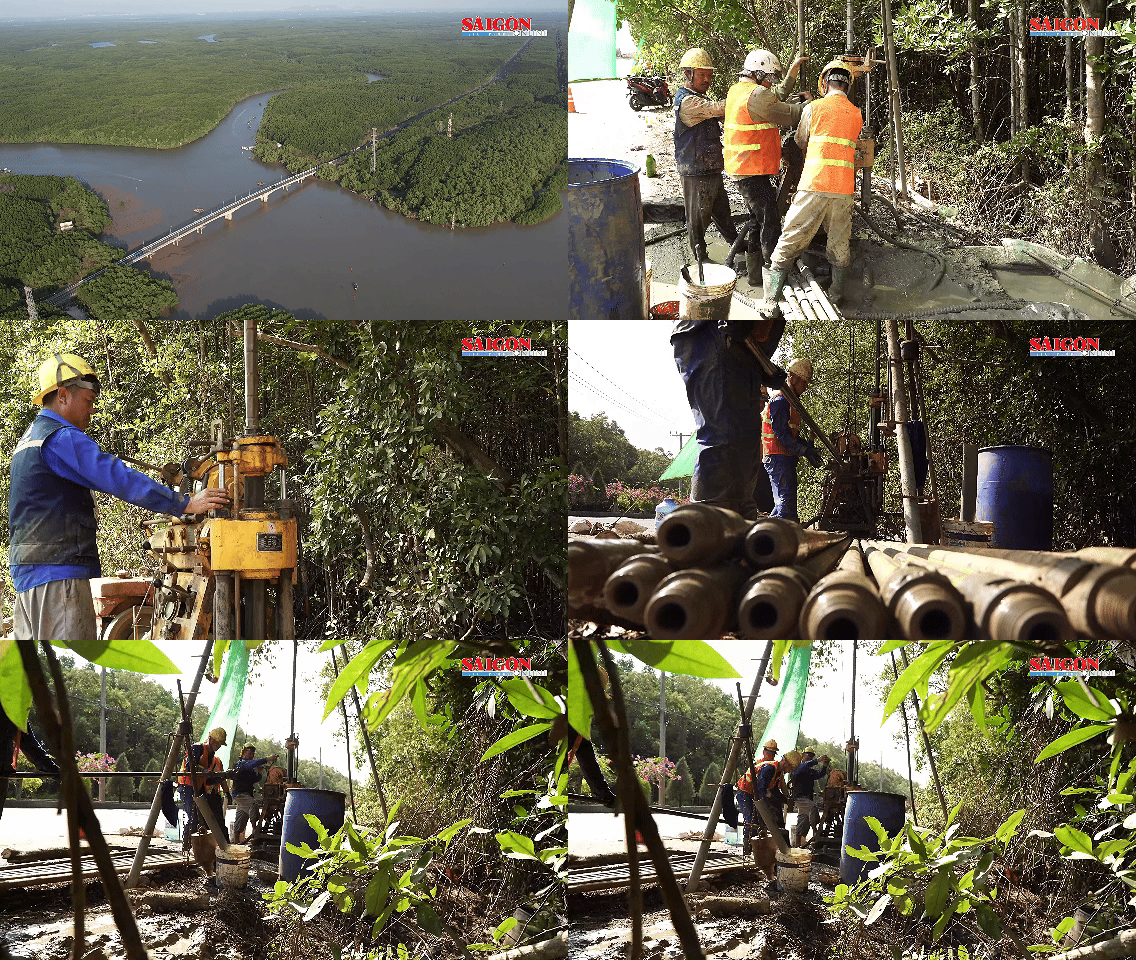
The Can Gio area is on the verge of transformation thanks to key infrastructure projects, including the Ben Thanh - Can Gio urban railway line, which broke ground at the end of 2025 and is expected to be operational in 2028. The Can Gio Bridge is expected to be completed in 2029, replacing the Binh Khanh ferry. In addition, Ho Chi Minh City is also preparing to implement the Rung Sac interchange connecting to the Ben Luc - Long Thanh expressway and is researching a sea-crossing route from Can Gio to Vung Tau.
In particular, Vinhomes Green Paradise, one of the largest projects in the Can Gio area, covering approximately 2,870 hectares, is oriented towards developing as a comprehensive urban model, including housing, commercial and service facilities, tourism and resort amenities, and public facilities, creating a new highlight for the coastal area of Ho Chi Minh City.
The project includes components such as the Song Xanh Theater complex with two auditoriums totaling approximately 5,000 seats, a conference and exhibition area, an outdoor plaza along with a system of restaurants and landscaped spaces, two 18-hole golf courses, an artificial lake covering more than 800 hectares, and a system of coastlines surrounding the urban area, including a section dedicated to public spaces.
The project also includes a cruise ship port, a large-scale entertainment complex spanning over 120 hectares, a safari park, an indoor ice and snow park, along with a system of hotels, commercial and service facilities, offices, a 108-story tower, and a hotel complex with approximately 7,000 rooms...
Lessons learned from green tourism and experiential education models.
Speaking to Tuổi Trẻ newspaper , Mr. Nguyen Minh Man, Deputy General Director of VinaGroup Travel, said that the unique combination of forest and sea spaces has given Can Gio a distinct advantage. People in Ho Chi Minh City can access a unique natural ecosystem in a short travel time, something rare for a large city.
According to Mr. Man, the value of the Can Gio mangrove forest lies not only in its landscape but also as an important foundation for developing ecotourism, environmental education, and short-term resort products. "Can Gio is blessed with great natural advantages, but these advantages are only truly meaningful if we know how to preserve and exploit them properly," Mr. Man said.
According to Mr. Man, all tourism development directions in Can Gio need to be closely linked to ecosystem conservation. Accordingly, the locality integrates environmental protection activities with regenerative tourism tours such as reforestation and ecosystem restoration. Tourists not only visit but also directly participate in activities that contribute to "returning" value to nature, aiming towards a community-based experiential tourism model.
"Tourists can join locals in the forest to catch crabs and fish, and learn about the livelihoods closely tied to the mangrove forest. The important thing is that these programs need to be professionally designed so that tourists truly 'travel alongside' the local people instead of just taking short sightseeing trips," Mr. Man said, adding that Can Gio is also a suitable space to develop experiential programs for students...
Source: https://tuoitre.vn/danh-thuc-tiem-nang-du-lich-can-gio-20260128211616751.htm


![[Photo] National Assembly Chairman Tran Thanh Man working with the Standing Committee of the Law and Justice Committee](https://vphoto.vietnam.vn/thumb/1200x675/vietnam/resource/IMAGE/2026/05/21/1779378929214_ndo_br_1-4610-jpg.webp)
![[Photo] General Secretary and President To Lam presides over a working session with the Central Policy and Strategy Committee on the development of the materials industry.](https://vphoto.vietnam.vn/thumb/1200x675/vietnam/resource/IMAGE/2026/05/21/1779359935432_a3-bnd-3129-1412-jpg.webp)






















































Comment (0)