

Their own calendar, which is still in use, has a 13th month, so it's only 2018 now.
Delayed by 7 or 8 years
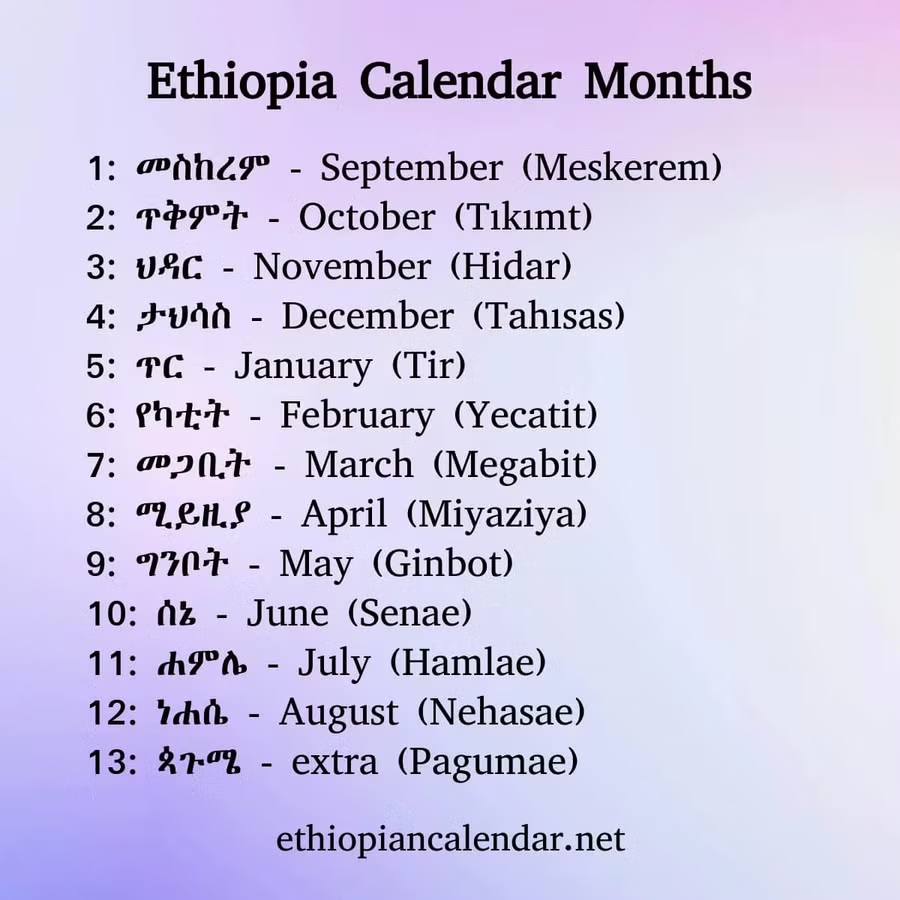
The official civil calendar of Ethiopia is the Ethiopian calendar. While we have to calculate or consult a calendar to know how many days are in a month, the Ethiopian calendar stipulates that each month has 30 days. A year in the Ethiopian calendar has a total of 13 months, but the 13th month is very short, only 5 or 6 days. It is called Pagume (Additional Month).
Comparing different calendars, the Ethiopian calendar is similar to the Coptic calendar of ancient Egypt. The Coptic calendar also has a year of 13 months, with the 13th month called Nasie (the last month), consisting of 5 or 6 days.
Both the Ethiopian and Coptic calendars are similar to the Gregorian calendar (the solar calendar) in that they have an extra day every four years. Therefore, the 13th month has 5 days in a non-leap year and 6 days in a leap year.
Ethiopians call the 13th month "Extra Month" because all the days in this month are added to ensure a year still has 365 or 366 days, according to the solar cycle. From a religious and customary perspective, Extra Month is a month of transition and reflection. Ethiopians use it to rest, reflect on the past, and plan for the future. Therefore, despite its short length, Extra Month is extremely important and beloved by all Ethiopians.
Due to the addition of the month of "More," the Ethiopian calendar lags behind the Gregorian calendar used worldwide , and instead of January 1st, its New Year's Day is September 11th (or September 12th in a leap year). Ethiopians call this day Enkutatash, meaning "gift of jewels." According to legend, this is the day their mythical Queen of Sheba returned after visiting King Solomon in Jerusalem. The entire nation celebrated with great excitement, offering her precious jewels, hence the name "day of jewels."
According to weather patterns, September 11th marks the end of the rainy season and the beginning of spring in Ethiopia. Everywhere, the country's symbolic flower, the adey abeba, blooms in vibrant yellow. Ethiopian girls joyfully celebrate the spring, picking adey abeba flowers and tying them into bouquets to give to friends, relatives, and lovers.
Ethiopians follow a 12-hour day system, starting at 6 AM, so according to Ethiopian time, both noon and midnight are 6 AM. If you don't know this and arrange to meet them for coffee at 10 AM, they'll likely arrive at 4 PM.
All of Ethiopia's important national and ethnic holidays are calculated and celebrated according to the Ethiopian calendar and are currently in 2018, seven years behind the global calendar.

Independent and unique
Ethiopia is the only African country that has not been colonized. Although, in 1895, Italian colonists attempted to invade it but failed. After conquering Eritrea, Ethiopia's neighbor, they returned to invade Ethiopia again, but suffered a bitter defeat. In just a few hours, Emperor Menelik II (1844-1913) commanded the Ethiopian royal army to defeat four Italian brigades, creating the world-shattering Battle of Adwa (March 1, 1896).
After two unsuccessful invasions, Italy was forced to sign a treaty recognizing Ethiopia's independence. Decades later, the notoriously tyrannical military dictator Benito Mussolini (1883–1945) violated the treaty, but Emperor Haile Selassie (1892–1975), successor to Emperor Menelik II, reversed the situation by promoting the establishment of the Organization of African Unity, now the African Union.
It was from Ethiopia that the ideal of anti-colonialism spread far and wide. South Africa's most famous leader, Nelson Mandela (1918-2013), participated in anti-colonial training there and expressed, "During my time in Ethiopia, I felt a sense of returning to my roots, understanding what makes me a son of the African continent."
Beyond its rich and influential history, Ethiopia boasts unique natural resources and culture. Coffee, a globally beloved beverage, originated here. Legend has it that centuries ago, a goatherd noticed his goats charging into a strange shrub with clusters of round berries. He tried some of the berries and the next day felt much healthier and more energetic.
Ethiopians practice vegetarianism. Each year, they fast for 200-250 days, but their fasting only includes meat, eggs, and dairy – foods of animal origin. Ethiopia has many religious holidays, and believers observe fasting before each holiday. Additionally, they fast on Wednesdays and Fridays, so most restaurants offer vegetarian options on their menus. For vegetarians, Ethiopia is nothing short of paradise.
Notably, Ethiopia is home to the world's oldest known human skeleton, Lucy, dating back 3.2 million years. Discovered by archaeologists in 1947 in the Afar region, the fossil belongs to the Austronesian hominid species.
Source: https://giaoducthoidai.vn/dat-nuoc-mot-nam-13-thang-post762781.html




![[Photo] National Assembly Chairman Tran Thanh Man working with the Standing Committee of the Law and Justice Committee](https://vphoto.vietnam.vn/thumb/1200x675/vietnam/resource/IMAGE/2026/05/21/1779378929214_ndo_br_1-4610-jpg.webp)
![[Photo] General Secretary and President To Lam presides over a working session with the Central Policy and Strategy Committee on the development of the materials industry.](https://vphoto.vietnam.vn/thumb/1200x675/vietnam/resource/IMAGE/2026/05/21/1779359935432_a3-bnd-3129-1412-jpg.webp)
































































































Comment (0)