Seasonal fruits
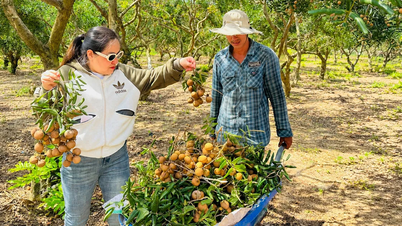
The path leading to Uncle Ba Son's garden, located at the end of Road 84 in Dong Long Phuoc neighborhood (Tam Long ward), is covered in the lush green of fruit trees. In the nearly 2-hectare garden, Ms. Nguyen Thi Thu Hang, the garden manager, is busy guiding visitors, handing out conical hats, plastic baskets, and even long poles (tens of meters long) so that visitors can pick mangosteen and durian themselves.
From April each year, when the fruits begin to ripen, the garden opens to visitors. However, the busiest time is from the beginning of June until the end of summer , with dozens of groups of visitors arriving on some days. "Most visitors to the garden are families, traveling in groups. The children are very excited and enjoy picking fruit themselves in the garden," Ms. Hang said.
Ms. Le Thi Hai Yen ( Vung Tau Ward, Ho Chi Minh City) said: “Durian at the orchard is sold for about 80,000 VND/kg, and mangosteen for 50,000 VND/kg. After visiting the orchard, we chose to pick nearly twenty kilograms directly from the trees as gifts for our relatives.”
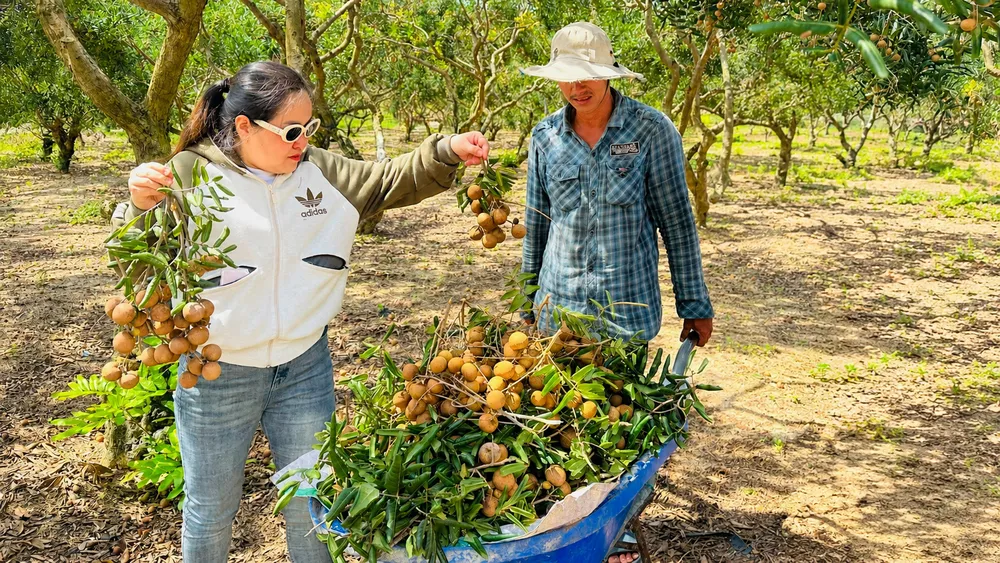
Leaving Tam Long ward, we continued our journey to Phuoc Hai commune, where the longan orchards were entering their harvest season. Ms. Truong Thi Bay's Hoa Thuan longan orchard is one of the community tourism destinations chosen by the local authorities for development in recent years. Every harvest season, the orchard gates open wide to welcome visitors. For an entrance fee of 50,000 VND per person, visitors can stroll around the orchard, learn about the tree care process, take photos, and enjoy longan to their heart's content right there. According to Ms. Bay, combining agricultural production with community tourism has brought significant income to her family: "Thanks to visitors, longan growers have additional income. My family also has more capital to reinvest for the next season."

With the formation of specialized fruit-growing areas, the agricultural sector has many opportunities to integrate with tourism. If properly invested in, garden tourism in localities has the potential to develop, contributing to the diversification of tourism products and encouraging tourists to stay for longer periods.
Not only Mrs. Bay's family, but many farming households in the area are also benefiting from the increasingly popular trend of experiential tourism. Mr. Pham Tham's longan orchard (Phuoc Hai commune) is a familiar destination for many tourists every summer. After more than 30 years of cultivation, his 4-hectare orchard with about 1,000 longan trees of various types has become a stable source of income for his family. To maintain productivity and improve product quality, in addition to participating in technical training courses organized by the local authorities, he also proactively researches new grafting and propagation methods. As a result, the longan fruit from his orchard is always highly valued for its thick flesh, sweet and refreshing taste, and high juice content. Each season, his family harvests 26-30 tons of longan. The selling price ranges from 25,000-30,000 VND/kg for both traders and tourists visiting the orchard.
According to Mr. Tham, experiential tourism in rural orchards is opening up a new direction for farmers. "Visitors come to tour and buy longan to take home for personal use or as gifts. This not only helps increase income but also contributes to promoting the local 'golden rice boat' longan brand," Mr. Tham said.
Towards product diversification
In Xuyen Moc commune, since 2017, Mr. Nguyen Kim Trinh (Nhan Thuan hamlet) has pioneered the garden tourism model with 2.4 hectares planted with longan, tangerine, orange, banana, and green pomelo trees. Recognizing the potential for developing this type of tourism, Mr. Trinh invested 50 million VND to build a canopy, buy 5 sets of tables and chairs, and construct restrooms... to serve visitors.
Visitors to Mr. Trinh's garden not only get to enjoy the fruit, sightsee, and take photos, but also savor rustic country meals with free-range chicken, fermented pork sausage, and fig leaves... "For many years, my wife and I have been involved in raising livestock, cultivating crops, and harvesting fruit year-round on our rural garden. But since we started doing tourism, visitors from all over have come, making our garden more lively, and my wife and I have earned extra income from providing food and drinks, organizing tours, and selling fruit," Mr. Trinh said.



Mr. Nguyen Hong Phuc, Vice Chairman of the People's Committee of Phuoc Hai commune, commented that the model of tourism associated with orchards is a tourism product with great development potential, creating conditions to improve farmers' income. The locality is continuing to support farmers in building orchard tourism routes, guiding tourists to participate in planting and harvesting activities with farmers.
Source: https://www.sggp.org.vn/dau-he-du-lich-vuon-que-soi-dong-post859195.html
![[Image] Schools organize meetings and introduce teaching models to students admitted to grade 10.](https://vphoto.vietnam.vn/thumb/1200x675/vietnam/resource/IMAGE/2026/06/25/1782368077271_ndo_br_z7970052192242-1ec8daeb77a6eed1a4e9f58c564ddd3e-jpg.webp)

![[Photo] General Secretary and President To Lam receives Palestinian Ambassador Saadi Salama](https://vphoto.vietnam.vn/thumb/1200x675/vietnam/resource/IMAGE/2026/06/25/1782365384740_a1-bnd-9423-8322-jpg.webp)

![[Image] Ho Chi Minh City: Ma Lang area, Chicken-Rice Market about to change its appearance](https://vphoto.vietnam.vn/thumb/1200x675/vietnam/resource/IMAGE/2026/06/25/1782377698627_ndo_br_m1-jpg.webp)