

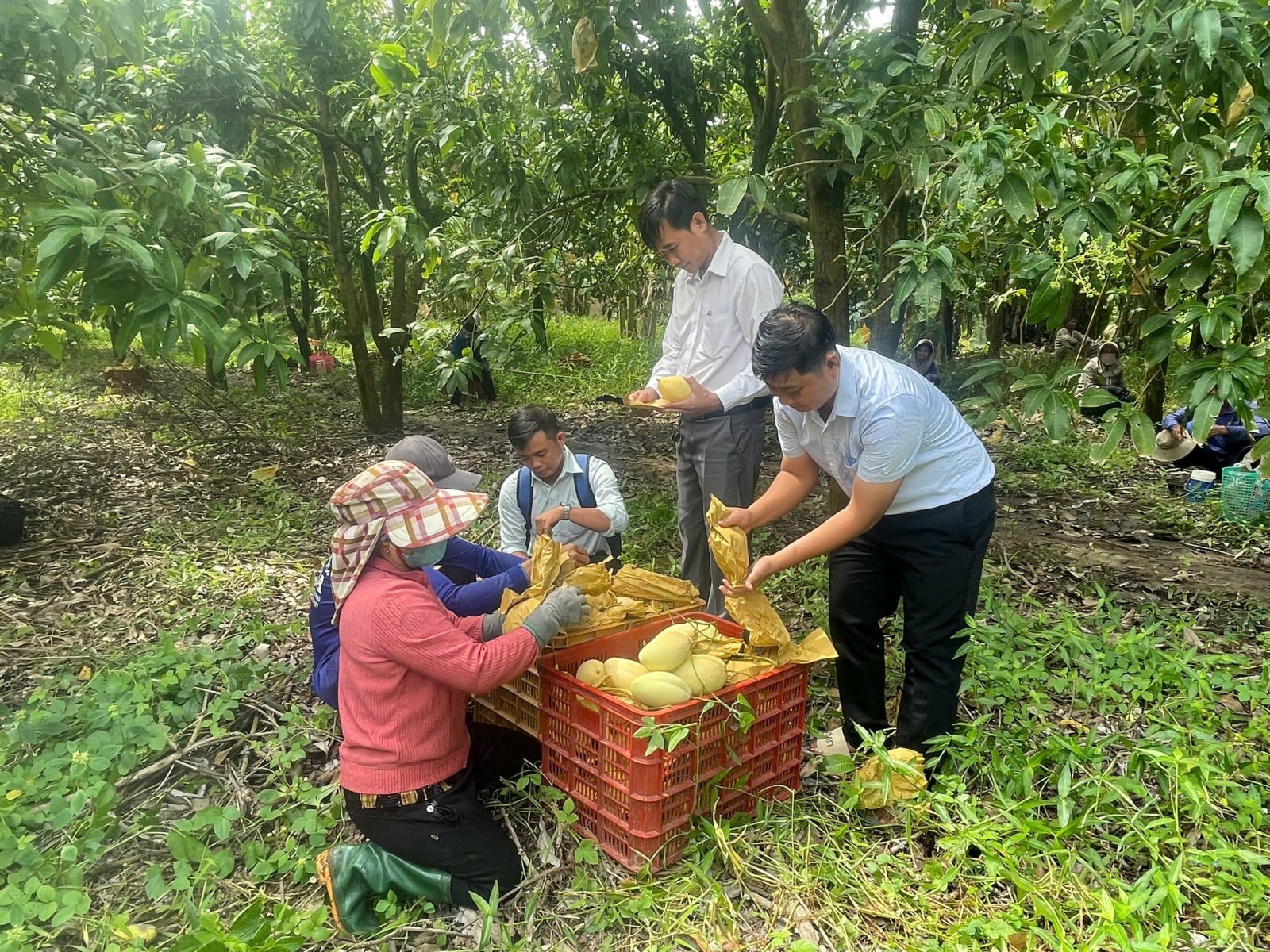
Mango orchard in Khanh Binh commune. Photo: KIM NGAN
Khanh Binh gets a new look.
In Khanh Binh on a morning, the wind from the Binh Di River carried the scent of alluvial soil. Standing on the Long Binh - Chrey Thom bridge, we looked at the winding river, which resembled a silk ribbon connecting the two border regions. On the other side was the Kingdom of Cambodia. On this side, the Khanh Binh National Border Gate was beginning to bustle. Trucks lined up waiting for customs clearance, the sound of engines mingling with the voices of people and footsteps crossing the border, creating the familiar lively sounds of a border region awakening.
Few would have imagined that this once remote and isolated area would today resemble a bustling trading hub. Even harder to imagine is that on this very land, once flooded every rainy season, the people are now nurturing dreams of reaching further afield. Mr. Ly Van Nhan, a resident of Binh Di hamlet, pointed towards the paved roads stretching into the center of the commune. His voice softened as he recalled the past: “Before, there weren’t roads like this here. All we could find were dirt roads; in the sun, dust flew everywhere, and when it rained, mud clung to our heels.”
In the memory of Mr. Nhan and many residents of Binh Di hamlet, before 1975, the entire Khanh Binh commune only had a few pedal-powered and motorized rickshaws carrying goods around Long Binh market. Boats and canoes were the main means of transportation. The commune only had one small primary school, with an old corrugated iron roof, nestled among a bamboo grove.
After the complete liberation of South Vietnam and the reunification of the country, this border region began its first steps in the journey of renewal. At this point, Mr. Nhan smiled slightly: “From the 1980s, the first road was opened, back then people contributed bags of soil and logs. Now the roads are wide and spacious, making travel easy, and life has clearly improved.” His words are simple, but they demonstrate that change is not only reflected in the numbers in reports but is also evident in the lives and activities of the people.
Khanh Binh is no longer a purely agricultural commune. The border economic zone, spanning over 18 hectares, is being systematically developed, with inspection yards and logistics centers springing up, creating a new face for the border region. Ms. Truong Thi Khanh, a local trader, said while inspecting a shipment: “Trading is much easier now than before. Transportation is easier, and people have basically stable jobs.”
But deep within this transformation, agriculture remains the vital backbone of Khanh Binh. The entire commune currently has 3 irrigation pumping stations, a comprehensive system of canals and ditches, and nearly 1,100 hectares of cultivated land, the majority of which is planted with Keo mangoes. At midday, the sun beats down on the mango orchards laden with fruit. Mr. Bui Van An, a resident of Khanh Binh commune, walks along the rows of trees, gently lifting Keo mangoes wrapped in paper bags. “Before, this land was used for rice cultivation, and the yield was very low! After working the whole season and deducting expenses, there was hardly anything left,” Mr. An recounted. The turning point came when the local authorities encouraged people to switch to growing Keo mangoes. Initially, he was worried. That worry was only truly dispelled when he joined the local Keo mango farming cooperative. His family's 18-hectare mango orchard yields 20-30 tons per hectare. Each harvest season, the whole family is busy, but it's a busyness filled with joy.
In Khanh Binh, mango orchards like Mr. An's are becoming increasingly common. Locals are gradually becoming accustomed to adhering to international production standards, carefully tending to each mango not only for sale but also for export. Mr. Truong Tri Thong, Head of the Economic Department of Khanh Binh commune, said that Khanh Binh's Keo mangoes have become a key agricultural brand of the commune, contributing to increased income and affirming the potential of the local agriculture in terms of value enhancement. Currently, Khanh Binh's Keo mangoes have 17 registered growing areas and are exported to many markets such as Australia, South Korea, New Zealand, China, Thailand, and Malaysia.
Along with economic transformation, cultural and social life in Khanh Binh commune is increasingly flourishing. Currently, the poverty rate in the commune has decreased to 5.54%, the near-poverty rate to 2.68%, and 97% of families have been awarded the title of "Culturally Advanced Family". Sports and traditional music performances are becoming increasingly vibrant.
In the afternoon, we visited the construction site of the newly started Khanh An Boarding Primary and Secondary School. Once completed, the school is expected to accommodate 1,500 students, including 96 boarding students. Many parents watching the event showed clear excitement. One mother whispered, "My child will be able to study near home and board, making things easier." Currently, the commune has 11 schools, 7 of which meet national standards, and the quality of teaching and learning is steadily improving. The new schools and spacious classrooms provide more opportunities for children in this border region to access knowledge, opening a door to the future in a land that once faced many hardships.
Vinh Xuong - a parallel flow
Across the Tien River, Vinh Xuong is equally bustling. The old embankment has now become a straight concrete road. Trucks carrying agricultural products and construction materials line up to pass through the Vinh Xuong International Border Gate. Import and export turnover through this border gate has increased from 500 million USD in 2010 to nearly 1 billion USD in 2025. Inter-regional transportation infrastructure is expanding, and the foundation for urbanization at the border gate is becoming increasingly evident. Mr. Tran Van Hop, Secretary of the Vinh Xuong Commune Party Committee, said: “The locality has shifted from ‘managing’ to ‘partnering,’ creating favorable conditions for businesses to invest in agricultural product processing, increasing the value of high-quality mangoes and rice for export.”
This transformation has ignited the aspiration to rebuild the homeland. In March 2023, Vinh Xuong was recognized as a new-style rural commune. Infrastructure such as electricity, roads, schools, health stations, and markets are all well-developed. The commune's economic growth rate is over 8.5% per year. By 2025, the average per capita income is expected to reach nearly 70 million VND, and the poverty rate will decrease to 1.3%. Mr. Bui Thai Hoang, Chairman of the People's Committee of Vinh Xuong commune, said: “To gain the people's trust, the government must lead the way and act first. Every project has the contribution of the people; this consensus creates a new face for our homeland.”
From small farms to large-scale partnerships
A new way of life is spreading across the fields and gardens of Khanh Binh and Vinh Xuong. From fragmented production, people are beginning to cooperate and organize production in a systematic manner. At midday on the border, at the Vinh Xuong Cooperative – home to 600 hectares of mango trees – the sun casts a golden glow on the heavily laden mango trees. Gently stroking a freshly picked mango, Mr. Huynh Van Hiep, Chairman of the Board of Directors of the Vinh Xuong Cooperative, said: “We focus on growing high-value mango varieties that are popular in the market, such as Hoa Loc, Cat Chu, and Keo mangoes. At the same time, we produce according to VietGAP standards, have links with businesses, and meet export requirements.”
In many fields, the bustling sound of combine harvesters sets the pace for the mechanized farming season. Large plots of land form concentrated production areas, applying the "1 must, 5 reductions" and "3 reductions, 3 increases" models, and using QR code traceability. Mr. Nguyen Van Thang, a successful farmer and businessman in Hamlet 5, Vinh Xuong Commune, confidently stated: "Farmers now work in cooperatives and have contracts guaranteeing product sales. With a stable market, everyone feels secure in their production, and their lives improve."
As the last rays of sunlight faded, we lingered by the Tien River, watching the water flow slowly. On the banks, newly opened roads leading to residential areas began to light up. From a region once considered a "low-lying area," Khanh Binh and Vinh Xuong have transformed into bright spots at the headwaters of the Mekong River as it flows into Vietnam. This transformation has been built upon the faith and persistent efforts of the government and the people. In this border region, the land not only nourishes the people but also nurtures their aspirations for a prosperous and sustainable future.
(To be continued)
Source: https://baoangiang.com.vn/dau-nguon-song-mekong-chay-vao-dat-viet-dau-an-mot-vung-dat-bai-3-doi-thay-o-vung-bien-a470633.html


![[Photo] Prime Minister Pham Minh Chinh attends the Conference on the Implementation of Tasks for 2026 of the Industry and Trade Sector](/_next/image?url=https%3A%2F%2Fvphoto.vietnam.vn%2Fthumb%2F1200x675%2Fvietnam%2Fresource%2FIMAGE%2F2025%2F12%2F19%2F1766159500458_ndo_br_shared31-jpg.webp&w=3840&q=75)































































Comment (0)