

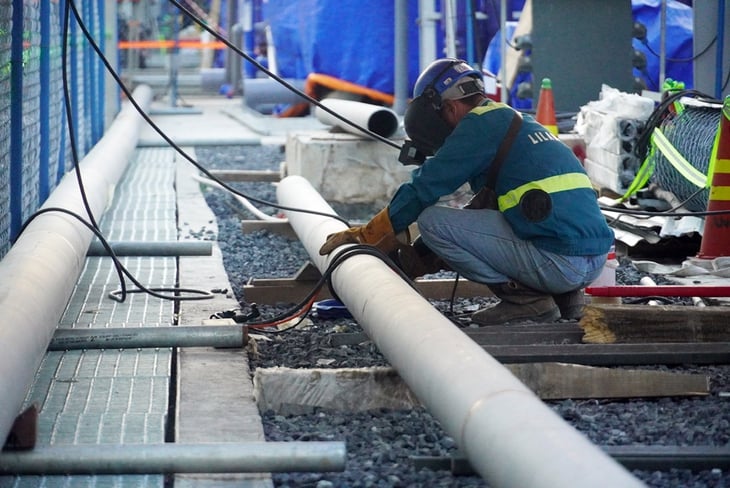
Nhon Trach 3 and 4 thermal power plants are preparing for commercial operation in Q4 2025 - Photo: NGOC AN
This information was provided by Mr. Nguyen Quoc Thap, Chairman of the Vietnam Oil and Gas Association, at the annual oil and gas and energy forum 2025: Energy Transition - Vision and Action, organized by the Vietnam Oil and Gas Association and the Vietnam National Energy and Industry Corporation ( Petrovietnam ) on July 28.
Is the mobilization of natural gas power low due to high prices?
According to Mr. Thap, the biggest concern for gas-fired power plants is the low level of electricity consumption at LNG-fired thermal power plants. He cited the Nhon Trach 1 gas-fired power plant and the Lan Tay gas-fired power project as examples, showing that the level of utilization is much lower than the supply capacity.
Similarly, two multi-billion dollar projects, such as the Nhon Trach 3 and 4 gas-fired power plants, have been completed and are ready to generate electricity, but the issue of electricity generation remains a "big question." According to Mr. Thap, the reason is that the Vietnam Electricity Group (EVN) is the buyer of all electricity sources to sell to customers, mobilizing them in order of priority from lowest to highest price.
This has resulted in LNG-fired power having high prices – making it an unpreferred power source in the grid, especially since hydropower is cheaper this year due to more abundant water resources and is therefore being utilized more frequently.
According to Mr. Thap, Government Decree 100 on the mechanism for developing gas-fired thermal power projects, which has just been issued, has introduced mechanisms such as transferring gas prices to electricity prices.
In addition, a policy guaranteeing a minimum long-term electricity output of no less than 65%, applicable for 10 years, has also been implemented. However, in reality, many obstacles in operating power plants and attracting investment in gas-fired thermal power plants have yet to be resolved.
According to data from EVN, in the first seven months of 2025, the proportion of gas-fired power generation accounted for 6.6%, a decrease compared to 8.2% in the same period of the previous year. Meanwhile, the proportion of hydropower generation accounted for 23.5%, an increase compared to 22.8% in the same period.
Mr. Nguyen Duy Giang, Deputy General Director of Vietnam Petroleum Power Corporation (PV Power), the investor of the Nhon Trach 3 and 4 gas-fired thermal power plants with a total capacity of up to 1,624 MW, expected to begin commercial operation in the fourth quarter of 2025, affirmed that one of the biggest obstacles is the mechanism for transferring gas prices to electricity prices.
A mechanism for direct electricity trading is needed.
According to Mr. Giang, although the mechanism of transferring gas prices to electricity prices has been allowed for the Nhon Trach 3 and 4 projects, the annual output off-take ratio of 65% is considered unsuitable by foreign investors, falling below the break-even point.
Therefore, along with a relatively complex investor selection mechanism, the production off-take mechanism with a fixed ratio is the two biggest barrier to attracting investors to the gas-fired power sector.
Mr. Giang stated that according to the National Power Development Plan 8, there are approximately 15 LNG projects, with the addition of projects in Hai Phong recently, bringing the total to around 16-18 LNG projects, playing a very significant role in the development of electricity.
Nevertheless, investors still hope that this ratio will increase to 80-90% within 15-20 years. "Apart from the Nhon Trach 3 and 4 projects which have already been implemented, the remaining projects are still in the investment stage, and I think it will be relatively difficult to get them operational before the 2028-2030 period," Mr. Giang assessed.
Meanwhile, according to Mr. Thap, to solve the problem of guaranteed output, it is necessary to recognize that the output market for LNG power is not a mass market, but rather industrial consumers and large consumers who desire long-term commitments.
These households will be guaranteed the purchase of their electricity output and imported gas output, instead of the current regulations which assign this responsibility to EVN and relevant ministries and agencies.
In reality, many investors and industrial parks, who are electricity consumers, want to be fully informed about the input information regarding energy used in production. These customers are also concerned about the long-term and consistent availability of electricity.
Given the current state of electricity input and usage, investors are unable to fully disclose information about their electricity consumption.
"Therefore, there needs to be a mechanism for direct electricity trading, where the power generator negotiates directly with the power buyer, applicable to both LNG power projects and renewable energy plants, to ensure long-term output guarantees and attract investors," Mr. Thap said.
High demand, but policies are not attractive enough for investors.
Mr. Nguyen Duc Hien, Deputy Head of the Central Policy and Strategy Committee, stated that with the energy transition demand reaching $135 billion, and the limited resources of the State, having mechanisms to attract private investment is a pressing requirement.
Therefore, reforming the energy market, electricity prices, and coordination mechanisms when separating the competitive electricity dispatch center is a step forward, but it needs further improvement to clearly differentiate the market between wholesale and retail to promote the efficient use of electricity sources.
Meanwhile, according to Mr. Nguyen Quoc Thap, chairman of the Vietnam Oil and Gas Association, policies for developing gas-fired power plants are still not attractive enough to investors, as there is no basis for government guarantees to secure loans for state-owned projects, and no mechanism for guaranteeing foreign currency conversion. Planning is still lacking and inconsistent, especially detailed planning from terminals, LNG storage, power plants, transmission and distribution grids to industrial clusters...
"Furthermore, the criteria for selecting investors are not yet consistent, as the Power Development Plan 8 and the National Energy Plan only provide some locations in principle, while gas companies want to build and develop into gas-fired power clusters and interconnected chains," Mr. Thap said.
Source: https://tuoitre.vn/dau-tu-hang-ti-usd-dien-khi-lng-van-e-20250728225914803.htm
![[Image] Hanoi's urban life under the challenge of a "scorching hot" environment](https://vphoto.vietnam.vn/thumb/1200x675/vietnam/resource/IMAGE/2026/05/25/1779706979265_nang-nong-t5-2026-minh-duy-7-4636-jpg.webp)


![[Image] Close-up view of the interchange connecting the two expressways and Long Thanh Airport.](https://vphoto.vietnam.vn/thumb/1200x675/vietnam/resource/IMAGE/2026/05/25/1779703378210_ndo_br_z7863716673926-224453a31600126cce10622af6290afd-4549-jpg.webp)














































































Comment (0)