

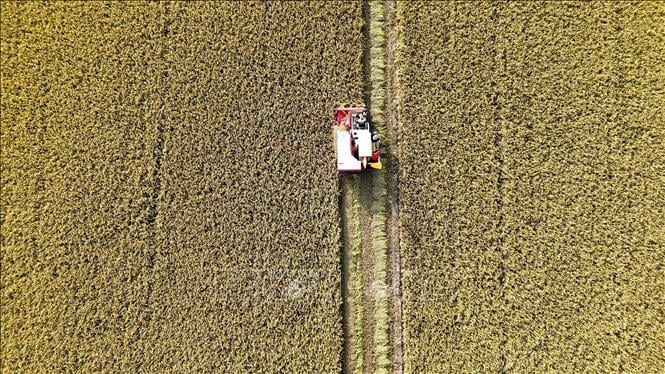
By participating in the project "Sustainable development of 1 million hectares of high-quality, low-emission rice cultivation associated with green growth in the Mekong Delta by 2030," An Giang hopes to create a significant impetus, helping the local rice industry shift strongly towards green growth, enhance the value of rice grains, increase farmers' income, and effectively adapt to climate change.
Changing the mindset in production
An Giang currently has over 600,000 hectares of rice-producing land, with more than 1.3 million hectares planted annually, yielding an average output of approximately 9 million tons. However, the province's rice industry is facing numerous challenges. These include increasingly severe climate change, rising input costs, unsustainable production and consumption linkages, disproportionate economic efficiency, and significant greenhouse gas emissions.
In this context, the implementation of the project "Sustainable development of 1 million hectares of high-quality, low-emission rice cultivation associated with green growth in the Mekong Delta by 2030" as per Decision No. 1490/QD-TTg of the Prime Minister is considered a strategic direction, creating momentum for An Giang to restructure the rice industry towards increasing value, sustainable development, and environmental friendliness.
The implementation over the past period has shown that many farmers in An Giang have boldly changed their farming practices. Technical advancements, especially cluster seeding machines, have been widely applied, helping to reduce the amount of seeds sown, increase the uniformity of rice fields, and save production costs. The project not only brings economic benefits but also gradually forms a modern and sustainable rice production method.
Participating in the project, Mr. Nguyen Hoang Van (a farmer from Binh My commune) said that the production process was applied quite strictly, including sparse sowing, reduced fertilizer, reduced pesticides, and complete record-keeping in production logs. After many seasons, the rice fields developed uniformly, had fewer pests and diseases, reduced costs, but still ensured yields, helping farmers achieve higher profits.
Mr. Van assessed that the project's effectiveness exceeded farmers' expectations. Compared to before, the cost of producing rice per hectare has decreased by several million dong, while the selling price is higher. Participating in the project has made rice farming easier for farmers and provided them with a stable income, so they are very enthusiastic.
Having participated in the project since its initial implementation in the province, Mr. Tran Van Tuan, a farmer from Thoai Son commune, said that the biggest change in his thinking was his approach to production. Previously, he believed that applying a lot of fertilizer and spraying a lot of pesticides would lead to a good rice harvest. However, when cultivating according to the new process, with sparse sowing and reduced fertilizer and pesticides, the rice plants grew healthily, yielded high productivity, and the soil became loose and porous, no longer compacted as before.
“Reducing the use of fertilizers and pesticides in the fields helps limit environmental pollution. Harvested straw is also collected instead of being burned in the fields, contributing to improved air quality. Rice grown under the project has superior quality. To reassure farmers about producing under the project, the agricultural sector and businesses need to work alongside them by building sustainable value chains, ensuring stable output with higher selling prices; at the same time, the agricultural sector needs to transfer green farming techniques that are easy to apply and develop livelihoods from straw, and provide financial support policies for farmers…”, Mr. Tuan shared.
According to the Department of Agriculture and Environment of An Giang province, the project has initially changed the awareness and production mindset of farmers. Farmers are gradually shifting from traditional farming to sustainable production, reducing emissions and improving economic efficiency; in particular, technical solutions such as water-saving management, rational fertilization, use of high-quality seeds, and reduced seeding volume have been implemented synchronously, helping farmers reduce costs, stabilize yields, and increase profits.
In 2025, An Giang province implemented 55 demonstration models covering nearly 1,500 hectares; localities built an additional 34 models covering nearly 514 hectares. The effectiveness of these models showed a reduction in production costs of 3.3 - 4.1 million VND/ha, an increase in average yield of 0.78 tons/ha, and an increase in profit of 6.1 - 9.35 million VND/ha. Rice participating in the models had more uniform quality and was easier to sell thanks to its connection with businesses and the value chain. Besides economic benefits, the project also brought clear environmental benefits. The farming models helped reduce emissions by 7.56 - 8.11 tons of CO₂e/ha, reduced the use of chemical fertilizers and pesticides, and gradually formed an environmentally friendly rice production system.
Enhancing the value of rice grains
In 2026, An Giang will implement 8 models in 8 communes, covering an area of nearly 399 hectares, with continuous production over 3 rice seasons: Winter-Spring, Summer-Autumn, and Autumn-Winter. The province aims to have nearly 183,600 hectares meeting the criteria of the Project by 2026. By 2030, An Giang aims to achieve nearly 351,400 hectares of high-quality, low-emission rice; in which, the amount of seeds sown will be reduced to less than 70 kg/ha; fertilizer and chemical pesticides will be reduced by 30%; and irrigation water will be reduced by 20%. 100% of rice straw will be collected and reused, and the entire area will have production and consumption linkages.
Mr. Tran Thanh Hiep, Deputy Director of the Department of Agriculture and Environment of An Giang province, assessed that the implementation of the project in An Giang has been very favorable thanks to the close guidance of the central and local authorities. Thanks to the long-standing rice cultivation experience of farmers, along with the foundation from effective production models such as "3 reductions, 3 increases," "1 must, 5 reductions," SRP, and a basic irrigation system that meets the requirements of alternating flooding and drying, An Giang has many favorable conditions to implement the project.
According to Mr. Hiep, besides the advantages, the implementation of the project in An Giang still faces many difficulties and challenges such as: irrigation and internal field transportation infrastructure is not yet synchronized in some areas; the market linkage capacity of cooperatives is still limited; the straw value chain has not yet been clearly formed; the monitoring and reporting of emissions (MRV) is still new and lacks specialized personnel.
To ensure the project's effectiveness, Mr. Hiep stated that the province will focus on deploying the MRV system on 1,180 hectares; boosting investment in irrigation and logistics infrastructure; promoting digital transformation in cultivation area management and traceability; and implementing preferential credit packages for farmers and cooperatives, as well as attracting businesses to invest in processing linked to raw material areas.
With the determination of the government, the support of businesses, and the proactive shift in production mindset by farmers, the project is gradually proving its effectiveness in An Giang. This is not only a solution to increase the value of rice and farmers' income, but also an important foundation for the province's rice industry to strongly shift towards green and sustainable growth. Through this, it contributes to building a brand of environmentally friendly Vietnamese rice, meeting the increasingly high demands of domestic and international markets.
Source: https://baotintuc.vn/kinh-te/de-an-1-trieu-ha-lua-chat-luong-cao-co-hoi-tai-co-cau-nganh-lua-gao-20260114130134763.htm


![[Photo] General Secretary and President To Lam presides over a meeting on preparations for the review of one year of operation of the three-tiered government system.](https://vphoto.vietnam.vn/thumb/1200x675/vietnam/resource/IMAGE/2026/06/02/1780391821195_a1-bnd-4595-9717-jpg.webp)
































































Comment (0)