

When young people choose the difficult path
In 2011, the personnel records of the Institute of Soil Science and Agricultural Chemistry recorded the joining of a young research officer, Tran Thi Hue (born in 1983), right at the time she had just gotten married. Her career change wasn't associated with any formal milestones, but was a quiet, personal decision. She left her familiar teaching environment to participate in agricultural research – a field where most of her time is spent in the field, in fields, hills, and remote production areas, rather than in a closed research environment.
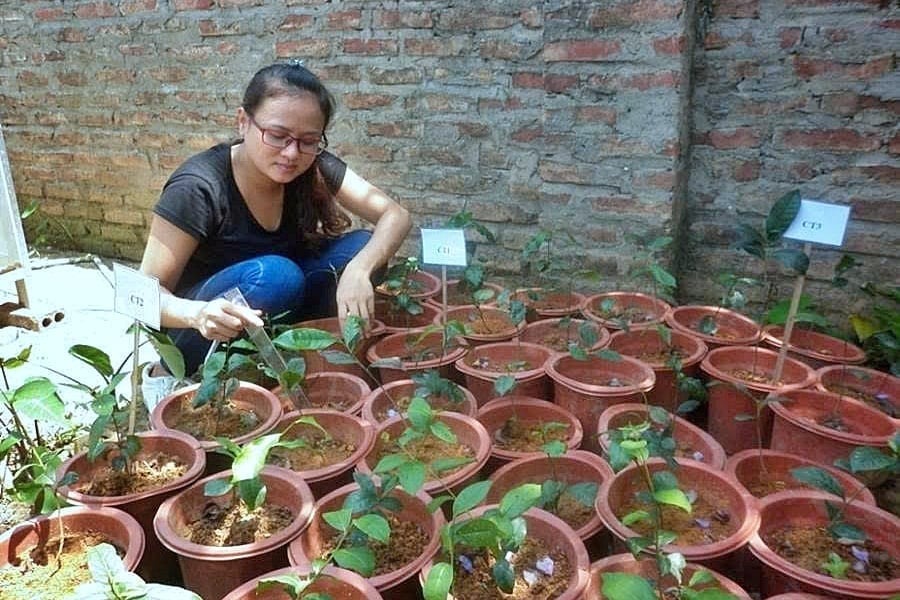
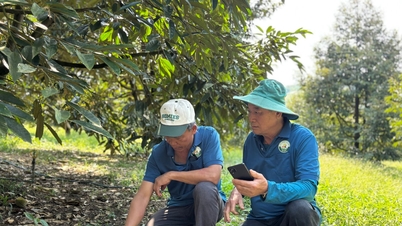
Dr. Hue participated in a research project to select beneficial microbial strains for use in Shan tea cultivation in Yen Bai in 2015. Photo: Provided by the author.
Back then, agricultural research wasn't a popular choice for young intellectuals, and it was even rarer for women with professional qualifications and stable jobs. In-depth research was even less pursued, as most topics required long fieldwork and harsh working conditions, while research results were often slow to appear and difficult to discern immediately. "I worried I wouldn't be able to keep up," she recalled. This concern stemmed not only from professional requirements but also from the pace of scientific life, where the progress of research projects, application demands, and pressures from practical production always went hand in hand, posing numerous challenges.
Having received formal training in plant science at the University of Agriculture I (now the Vietnam Academy of Agriculture), along with years of teaching at the university in Phu Tho, she developed a habit of systematizing and conveying knowledge scientifically. However, it was her participation in grassroots work with colleagues and practical activities with students that gave her a deeper understanding.
Practical experience shows that the gap between theory and application is sometimes quite large. Abnormal crop behavior often appears relatively early when the soil environment is unbalanced, while soil degradation occurs slowly, cumulatively, and insidiously, making detection and soil improvement more difficult. Simply imparting knowledge is unlikely to bridge the gap between theory and practice. To better understand and increase the effectiveness of interventions, participating in in-depth research became her burning desire and aspiration.
Entering a new environment, she was acutely aware that she was choosing a slow and difficult path. As a young, newly married woman, long business trips to remote areas were not only a professional challenge but also a challenge to her family life, because her research work did not allow her to choose the easiest path. It demanded on-site presence, patience, and the ability to accept results that were not immediately apparent. This was not a romantic endeavor, but a sensible choice in a field with no shortcuts.

Dr. Hue at a model of intensive cultivation of imported zucchini varieties with high yield and quality in Thai Nguyen in 2015. Photo: Provided by the interviewee.
A green heart amidst very real challenges.
In the next phase, Dr. Hue's workload increased significantly. Since 2012, areas such as Hoa Binh, Thai Nguyen, Son La, Dien Bien, and Lai Chau were no longer seasonal survey sites, but became research areas monitored repeatedly over multiple cycles, spanning many years. Research on soil and plant nutrition requires a cautious and long-term approach, because each change in farming practices takes time to show its impact. Any deviations in soil management and plant nutrition can leave unsustainable consequences on the farming system.
In Son La, research on fruit trees on sloping land presented the research team with unique field challenges. The steep terrain, combined with heavy seasonal rainfall and cultivation methods that do not allow for canopy closure, significantly accelerates soil erosion. Data analysis showed a marked decline in soil quality, but this is only part of the problem. The other part relates to the realities of production, where farmers have to make daily decisions under limited economic conditions, unable to wait for the land to recover. The choice of cultivation techniques is always closely tied to immediate livelihood needs.
According to Dr. Hue, "there are models we've built up over a long period, but just one natural disaster can wipe them out," illustrating this with the medicinal plant project in Van Ho in 2018, when hailstorms and landslides occurred repeatedly. At that time, she had just given birth a little over a month earlier and couldn't be present at the site. The research team had to proactively respond to preserve the viable parts of the model. These losses weren't reflected in the final report, but they left a significant mark on how to approach future research topics: more cautious, more practical, and prioritizing risk management in research.
Each research area presents its own unique challenges. In Hoa Binh, the main difficulty relates to long-established farming practices. Organic vegetable farming models require strict management of soil, nutrients, and plant protection, while the market is not yet stable. The team observed that if farmers do not see economic benefits, they tend to revert to traditional farming methods.

Dr. Hue participated in research on rice production using circular agriculture methods adapted to climate change in Thai Nguyen in 2023. Photo: Provided by the interviewee.
In Thai Nguyen, tea cultivation is the livelihood of thousands of households, posing new challenges for the research team. Surveys revealed significant signs of soil depletion in many tea-growing areas. In some places, the topsoil was no longer suitable for cultivation, forcing farmers to remove the old soil and seek new land. For Dr. Hue, this issue not only relates to productivity but also reflects the sustainability limits of a production system under prolonged pressure. Concerns about soil health, plant nutrition, and food safety are increasingly urgent and cannot be ignored during the research process.
The difficulties became more urgent in 2020 when Covid-19 broke out. Restricted travel, coupled with fear and anxiety, led people to limit contact with outsiders, complicating the implementation of field experiments. To ensure progress, the team had to undergo regular Covid testing and, at times, stayed in the fields to minimize close contact. During this period, Dr. Hue rarely emphasized "passion," instead focusing on professional responsibility. According to her, "having invested so much effort and money, we cannot abandon it halfway," and this was also her reminder to her colleagues working with her. From this practical experience, a direction became increasingly clear: persistently researching and applying farming methods that reduce dependence on chemicals, increase soil cover, balance nutrients, and restore soil ecosystems.
Accumulated failures in the research process led to a shift in scientific thinking. In 2018, while working on a project related to safe agricultural production, she began to notice a direct relationship between farming methods and risks to human health. This awareness became even clearer when a friend living near the research site developed cancer. In reality, when agricultural production is not safe, the risks not only exist in the fields but also directly affect the health of the community and families.
For Dr. Hue, green agriculture is no longer an abstract concept, but has become a guiding principle in most of her research projects. The focus is on restoring and improving soil health and providing appropriate plant nutrition, reducing chemical use before considering yield, and placing soil health and plant nutrition on par with economic efficiency. While positive results may not appear immediately, they are convincing enough for people to trust and continue applying new farming methods for many years after the project ends.
This path cannot be walked alone.
After years of working in the field, Dr. Hue realized a clear limitation: no scientist can pursue green agriculture alone. Research toward sustainability requires long-term commitment, stable resources, and collective patience. Her achievements are not only based on her personal capabilities but also on a research environment that allows for experimentation, adjustment, and a slow, steady approach without being left behind when faced with difficulties.
According to her, "knowing that there are always people ready to continue the work makes me feel much more secure," reflecting a spirit of cooperation and collective responsibility. This approach creates cohesion, helping young scientists in the group see a concrete career path, rather than pursuing an idealized model.

Dr. Hue: 'Just knowing there are always people ready to continue my work makes me feel much more at ease.' Photo: Provided by the interviewee.
In professional discussions, the recurring question isn't "how to get results quickly," but rather "how to ensure the results are sustainable after the project ends." This approach reflects the research philosophy that she and her colleagues at the Institute of Soil Science and Agricultural Chemistry pursue. Green agriculture is not a short-term experiment, but a long-term endeavor requiring consistency from research to application, from the laboratory to the field.
For young scientists, the path of agricultural research is not as attractive and glamorous as some other professions. Many drop out midway due to pressure and the feeling of uncertainty when results come slowly. Dr. Hue saw this in the members of her group. "Becoming a PhD isn't too difficult, but becoming a real researcher is different," she confided. The difference lies in the fact that you have to read very deeply, work very meticulously, and accept that results only come after repeated attempts.
What keeps her in the profession, besides personal motivation, is the joy of seeing small but lasting changes. A piece of land no longer left fallow, a group of farmers maintaining a new farming method after many years. Or seeing a young researcher still passionate about data even more than the day before.
Does the measure of scientific value perhaps come from those rare moments? Is it the feeling of receiving approval from the institution to continue difficult research directions to the very end? There, progress is not always smooth, results are not always clear... All of this is seen as an inevitable part of the professional process.
Out there, many younger, more energetic Tran Thi Hues are still waiting for the "Agricultural Soil Science Institutes" to come and give them opportunities. This isn't necessarily a path only for those ready to face difficulties, but rather a choice to pursue if there's a trustworthy environment to stay in. There are no promises of breakthroughs. Only shared patience, distributed risks, and responsibility borne by many shoulders.
The green path cannot be walked alone, and what helped Dr. Hue persevere and remain determined was the feeling of not having to fend for himself. In science, sometimes that's all it takes for young people to dare to embark on long journeys.
Source: https://nongnghiepmoitruong.vn/de-dat-tho-tu-nhung-doi-chan-tre-d791133.html
![[Photo] General Secretary and President To Lam and his wife begin their official visit to Thailand.](https://vphoto.vietnam.vn/thumb/1200x675/vietnam/resource/IMAGE/2026/05/27/1779881249412_anh-man-hinh-2026-05-27-luc-18-10-51.png)
![[Photo] The courage of new recruits of Brigade 144 on the training ground.](https://vphoto.vietnam.vn/thumb/1200x675/vietnam/resource/IMAGE/2026/05/27/1779881651341_anh-man-hinh-2026-05-27-luc-18-32-52.png)











































![[Photo] The courage of new recruits of Brigade 144 on the training ground.](https://vphoto.vietnam.vn/thumb/402x226/vietnam/resource/IMAGE/2026/05/27/1779881651341_anh-man-hinh-2026-05-27-luc-18-32-52.png)






















Comment (0)