

At the ceremony celebrating the 120th anniversary of Hanoi National University, General Secretary To Lam emphasized: The Party has repeatedly warned that backwardness is an overarching threat to the nation's destiny and future. This backwardness in development stems from backwardness in science , technology, innovation, and the knowledge content in production, services, and national governance.
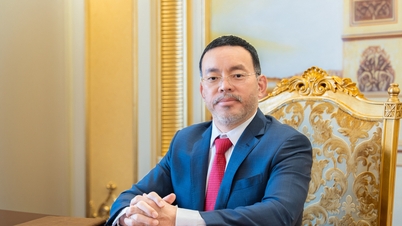
According to Dr. Cu Ngoc Phuong, Head of the Department of Political Theory at Nguyen Tat Thanh University, in the era of the knowledge economy and the new industrial revolution, backwardness, ultimately, is not just a technological gap, but more fundamentally, a backwardness in thinking capacity, creative capacity, and the ability to organize social life using knowledge.
A country can import machinery, adopt technology, and even borrow management models; but it cannot borrow the creativity, scientific spirit, and intellectual prowess of its people.
Therefore, education and training in general, and higher education in particular, must become the place where the nation's genuine development capabilities are formed, not just a mechanism for awarding diplomas or expanding the scale of training broadly.
According to Dr. Cu Ngoc Phuong, this requirement necessitates a shift in education from a mindset of "learning to complete the curriculum" to one of "learning to develop competencies"; from a passive learning model to a model of inquiry, creativity, and practical problem-solving.
A truly effective education is not measured primarily by the number of bachelors, masters, or doctorates, but by its ability to produce individuals with independent thinking, innovative skills, the capacity to adapt to technological changes, and a sense of responsibility towards the community.
"If knowledge is limited to memorization and reproduction, education will struggle to create national competitiveness. However, when knowledge becomes a capacity for action, research, and practical transformation, education truly becomes a driving force for national development," shared Dr. Cu Ngoc Phuong.
Regarding higher education specifically, Dr. Cu Ngoc Phuong emphasized the requirement that it cannot simply be a place for transmitting completed knowledge, but must be a center for generating new knowledge, where science is linked to technology, innovation is linked to the needs of social development, and learners are directly involved in the process of discovery, research, and practice.
Universities must contribute to training individuals who not only "know how to do things," but also have the ability to question, critically analyze, create, and lead future development. This is also a prerequisite for forming a high-quality workforce capable of helping Vietnam overcome the middle-income trap and enhance its self-reliance in global competition.
Only when education truly becomes the foundation of innovation and national intellectual development will knowledge transform into intrinsic strength, enabling the country to escape the risk of backwardness and rise to the group of advanced developed nations.
Source: https://giaoducthoidai.vn/de-giao-duc-thuc-su-tro-thanh-dong-luc-phat-trien-dat-nuoc-post778225.html
















































































Comment (0)