

"Shifting" all the pressure of innovation onto the shoulders of students.
Professor Le Anh Vinh, Director of the Vietnam Institute of Educational Sciences (Ministry of Education and Training), believes that the English and Mathematics subjects in the high school graduation exam raise a serious question: When students are confused, teachers are bewildered, and society reacts, is the fault with the learners and the teachers? He argues that connecting mathematics to real-world applications is a positive direction; strengthening reading comprehension in English is necessary to develop language skills; and differentiating exam questions for university admissions is entirely justified. “But if these correct approaches are implemented in a way that leaves many students stunned during the graduation exam, then that approach may not necessarily be right,” Professor Vinh said.
 |
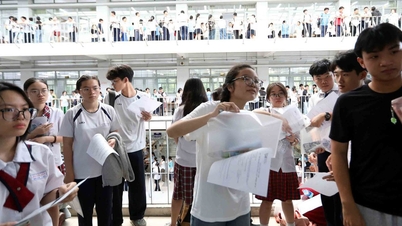
Timely encouragement from parents helps students feel confident after the exam. Photo: DUY PHAM |
Professor Le Anh Vinh recalled his first experience designing exam questions. He enthusiastically included two excellent and novel problems, but none of the participating students could solve them. “That’s when I understood that creating good, new, and unique questions isn’t difficult. The challenge lies in creating questions that are appropriate. The problem today is similar. It’s not because the students are weak or the teachers are incompetent, but because the exam questions are far beyond the curriculum and detached from the reality of teaching and learning. Students learn according to a specific path, practice according to a certain logic, but are tested in a way they have never prepared for. That’s unfair, especially in a mass exam like this,” Professor Le Anh Vinh lamented.
Dr. Tran Nam Dung, Vice Principal of the High School for the Gifted (Vietnam National University Ho Chi Minh City), believes that teaching and learning in high schools have not yet met the requirements of the 2018 curriculum reform. Therefore, the school organizes training sessions, assigns tasks to subject teacher groups, and conducts more classroom observations to provide feedback to teachers. The school sets KPIs for digital lesson plans, experiential activities, and assessment in accordance with the new curriculum.
He stated that the math exam was long, with many "practical" problems that were unfamiliar to him. The English exam demanded vocabulary and reading speed exceeding the standard output. Students didn't react because the exam was difficult, but because it didn't resemble what they had learned. We can demand more from teachers and students. But we cannot ignore the fact that if an exam confuses even diligent, consistent students, then the problem is no longer with the learners.
Education should not be a place where all the pressure of innovation is dumped onto students' shoulders. Reform is necessary, but it must be timely and appropriate. Innovation is not a race to overcome obstacles, but a journey of companionship. Even the most modern graduation exam should only serve as a bridge between what exists and what needs to be achieved. If we turn it into a wall, we may be going against the philosophy of student-centered education.
A good exam doesn't need to be easy, but it needs to be appropriate. Appropriate means that average students can achieve their graduation goals. Appropriate means that above-average students have the opportunity to demonstrate their efforts. Appropriate means that gifted students can shine according to their abilities. Appropriateness means reducing the ego and willfulness of the exam setters, putting themselves in the students' shoes to understand how they are being taught, and ensuring that no one is left behind simply because of an "overly innovative" exam. Because a reform that ignores the students is a reform that fails from the very beginning. If you are truly concerned about the students, start by listening to them.
A critical "break point".
Dr. Sai Cong Hong, from the Association of Vietnamese Universities and Colleges, assessed that the graduating class of 2025 is the first cohort to have completed the entire 2018 general education curriculum at the high school level, but lacks sufficient foundational preparation at the lower secondary level. Accessing foundational knowledge through the digital environment faces many obstacles, making it difficult for students to fully compensate for the core content necessary for the new high school curriculum.
The new curriculum focuses on developing students' qualities and competencies – a relatively new approach in teaching practice. Although teachers have received training in this innovative direction, the transition from a content-based approach to a competency-based approach is still in a transitional phase. Teachers need more time to adjust and adapt to the new approach, especially since old professional habits are still prevalent.
Another notable discrepancy lies in the inconsistency between school-based assessment methods and the high school graduation exam. For many years, teachers have constructed periodic tests according to Circular 22 (regulations on the assessment of junior and senior high school students by the Ministry of Education and Training ) based on a fixed test matrix and detailed test specifications, ensuring coverage of content, difficulty levels, and suitability to the learning objectives. Conversely, the 2025 high school graduation exam uses a random test matrix, leaving teachers without a solid basis for guiding exam preparation.
In the absence of coordinated preparation, rapid changes in exam question design risk shocking both teachers and students. When exam requirements exceed the adaptability of the teaching staff and learners, instead of promoting reform, this can lead to confusion, disorientation, and a negative reaction throughout the system. The gap between curriculum requirements, teaching practices, assessment methods, and graduation exam formats has not been narrowed, creating a serious "break point" in the educational system. In particular, the significant differences between sample questions and official exams further increase confusion and anxiety among both teachers and students.
Dr. Sai Cong Hong believes that a comprehensive and systematic solution package is needed. The exam should return to its original purpose of assessing graduation eligibility, prioritizing basic-level questions to ensure that average students can achieve a minimum score. A clear separation between the high school graduation exam and the university entrance exam is also necessary.
The question-building process should be based on a standardized question bank, with practical testing for difficulty and discrimination. Software should only be used as a supporting tool and cannot replace independent professional review. Each question in the exam must be controlled by clear specifications regarding its objectives, competencies, difficulty level, and assessment skills.
He emphasized the need for transparency in the exam question development process and consistent information from the Ministry of Education and Training. Teachers and students must be provided with clear guidance and adequate preparation time. Policies for educational reform must go hand in hand with adjustments to assessment. While the curriculum aims to develop competencies, teaching and testing must create conditions for learners to practice and demonstrate those competencies effectively.
The 2025 high school graduation exam is not just a single test, but reflects a comprehensive picture of the education system during this transitional period. Mr. Sai Cong Hong argues that the exam exceeding the general education level is not simply a technical error, but a consequence of a series of shortcomings ranging from awareness and procedures to policy communication.
Source: https://tienphong.vn/de-kho-lech-pha-giua-hoc-va-thi-post1757206.tpo
![[Photo] General Secretary and President To Lam meets with National Assembly delegates from ethnic minorities.](https://vphoto.vietnam.vn/thumb/1200x675/vietnam/resource/IMAGE/2026/04/20/1776696701056_a1-bnd-8331-3342-jpg.webp)

![[Image] National Assembly discusses the implementation of the socio-economic development plan.](https://vphoto.vietnam.vn/thumb/1200x675/vietnam/resource/IMAGE/2026/04/20/1776696707422_ndo_br_img-20260420-185419-jpg.webp)



























































































Comment (0)