

SGGP
It is crucial to quickly establish strong cooperatives capable of proactively supporting and responding to challenges, generating added value based on the efficient exploitation of scientific and technological resources, innovation, and digital transformation. Developing a multi-valued, integrated fruit industry is a sustainable path to prevent fruit growers from repeating the cycle of "laughter and tears."
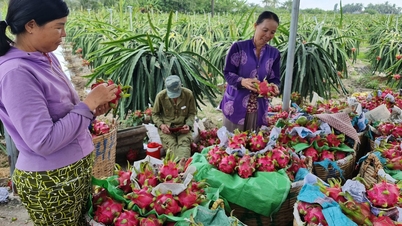
The three provinces of Binh Thuan, Tien Giang, and Long An have the largest dragon fruit growing area in the country, with over 45,000 hectares, accounting for 82% of the total area and 90% of the total production. However, while the entire Vietnamese fruit industry is experiencing record export growth of over 78% compared to the same period last year, this "king" fruit, which once helped many farmers become wealthy, is now facing plummeting prices and loss of market share. Dragon fruit growers have experienced both joy and sorrow.
Currently, the practice of farmers cutting down dragon fruit trees is occurring in many places. The "dragon fruit kingdoms" of Binh Thuan, Tien Giang, and Long An have each seen a reduction of several thousand hectares in their dragon fruit cultivation. Vietnam's dragon fruit export value has fallen from $1.27 billion in 2018 to less than $600,000 today.
Meanwhile, China, which accounts for 90% of Vietnam's dragon fruit exports, has expanded its dragon fruit growing areas and surpassed Vietnam's. The country has also implemented strict controls on dragon fruit imports, reducing and eliminating unofficial trade channels while increasing official imports.
The lessons learned from sugarcane's "bitter" prices; the flooding of markets for pepper, cashew nuts, and citrus fruits; and the plight of onions, sweet potatoes, and watermelons awaiting "rescue" have all happened before. Just last year, dragon fruit was ranked first among the 14 key national fruits under the Ministry of Agriculture and Rural Development's investment plan for developing key fruit-growing areas, but now its price has plummeted. This raises the question of how to sustainably develop this potentially lucrative industry. A comprehensive approach, multi-sectoral coordination, and inter-sectoral solutions are needed for the sustainable development of the dragon fruit industry in particular, and the fruit and vegetable industry in general, in the future.
According to the Ministry of Agriculture and Rural Development's export plan, the entire fruit industry will achieve an export turnover of 5 billion USD by 2025. However, this year, fruit exports are likely to reach this figure, exceeding the plan by two years, but dragon fruit exports are currently moving in the opposite direction. We have a plan for growing areas, a project for developing the processing industry, including fruit processing, and identifying export markets. However, these three aspects need to be integrated.
The requirements extend beyond investing in the development of raw material areas, traceability, improved varieties, and cultivation methods; it is also crucial to enhance the quality of linkages and cooperation between farmers and businesses. For the factors in the fruit value chain in general, and dragon fruit in particular, to be effectively linked, strict standards and regulations must be ensured. A well-organized, substantive production chain is needed, encompassing the growing region, packaging facilities, plant quarantine processing facilities, and export businesses, in order to create high-quality products that meet plant quarantine and food safety standards.
Competitive challenges for businesses, cooperatives, and farmers are increasing; the responsibility of agencies responsible for formulating mechanisms, policies, laws, and setting quality standards to meet market demands is growing. There is a need for competitive "technology," product diversification, brand building, and the simultaneous promotion of exports and development of domestic distribution channels. Investment in the development of deep processing of fruit products is also crucial.
Furthermore, it is necessary to develop policies to support businesses, cooperatives, and farmers in accessing markets, capital, purchasing machinery, consolidating land, and applying technology to develop in a professional direction, increase production scale, and participate in cooperatives and link with businesses in value chains. Improve the quality of vocational training; the level and effectiveness of research, application, transfer of science and technology, and innovation.
It is crucial to quickly establish strong cooperatives capable of proactively supporting and responding to challenges, generating added value based on the efficient exploitation of scientific and technological resources, innovation, and digital transformation. Developing a multi-valued, integrated fruit industry is a sustainable path to prevent fruit growers from repeating the cycle of "laughter and tears."
Source


![[Photo] General Secretary and President To Lam receives Amazon's Senior Vice President David Zapolsky](https://vphoto.vietnam.vn/thumb/1200x675/vietnam/resource/IMAGE/2026/05/22/1779466547770_a1-bnd-3513-6601-jpg.webp)

















































































Comment (0)