

According to the astronomy tracking website Time and Date, people in Vietnam will see the April new moon at 6:51 PM on April 17th.
This is a great opportunity to observe the Lyrids, a meteor shower named after the Latin "Lyra" of the constellation Lyra, which is closest to where the meteors originate in the sky.
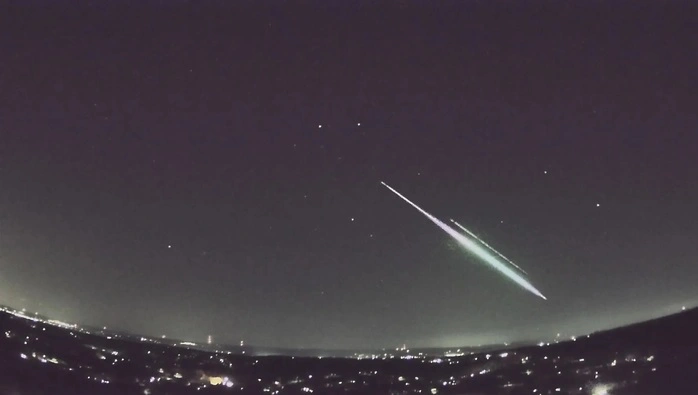
A Lyrids fireball appeared in the sky over Northford County, Connecticut, USA in 2023. The new moon in April 2026 will provide an exciting opportunity for astronomy enthusiasts to observe and photograph similar moments - Photo: AMERICAN ASTRONOMICAL SOCIETY
This year, the first Lyrid meteor showers began falling on April 14th, with the frequency increasing day by day.
On the night of April 22nd and the early morning of April 23rd, the Lyrids meteor shower will reach its peak, with up to 18 meteors appearing per hour.
The Lyrids' true origin is Thatcher, a comet that orbits the Sun with a period of up to 415 years. However, every year, Earth passes through the rocky, dusty tail it leaves behind, causing debris to fly into the atmosphere and create meteors.
Some debris in Thatcher's comet tail was quite large, causing Lyrids to occasionally release fireballs.
Unlike meteors, which are faint and fleeting, "fireballs" create extremely bright streaks of light across the sky, lasting for extended periods and sometimes leaving trails of smoke and dust that persist for several seconds.
On the night of April 17th, the meteor shower will still be sparse. But the densest darkness of the new moon will give you a chance to clearly observe even the faintest meteor trails. And if a fireball appears, it will be incredibly brilliant.
Of course, you can also observe it starting tonight, April 16th, when the crescent moon will be just a very thin strip of light.
Even on the night of the 22nd and the early morning of the 23rd, the moonlight was still faint enough not to significantly affect the observation of the Lyrids' peak night.
According to the Nguoi Lao Dong newspaper.
Source: https://baocantho.com.vn/dem-mai-cho-don-cau-lua-thien-cam-ruc-sang-duoi-trang-non-a202269.html

![[Image] Hanoi's urban life under the challenge of a "scorching hot" environment](https://vphoto.vietnam.vn/thumb/1200x675/vietnam/resource/IMAGE/2026/05/25/1779706979265_nang-nong-t5-2026-minh-duy-7-4636-jpg.webp)


![[Image] Close-up view of the interchange connecting the two expressways and Long Thanh Airport.](https://vphoto.vietnam.vn/thumb/1200x675/vietnam/resource/IMAGE/2026/05/25/1779703378210_ndo_br_z7863716673926-224453a31600126cce10622af6290afd-4549-jpg.webp)


























































































Comment (0)