

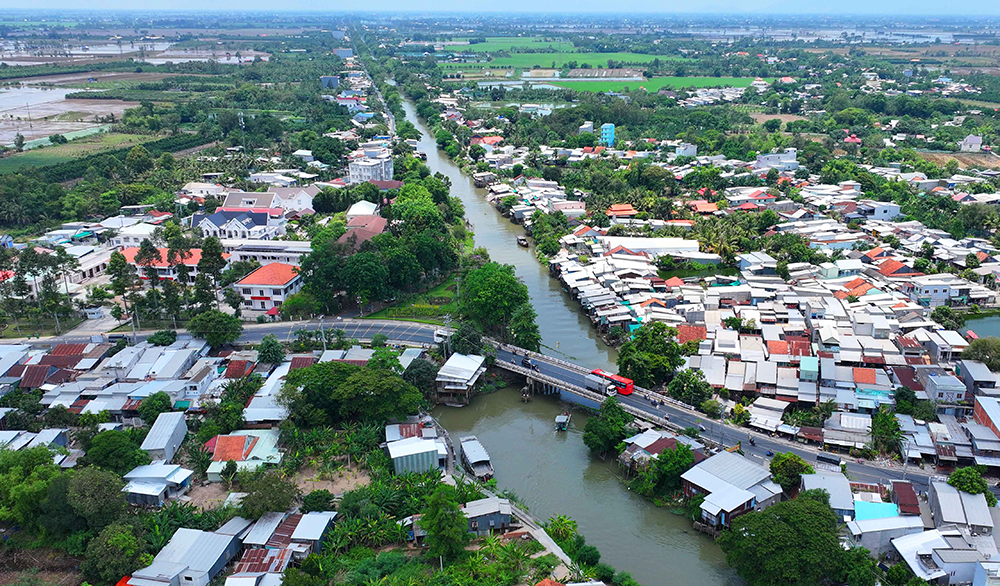
Viewed from above, the bridge spanning National Highway 91 resembles the letter S at the beginning of the canal.
Populous
At the scientific conference on the history of land reclamation in the Long Xuyen quadrilateral from the beginning of the 18th century to the present, Professor Tran Thi Mai (University of Social Sciences and Humanities) informed that after April 30, 1975, irrigation work was given importance by the provincial governments in the Long Xuyen quadrilateral region to exploit land and water resources. In An Giang, the project began with the construction of Canal 10 in Chau Phu, funded by the provincial budget, from November 1976 to December 1978. The canal is over 20km long, 20m wide, and has an average depth of 2.5m. The canal starts from the S-shaped bridge, connecting the Lo Te canal (Tri Ton district) at Iron Bridge No. 10 (Chau Thanh district), becoming the border between four localities: Chau Thanh, Chau Phu, Tri Ton, and Tinh Bien town.
To explore this canal, at dawn, from National Highway 91, we followed a rural road, running straight through the fields of Lang Linh area. In the past, the road along the canal was a dirt road, dusty in the dry season and muddy in the rainy season, making it difficult to travel, so people had to use boats and canoes to get around.
At this moment, farmer Nguyen Van Thanh (71 years old, residing in Thanh My Tay commune, Chau Phu district) is tending to his young green rice seedlings on his 20-acre plot. He recounts that before the canal was built, this place was very desolate! The villagers mainly grew floating rice. During the flood season, the rice grew wherever the water rose. When the floodwaters receded, the villagers harvested the rice simultaneously. Every household brought out their tools to the fields to thresh the rice, creating a bustling, festive atmosphere. Each acre yielded a few bushels, enough to eat for the whole year, with little surplus to sell like now.
But after liberation, the State dug an S-shaped canal running through the fields, bringing fresh water to the inland areas. Farmers boldly switched to cultivating the "Thần Nông" rice variety, with two harvests per year. "Back then, the water reached deep into the fields, and I had a bumper crop of rice. 20 acres yielded 600 bushels. For the first time in my life, my family had such a successful rice harvest. At that time, we used less fertilizer and pesticides than now, yet the rice still grew well," Mr. Thanh happily recounted. From then on, houses were built in this remote field, and people came to settle and start businesses. The lives of the people in the field gradually changed, creating the prosperous life we see today.
The important canal
Continuing our journey deeper into the Đá Nổi area, we encountered farmers chatting in the shade of their fields. When asked about the role of this canal, Mr. Trần Văn Hùng (70 years old) recalled that everyone was overjoyed when they heard the government was preparing to dig the canal. Once completed, the canal would bring water to the fields, allowing farmers to cultivate two rice crops per year. “The canal regulates water flow from the Hậu River deep into the fields, helping farmers cultivate rice and facilitating smooth waterway transportation from An Giang to Hà Tiên ( Kiên Giang province). In addition, the S canal also provides drinking water for the people,” Mr. Hùng explained.
Currently, Mr. Hung is cultivating 40 acres of rice in two seasons. For the past few years, rice prices have been quite good, so his income has been stable. With surplus production, he continues to reinvest in cultivating rice in the summer-autumn season. When he reached 70 acres of rice paddies, he bought a tractor to prepare the land. Seeing that his neighbors needed their land leveled, he readily offered his services. From there, with the accumulated money, he invested in more rice paddies. “Now that I’m older, I’ve divided the land among my three children, giving each of them 10 acres. Last winter-spring season, I planted the Dai Thom rice variety, selling it for 7,200 VND/kg, with each acre yielding 1 ton. After deducting expenses, I pocketed over 150 million VND,” Mr. Hung happily shared.
Approaching the middle of the S-shaped canal (the section connecting to the Mac Can Dung canal, in Chau Thanh district), I met Mr. Nguyen Van Thanh (68 years old, residing in Vinh An commune, Chau Thanh district). He has lived here since childhood, so he knows the story of the canal's construction very well. Back then, this area was uninhabited; farmers would come to cultivate rice in the mornings and rush home in the afternoons because the fields were so deserted and desolate! When the canal was completed, farmers came and built houses close together. The muddy rural dirt road was later paved smoothly by the government, allowing vehicles to travel straight from the beginning to the end of the canal.
Pointing down to the canal, Mr. Thanh explained that the canal's most important function is water regulation. During years of major floods, boats and canoes crossing the canal frequently sink. "Before the floods, we always set up rescue teams at the sections where boats and canoes are often swept away by the floodwaters. After the S-shaped canal was completed, it regulates water flow to the sea during floods, reducing the pressure of the swirling water in the canal," Mr. Thanh said.
For decades, this S-shaped canal has continued to bring water from the Hau River to the fields for farmers' production. Along the canal, boats and canoes travel back and forth, carrying rice and goods for distribution far and wide, creating a vibrant scene in what was once a remote area.
| The S-shaped canal has two sections: the northern bank is Vinh Thanh Trung town, the southern bank is Cai Dau town (Chau Phu district), and its end point connects with the Rach Gia - Ha Tien canal. The canal has two sections: Section 1, from the Hau River through Chau Phu district (20km long), intersects with the Mac Can Dung canal at Bridge No. 10 (Provincial Road 941), hence it is also called Canal 10. Section 2 (19km long) goes straight from Bridge No. 10 through Tan Tuyen commune (Tri Ton district), connecting with the My Thai canal, and continuing to the Rach Gia - Ha Tien canal. From 1990 to 2002, the S-shaped canal was dredged by the government and people using excavators, and the soil was used to build embankments on both sides of the canal, thus making the canal deeper and wider. |
Source: https://baoangiang.com.vn/di-qua-dong-kenh-chu-s-a419907.html









![[Photo] Prime Minister Pham Minh Chinh attends the Conference on the Implementation of Tasks for 2026 of the Industry and Trade Sector](/_next/image?url=https%3A%2F%2Fvphoto.vietnam.vn%2Fthumb%2F1200x675%2Fvietnam%2Fresource%2FIMAGE%2F2025%2F12%2F19%2F1766159500458_ndo_br_shared31-jpg.webp&w=3840&q=75)























































Comment (0)