

In the context of rapidly changing information access behaviors, especially in the digital environment, the question is no longer "does heritage exist?", but rather how heritage can be seen, understood, and cherished in contemporary life.
Innovate your approach.
The digitization of heritage sites is evident at many familiar destinations in Hanoi . At Thang Long Imperial Citadel, visitors can explore the historical space through VR360 technology or watch 3D mapping projections recreating the history of "Thang Long Capital". At the Temple of Literature - National University, night tours utilize interactive technology, allowing viewers not only to hear but also to "touch" the ancient knowledge. The Hanoi Museum has integrated digital screens and animated images to enhance the visual experience for visitors…
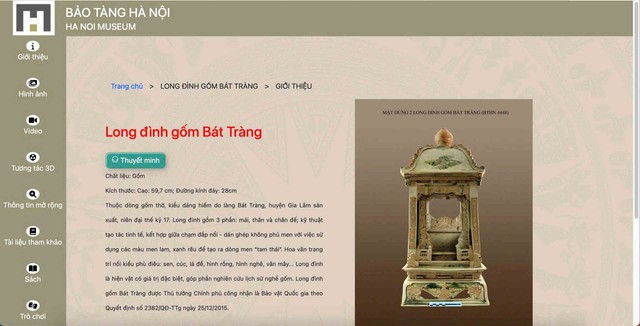
The Bat Trang ceramic pavilion is digitized in 3D at the Hanoi Museum.
PHOTO: SCREENSHOT
Ms. Nguyen Thi Huong, Deputy Head of the Exhibition and Propaganda Department of the Hanoi Museum, said that the museum is promoting the application of digital technology in its exhibition spaces to help the public, especially young people, access heritage in a more visual and interactive way.
According to Ms. Huong, in addition to the static display system, the museum integrates multimedia search screens so that visitors can learn more about the artifacts and related information with just a touch and swipe on the screen. "Viewers can not only look at the artifacts in the display cases but also search for a lot of related information on the multimedia system," she shared.
In addition, many exhibition spaces are supplemented with videos , documentaries, and interviews with artisans and experts to help viewers better understand the crafting process, historical stories, and values behind the artifacts.
Beyond existing applications, the Hanoi Museum is also developing a "digital exhibition" system, allowing the public to visit online via its website with complete information about artifacts, 3D and 4D images. Simultaneously, the museum is developing a multilingual audio guide integrated with QR codes so visitors can listen to automated explanations instead of traditional guided tours.
Through these changes, Hanoi's heritage is gradually being retold in a more visual and accessible way to younger audiences through interactive digital formats. Technology not only supports exhibitions but also contributes to changing how the public accesses, remembers, and experiences history.
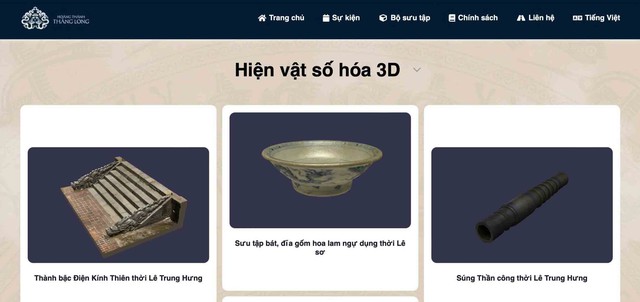
3D digitized artifacts at Thang Long Imperial Citadel allow the public to observe details and interact online on a digital platform.
PHOTO: SCREENSHOT
The initial effectiveness of digitalization has been evident both in the physical world and on social media. Many videos showcasing Hanoi's heritage sites have attracted hundreds of thousands of views, drawing in young visitors who come to explore and share their experiences.
Open data, connect innovation.
Beyond simply applying technology at historical sites, Hanoi is aiming to build an open digital media ecosystem where management agencies, heritage units, and the creative community can work together to spread cultural values. Recently, speaking at a meeting with content creators organized by the Hanoi Department of Culture and Sports in collaboration with MCN Company to connect and promote Hanoi's heritage, the Director of the Hanoi Department of Culture and Sports, Pham Tuan Long, emphasized that for culture to truly "live" in contemporary life, especially in the digital environment, the force of content creators – those who directly recount and spread heritage values using the language of the times – is indispensable.
According to Mr. Long, Hanoi will focus on innovating the way cultural storytelling is presented in a modern way, suitable for each audience group; while also expanding data and creating conditions for filming and content creation in cultural spaces.
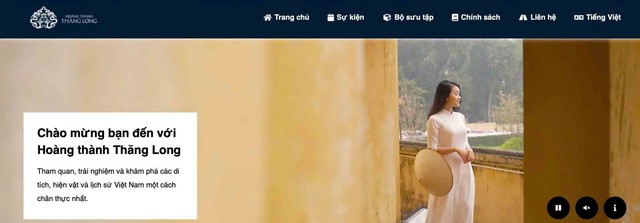
Digital footage of Thang Long Imperial Citadel takes the public on a journey to explore and experience the heritage site in a visual and engaging way.
PHOTO: SCREENSHOT
From the perspective of young content creators, the Long Khoa Hoc group – founders of the "Hello Vietnam" channel and many other platforms promoting culture and history on social media – believes that the appeal of Hanoi's heritage stems from a change in storytelling and approach. According to the Long Khoa Hoc group, young people are increasingly interested in identity and roots, so content about heritage has become a way for them to "connect" with their own cultural identity. "For Hanoi's heritage to not only spread online but also inspire young people to experience it firsthand, content needs to be guided by stories, emotions, and relatable perspectives," a representative of the group shared.
Great opportunities, but also many challenges.
From a professional perspective, tourism expert Le Trung Thu, Director of Viettourist Hanoi Tourism Company and lecturer in tourism and travel service management at FPT Polytechnic College, believes that digitalization is creating a shift from "static displays" to "interactive experiences".
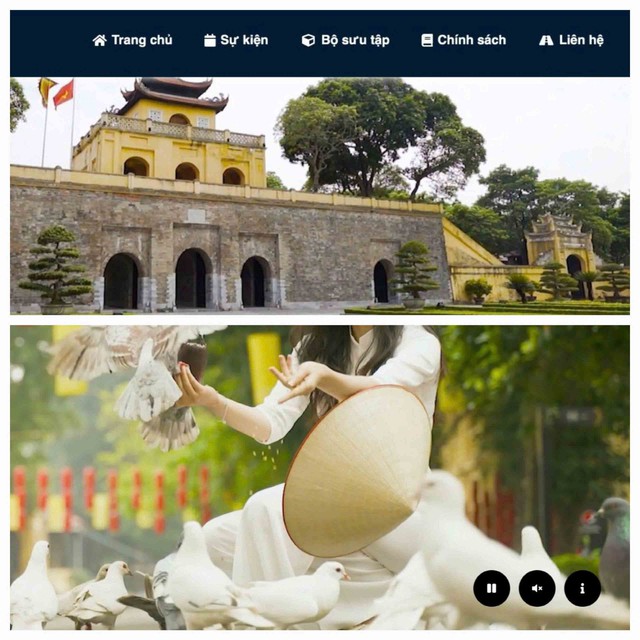
The videos guiding viewers on a journey through the Thang Long Imperial Citadel are helping to bring the heritage closer to the public in the digital environment.
PHOTO: SCREENSHOT
According to Mr. Thu, digitalization not only creates a media effect but also forms new tourism products. However, if it only stops at check-in without depth, the effect will be short-lived. "Technology is a tool, not a replacement for real experiences. The real value lies in the ability to transform into experiences and tourism products," he emphasized.
Meanwhile, Mr. Nguyen Ngoc Doanh, a French-speaking tour guide with nearly 30 years of experience, believes that digitalization is the right direction for conservation, but the effectiveness of tourism exploitation is not yet uniform.
According to Mr. Doanh, digital experiences are more suitable for individual travelers or independent international tourists. "For large groups, stopping to scan QR codes or watch VR is impractical. Tourists still prefer authentic experiences – history, culture, and local life," he said.
Source: https://thanhnien.vn/di-san-ha-noi-cham-den-gioi-tre-bang-cong-nghe-so-185260505212051971.htm

![[Image] Hanoi's urban life under the challenge of a "scorching hot" environment](https://vphoto.vietnam.vn/thumb/1200x675/vietnam/resource/IMAGE/2026/05/25/1779706979265_nang-nong-t5-2026-minh-duy-7-4636-jpg.webp)



![[Image] Close-up view of the interchange connecting the two expressways and Long Thanh Airport.](https://vphoto.vietnam.vn/thumb/1200x675/vietnam/resource/IMAGE/2026/05/25/1779703378210_ndo_br_z7863716673926-224453a31600126cce10622af6290afd-4549-jpg.webp)































































































Comment (0)