

Current salary scale
According to the Law on Cadres and Civil Servants, a job position is a job associated with a title, position, structure, and civil servant rank to determine the staffing and placement of civil servants in an agency, organization, or unit.
Furthermore, the Law on Public Employees stipulates that a public employee's job position is a job or task associated with a corresponding professional title or managerial position, serving as the basis for determining the number of employees and the structure of public employees for recruitment, employment, and management within public service units.
According to Circular 10/2023/TT-BNV, the salaries of civil servants, public employees, and members of the armed forces are calculated using the formula: Salary = Base salary x Salary coefficient.
The current basic salary according to Decree 24/2023/ND-CP is 1.8 million VND/month.
Currently, according to Article 3 of Decree 204/2004/ND-CP, salaries and allowances for leadership positions are determined according to the following principles:
Officials, civil servants, and public employees appointed to a particular civil servant or public employee rank or professional/technical title will have their salaries determined according to that rank or title.
Officials holding elected positions who are subject to professional and technical salary classifications and receive leadership allowances shall have their salaries classified according to the administrative civil servant grades and levels, and shall receive leadership allowances corresponding to the elected position they currently hold.
Officials, civil servants, and public employees holding leadership positions shall have their salaries or allowances determined according to those leadership positions.
Thus, currently, the management and leadership levels of many agencies are being paid according to the administrative civil servant salary scale and grade, and also receive additional leadership position allowances.
In principle, salary payments must be linked to the performance of officials, civil servants, and public employees, and to the source of salary payment (from the state budget or support, and from other revenue sources as stipulated by law used for salary payments) of the agency or unit.
The five currently applied salary scales include: 1. Salary scale for senior experts; 2. Salary scale for professionals and civil servants in state agencies (including elected officials whose salaries are classified according to administrative civil servant grades and receive leadership allowances, and civil servants in communes, wards, and towns); 3. Salary scale for professionals and employees in state-owned enterprises; 4. Salary scale for support and service staff in state agencies and state-owned enterprises; 5. Salary scale for full-time officials in communes, wards, and towns.
Salary scale by job position effective from July 1st.
According to Resolution 27 of 2018 of the Central Committee and Resolution 104 of 2023 of the National Assembly , the new salary structure for civil servants and public employees when implementing salary reform is calculated as follows:
Salary = Basic salary (70% of total salary fund) + Allowances (30% of total salary fund). In addition, there is an extra bonus.
The State will establish a new salary scale based on job positions, titles, and leadership roles, specifying monetary amounts. A new salary system based on job positions, titles, and leadership roles will be issued to replace the current system. The new salaries will be developed and applied with the principle of ensuring they are not lower than the current salaries.
The two new salary scales based on job positions include a position-based salary scale applicable to officials, civil servants, and public employees holding leadership positions; and a professional and technical salary scale based on civil servant ranks and professional titles applicable to all civil servants and public employees who do not hold leadership positions.
Thus, it can be seen that the salary reform from July 1st will create two new salary scales based on job position, title, and leadership role, replacing the current system of five salary scales for civil servants and public employees.
These salary scales are based on specific figures, not on base salaries and salary coefficients, and are no longer based on a uniform system as before.
Paying salaries based on job position means determining the specific salary for each individual based on their job title, position, and organizational structure within the civil service.
Source
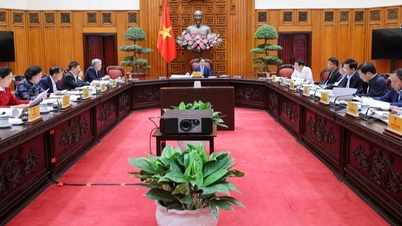
![[Photo] Prime Minister Pham Minh Chinh presides over a meeting on private sector economic development.](/_next/image?url=https%3A%2F%2Fvphoto.vietnam.vn%2Fthumb%2F1200x675%2Fvietnam%2Fresource%2FIMAGE%2F2025%2F12%2F20%2F1766237501876_thiet-ke-chua-co-ten-40-png.webp&w=3840&q=75)































































































Comment (0)