

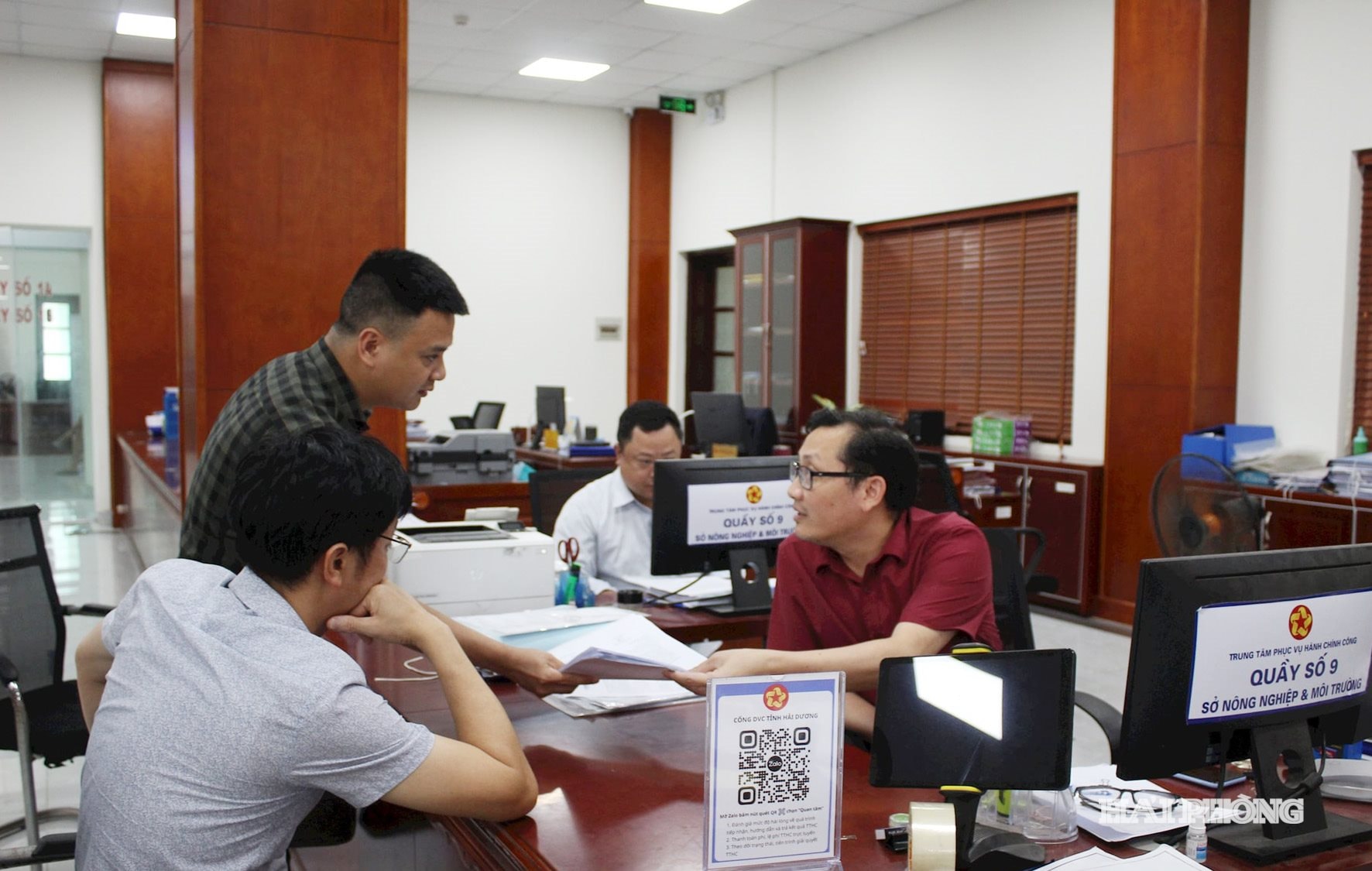
The Ministry of Interior is drafting a Decree regulating the job positions of civil servants, expected to take effect from March 1, 2026. The core new point of the draft is that all requirements for civil servants will be standardized into a unified competency framework, assessed at five levels. This will be the direct basis for reforming recruitment, employment, training, evaluation, and salary payment based on job positions, replacing the current egalitarian mechanism.
According to the draft, the Government will issue six framework job position categories to be applied uniformly throughout the system from the central to the commune level, including 95 leadership and management positions at central and provincial agencies; 637 specialized professional civil servant positions; 60 general professional and technical positions; 22 support and service positions; 92 positions at the offices of the National Assembly delegation and the People's Council at the provincial level; and 45 positions at the commune, ward, and special zone levels.
From these lists, each agency will develop a job description and competency framework for each position, from head, deputy, head of advisory team, secretary, assistant, senior expert to senior expert, chief expert, specialist, officer, staff and commune-level civil servant.
Each job description must clearly state the objectives, specific tasks, evaluation criteria, internal and external working relationships, scope of authority, working conditions, and required qualifications, experience, and character. Depending on the position, the tasks and authority will vary, but they must all be clear to avoid overlaps and omissions.
In terms of general competence, all civil servants, regardless of leadership or expertise, must meet seven groups of requirements: ethics and integrity; work organization and implementation; drafting and issuing documents; communication and conduct; collaborative relationships; use of information technology; and foreign language proficiency. Each criterion is divided into five levels, from lowest to highest.
For example, regarding ethics and competence, the lowest level requires responsibility for assigned tasks and maintaining standards in performing duties; the highest level is the ability to build a culture and lead the implementation of ethics and competence within the organization. With information technology, the lowest level is the ability to use computers and basic software; the highest level is in-depth understanding and the ability to program specialized software.
In addition to general capacity, civil servants must also meet professional capacity with 5 requirements on advising on the development, appraisal, guidance, inspection and organization of document implementation. This capacity is assessed from level 2 to level 5. At the lower level, civil servants participate in the development of specific documents as assigned; at the highest level, they preside over research, develop documents within the scope of management, propose major projects of the industry and field.
The leadership and management team must also meet specific requirements for management capacity with 5 criteria including strategic thinking, decision making, change management, resource management and employee development. These criteria are also assessed according to 5 levels. For example, with employee development, the low level is sharing knowledge and expertise; the highest level is creating an environment for employees to develop comprehensively in skills and experience.
Agencies are allowed to proactively approve job positions, but must adhere to the goal of streamlining, reducing unnecessary positions, and merging positions with similar functions to make the apparatus more compact. Each position needs to have a clear job description, avoiding overlapping or missing tasks; the right person, the right standards, and digital transformation in job position management.
The draft also stipulates the ranking ratio for each position group. At ministries and ministerial-level agencies, the ratio of senior experts in specialized departments is a maximum of 40% of the payroll; at the staff department is no more than 30%; at the general staff office is 15%. At the local level, heads of specialized agencies at the provincial level can be ranked as senior experts; for deputies, this ratio does not exceed 50%.
For management positions such as heads, deputy heads of departments, branches and equivalent organizations, the proportion of those classified as senior specialists must not exceed 70%. For professional civil servants, the proportion of senior specialists must be a maximum of 50% in professional departments and no more than 30% in offices. At the commune level, heads, deputy heads and professional civil servants are classified as senior specialists at a maximum of 30%, the rest are specialists or lower.
The Ministry of Home Affairs requests that by December 31, 2026, ministries, ministerial-level agencies and People's Committees of provinces and cities must complete the approval of job positions. By July 1, 2027, units must complete the arrangement of civil servants and the corresponding ranks.
For civil servants who do not meet the requirements of the job position, the head will be temporarily assigned for up to 24 months to complete the standards. After this period, if they do not meet the requirements, they will be demoted to a lower rank, transferred to another job or downsized if there is no suitable position.
The project was built in the context of a large-scale streamlining of the administrative apparatus, when the Government for the 2021-2026 term has 14 ministries and 3 ministerial-level agencies, the whole country is reorganized from 63 provinces and cities to 34 and the number of commune-level units is reduced from more than 10,000 to 3,321.
Currently, the assessment of civil servant capacity is mainly through recruitment exams, tests and work processes, not closely linked to the capacity framework according to job positions. When the capacity framework is applied from 2026, the conditions for recruitment, use and salary payment of civil servants will shift to a competitive model based on position and actual capacity, creating a foundation for screening and improving the quality of the team.
PV (compiled)Source: https://baohaiphong.vn/cong-chuc-phai-dap-ung-khung-nang-luc-chuan-hoa-theo-vi-tri-viec-lam-529137.html
![[Photo] The captivating scenery of the fragrant maple forest in Quang Tri](/_next/image?url=https%3A%2F%2Fvphoto.vietnam.vn%2Fthumb%2F1200x675%2Fvietnam%2Fresource%2FIMAGE%2F2025%2F12%2F10%2F1765353233198_lan09046-jpg.webp&w=3840&q=75)


![[Photo] Explore the US Navy's USS Robert Smalls warship](/_next/image?url=https%3A%2F%2Fvphoto.vietnam.vn%2Fthumb%2F1200x675%2Fvietnam%2Fresource%2FIMAGE%2F2025%2F12%2F10%2F1765341533272_11212121-8303-jpg.webp&w=3840&q=75)


















![[Video] The craft of making Dong Ho folk paintings has been inscribed by UNESCO on the List of Crafts in Need of Urgent Safeguarding.](https://vphoto.vietnam.vn/thumb/402x226/vietnam/resource/IMAGE/2025/12/10/1765350246533_tranh-dong-ho-734-jpg.webp)





























































Comment (0)