

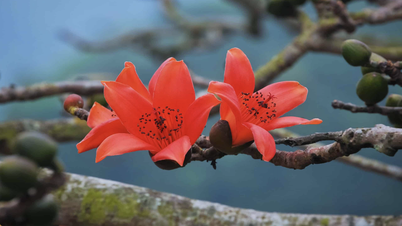
Tan Trach and Thuong Trach communes in Bo Trach district, Quang Binh province, are located deep within the core area of Phong Nha - Ke Bang National Park. Transportation is difficult, and access to the national power grid seems like a distant dream for the Bru Van Kieu people living there. However, today, a power line has crossed the forest and run underground, realizing the dream of bringing electricity from the national grid to the people here. Teaching both cultural knowledge and Khmer language and Pali to students, the Southern Intermediate Pali Cultural Supplementary School (located within the grounds of Kh'Leang Pagoda, Ton Duc Thang Street, Soc Trang City) is currently a training center for high-quality human resources, including monks and Khmer ethnic people from 9 provinces in the Mekong Delta. For the past 30 years, the school has contributed to developing high-quality human resources for the ethnic minority communities in the South. On the morning of March 26th, immediately after the official welcoming ceremony at the Government headquarters, Prime Minister Pham Minh Chinh held talks with Singaporean Prime Minister Lawrence Wong. For many years, the culvert connecting Tay village with the center of Duc Yen commune, Dam Ha district (Quang Ninh province) was designed to be deep under the stream, so every time there was heavy rain, traffic was completely cut off, causing people to fall into the stream. In a situation of "no one in, no one out." Now, the people in the highlands are extremely excited with the new bridges and culverts that are about to be completed, breaking the "isolation" during the rainy season! On March 26th, in Kong Chro district, the Gia Lai Provincial Women's Union organized a communication conference on "Safe Credit for Women" for 90 women, including branch leaders, core members, special women members, and ethnic minority women members in the district. In Kon Tum province, the number of measles cases has increased dramatically, and the local health sector is strengthening measles prevention and control efforts, aiming to complete full vaccination coverage for 95% of eligible individuals by March 2025. The Southern Intermediate Pali Cultural Supplementary School (located within the Kh'Leang Pagoda complex, Ton Duc Thang Street, Soc Trang City) teaches both cultural knowledge and Khmer Literature and Pali language to students. Currently, it is a training center for high-quality human resources, including monks and Khmer ethnic people from 9 provinces in the Southern Mekong Delta. For the past 30 years, the school has contributed to developing high-quality human resources for ethnic minority communities in the Southern region. After 4 years of contracting out 13,000 hectares of special-use forest to 16 communities for protection, in 2025, the Management Board of Chu Mom Ray National Park, Kon Tum province, will be unable to continue this program due to regulations in Circular 22, dated December 11, 2024, of the Ministry of Agriculture and Rural Development . This inability to continue contracting out has put these 13,000 hectares of forest at significant risk. This is a summary of news from the Ethnic and Development Newspaper. This afternoon's news bulletin (March 25th) includes the following noteworthy information: The enchanting pink blossoms of B'Lao; the stone church in Sapa; the vibrant colors of Bac Son; and other current events in the Mekong Delta region. Ethnic minority and mountainous areas. The Mang Den Market in Kon Plong district, Kon Tum province, is open from Friday afternoon to Sunday every week, attracting many tourists to visit, shop, and enjoy the unique cuisine and culture of the ethnic minority people. This is an indispensable destination for those who love this land. Responding to the movement to eliminate temporary and dilapidated houses for the poor and those with housing difficulties, the Yen Bai Provincial Youth Union has mobilized social resources to support the construction of houses for particularly disadvantaged families in the province. A summary of the Ethnic Minorities and Development Newspaper. The morning news on March 26th includes the following noteworthy information: Yen Bai has 260 rural road lighting lines. The "soul" of the Tay people in Phu Thien. Preserving traditional culture at Chroi Tum Chas Pagoda. Along with other current news in the ethnic minority and mountainous areas. According to statistics, Thanh Hoa province has 25 hydropower projects with a total capacity of 957.66 MW have been approved for planning. To date, 13 projects have been completed and are generating electricity, with a total capacity of 610.6 MW. To proactively manage reservoir operation and regulation, calculate flood forecasts, and ensure the safety of the structures and downstream areas, the Department of Industry and Trade of Thanh Hoa province has implemented disaster prevention and control measures at hydropower projects. Currently, most hydropower projects are operating safely, ensuring the safety of interconnected reservoirs and responding promptly to any unexpected situations. On March 25th, at the Youth Activities Center of Yen Bai province, the Yen Bai Provincial Youth Union organized a seminar commemorating the 50th anniversary of the Liberation of Southern Vietnam, a forum to meet young talents, and a ceremony to honor outstanding youth following Uncle Ho's teachings, awarding the "Red Bow" Prize for 2025.
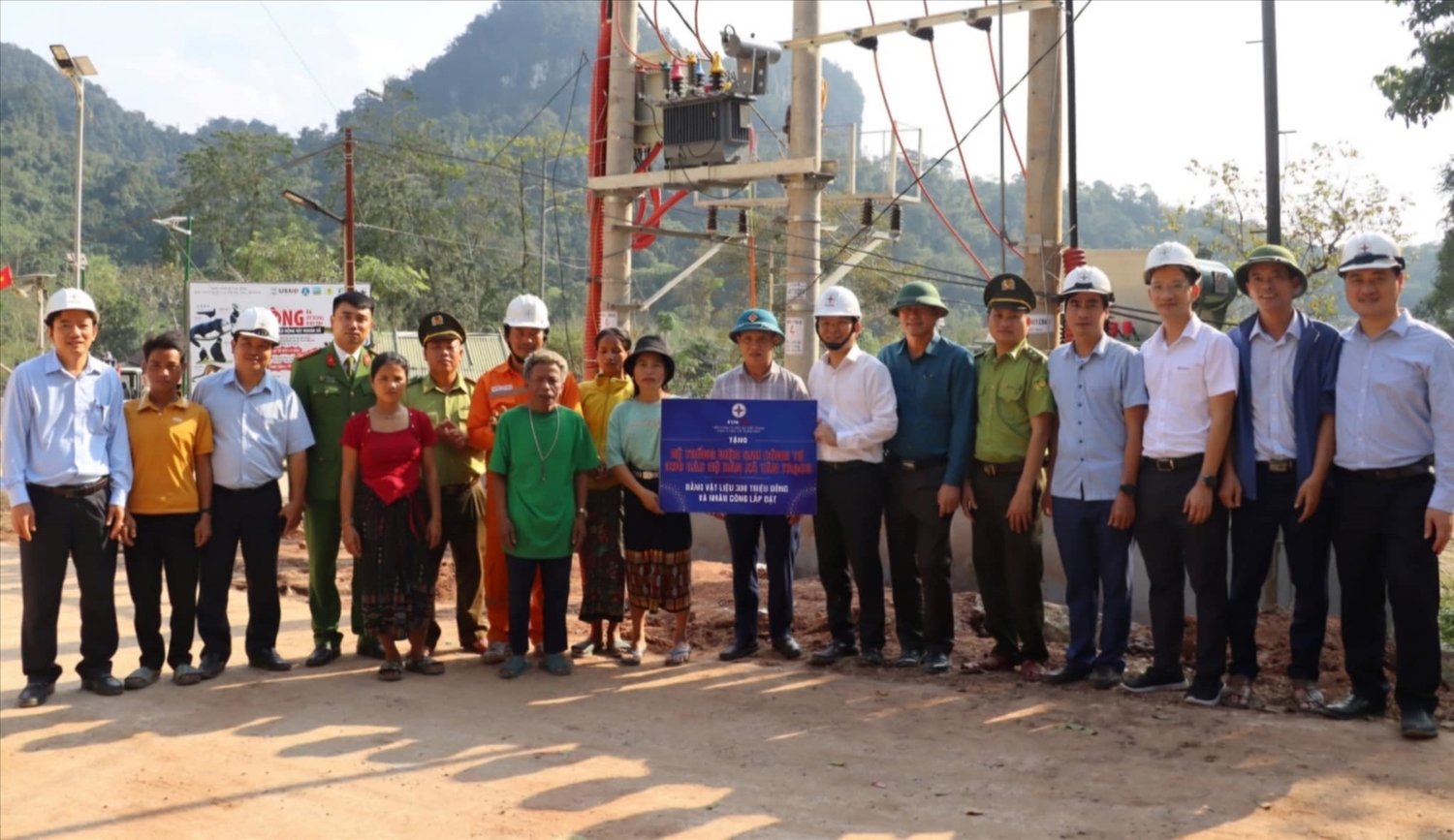
The arduous journey to bring electricity to the village.
Previously, the Bru Van Kieu people in Tan Trach and Thuong Trach communes (Bo Trach district) used oil lamps for lighting. Wealthier households and government offices used small generators or solar panels, which operated very unreliably, for electricity. When the sun set, darkness enveloped the villages of Tan Trach and Thuong Trach. The dream of one day having electricity for lighting, watching television, and for children to study always weighed heavily on the hearts of the Bru Van Kieu people.
Bringing the national power grid to Tan Trach and Thuong Trach to enable the Bru Van Kieu people to develop their socio-economic lives is a crucial political task. Recognizing this, the local government and the Quang Binh power sector have launched a bold and challenging project.
After years of surveying and planning, on June 14, 2022, the project to bring national grid electricity to the last two communes of Quang Binh province commenced. The project, which extends the national power grid to Tan Trach and Thuong Trach communes, is invested by the Department of Industry and Trade, with a total capital of 110 billion VND from the provincial budget, for the period 2021-2025.
Due to the rugged terrain, the power lines to Tan Trach and Thuong Trach had to cross steep slopes and deep ravines. Adding to the difficulty, 27.5 km of the power line passed through the core area of Phong Nha-Ke Bang National Park. To avoid impacting the park's ecological environment, the construction unit had to lay the power lines underground.
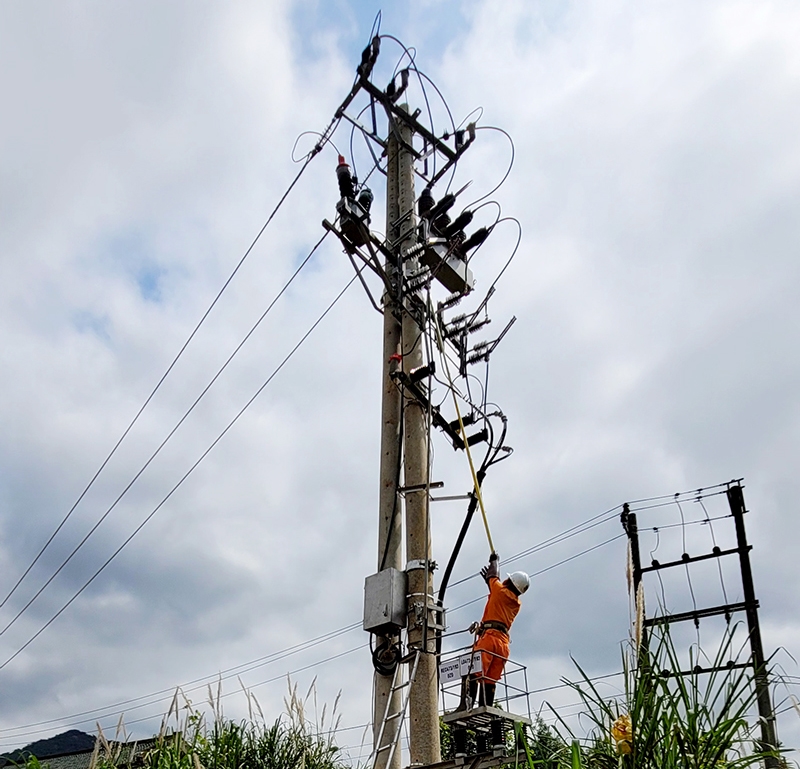
The work of transporting materials such as power poles tens of meters high, wires, transformers, etc., all had to be done by specialized trucks to the nearest point, and then carried into the village by human labor. The Bru Van Kieu people also lent a hand to support the construction team in many ways, such as bringing food and water, carrying cement, and hauling iron...
The journey to bring electricity to the village is no longer just an ordinary project, but has become a story of human connection in the Trường Sơn mountain range. A story of willpower and a burning desire to bring light to the village.
The dream of a power grid has become a reality.
After nearly two years of arduous construction, on February 6, 2024, the first phase of the national power grid project for the last two communes (Tan Trach and Thuong Trach) in Quang Binh province was completed. Phase II, involving the installation of power lines and substations, is also underway and is expected to be completed and energized in October 2024.
On the first night with electricity, the entire village was brightly lit, and cheers echoed everywhere. The arrival of the national power grid became a significant milestone in the socio -economic development journey of the Bru Van Kieu people in the two communes of Tran Trach and Thuong Trach.
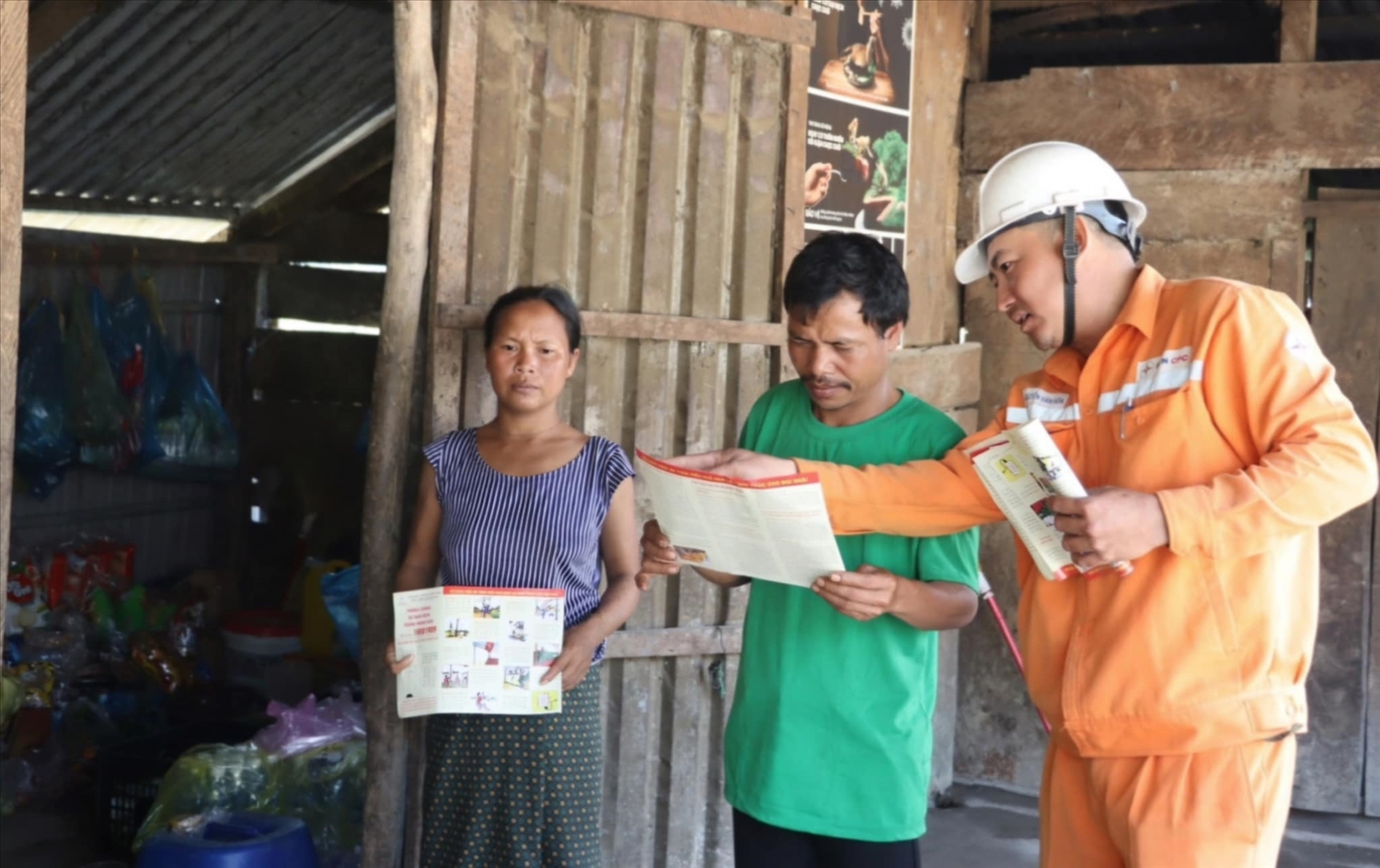
With 6 22/0.4kV substations, totaling 450kVA; nearly 45km of medium-voltage lines, including 27.5km underground through the core area of Phong Nha-Ke Bang National Park and 17.4km overhead lines; and nearly 8.2km of low-voltage lines. To date, the project has energized the main trunk line from outgoing line pole No. 141/72/192 (OZO) to Substation 61 at pole No. 141/72/356 (km 16+400 to km 62+560 Provincial Road 562) and 2 branch lines to Substation 51, Substation Ca Roong 1 and 2 in Thuong Trach commune.
In Tan Trach commune, electricity has been supplied to households in Arem village, the commune People's Committee office, and other administrative and public service agencies. In Thuong Trach commune, electricity has been supplied to the commune People's Committee office and the power grid has reached 8 villages (Ban village, But village, Ca Roong 1 and 2 villages, village 51, village 61, Khe Rung village, and Tuoc village).
Due to difficult economic conditions, Bru Van Kieu ethnic minority households in Tan Trach commune lacked the means to purchase power lines and post-meter equipment to bring electricity to their homes. The Central Vietnam Power Corporation and Quang Binh Power Company allocated over 300 million VND from their welfare funds to support investment so that the people could have access to electricity. In Thuong Trach commune, the Quang Binh Provincial People's Committee mobilized social resources to invest in post-meter equipment so that the people could have electricity as soon as possible.
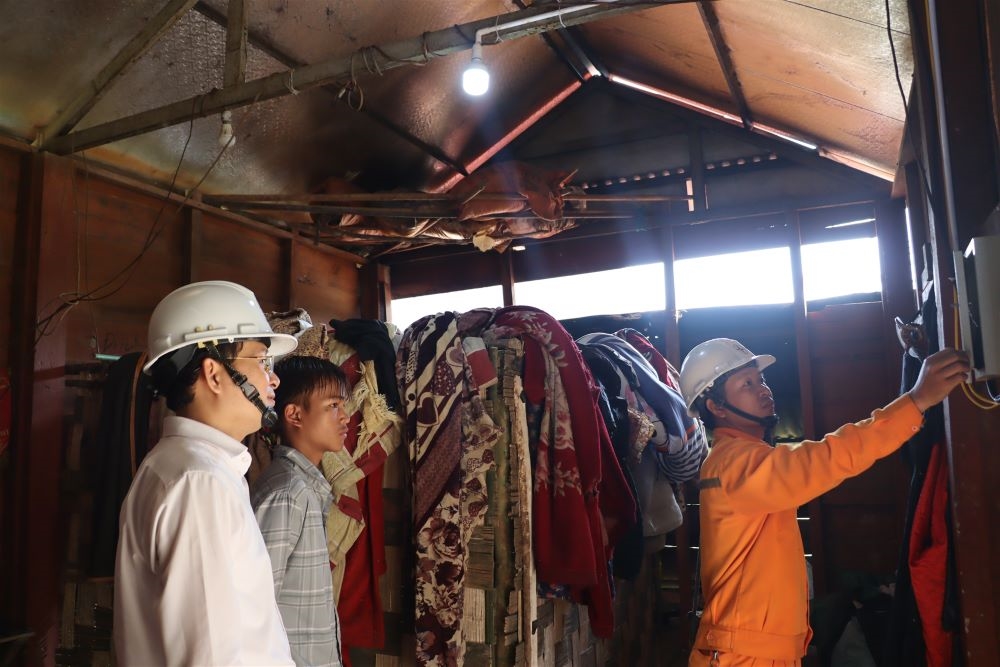
The arrival of the national power grid in the villages marks a major turning point in the socio-economic development of the two border communes of Tan Trach and Thuong Trach. With electricity, the Bru Van Kieu people in Tan Trach and Thuong Trach have more opportunities to access information and scientific and technical knowledge, thereby improving their awareness and skills in agricultural production.
With electricity now available, cultural and sports activities between the villagers and the border guards have become more frequent. Through these activities, the solidarity between the military and the people has become stronger, and the people's support has become more robust, contributing to the firm protection of national sovereignty.
Unable to hide her joy, Mrs. Y Tran, from Tan Trach commune, Bo Trach district, shared: “Many generations of people here have waited for this moment for a long time. The dream of having access to the national power grid has now come true. The villages are now brightly lit with electricity, and people are buying more machinery to serve production and develop the economy.”
Source: https://baodantoc.vn/dien-luoi-da-ve-with-dong-bao-bru-van-kieu-o-vung-sau-1742975566522.htm
![[Photo] Secretary of the National Assembly Party Committee, Chairman of the National Assembly presides over the meeting of the Standing Committee and Executive Committee of the National Assembly Party Committee.](https://vphoto.vietnam.vn/thumb/1200x675/vietnam/resource/IMAGE/2026/06/03/1780480353201_ndo_br_bnd-2585-jpg.webp)
![[Photo] General Secretary and President To Lam presides over a meeting with the Central Organizing Committee.](https://vphoto.vietnam.vn/thumb/1200x675/vietnam/resource/IMAGE/2026/06/03/1780482764658_a1-bnd-4741-3342-jpg.webp)
![[Photo] First session of the 14th Congress of the Vietnam Trade Union](https://vphoto.vietnam.vn/thumb/1200x675/vietnam/resource/IMAGE/2026/06/03/1780465947883_ndo_br_img-3852-jpg.webp)































![[Video] Sunset at Lap An Lagoon – Where the sun sets over the fishing nets](https://vphoto.vietnam.vn/thumb/1200x675/vietnam/resource/IMAGE/2026/05/31/1780192137701_beach-landscape-sea-water-nature-grass-745871-pxhere-com.jpeg)

























Comment (0)