

The construction boom, coupled with China's rapid economic development, has triggered a wave of large-scale residential and commercial projects across the country.
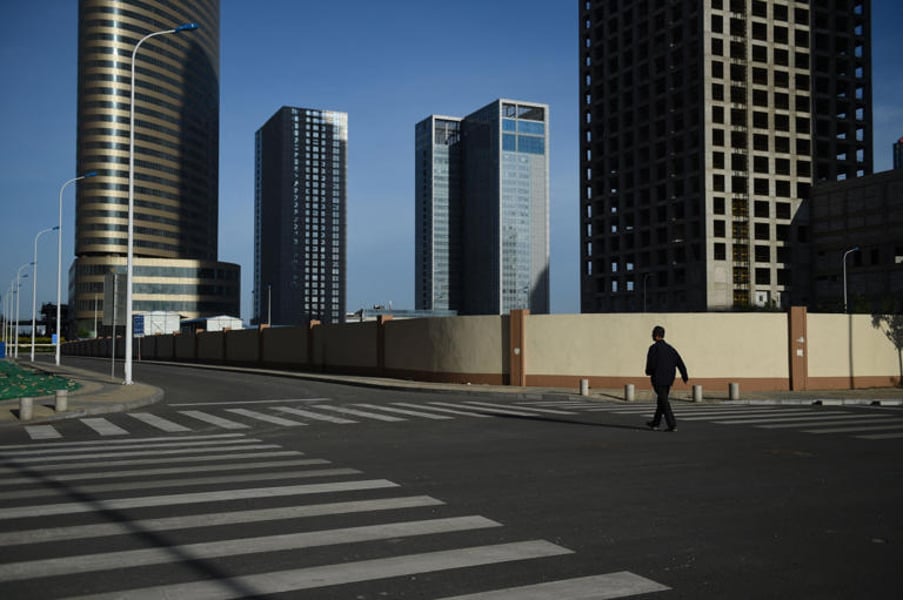
A deserted street in Conch Bay, opposite the new Yujiapu financial district, in Tianjin, northern China. Photo: Greg Baker
As a result, numerous large urban areas have been left uninhabited, with some cities even being completely built but uninhabited, earning them the nickname "ghost cities".
The real estate bubble
One of the main reasons is the Chinese people's habit of buying multiple properties. With a population of 1.4 billion, owning real estate is considered a safe investment channel. It is estimated that about 70% of total household assets in China are in this sector.
However, the real estate market froze around 2020 as the speculative bubble that had accumulated over many years began to burst due to stricter regulatory policies. As a result, tens of millions of apartments were left vacant, many projects were left unfinished, further increasing concerns about the economic downturn.
Developers continue to build housing even when the market has reached saturation point, meaning supply far exceeds demand. According to Sarah Williams, associate professor of technology and urban planning at the Massachusetts Institute of Technology (MIT), the Chinese government has encouraged too many projects but cannot stop them because banks have already financed a multitude of constructions.
"The government is expanding land holdings and continuing to provide loans so that real estate developers can pay off old debts with new ones. The easiest way to understand it is that it operates on a model similar to a 'Ponzi scheme'," Williams commented in Newsweek.
A glimmer of hope
Nevertheless, some areas have gradually attracted residents and somewhat erased the "ghost city" label. However, the scale of vacant housing remains enormous, with an estimated 65 to 80 million unoccupied apartments across China.
One of the most striking examples is the Kangbashi district in Ordos, Inner Mongolia. Built to accommodate 300,000 residents, in reality less than 10% of the apartments are occupied.
The main reasons are the lack of jobs, healthcare, education , and essential services, which discourage many people, even those who can afford to buy a home, from moving there.
"It was once expected that even without job growth, investment in real estate could help boost regional economic development. However, for a city to truly thrive, the most important thing is still having jobs," Williams explained.
Currently, Kangbashi's population has exceeded 120,000, with thousands of students attending local schools. However, the region's growth prospects remain limited, especially in the context of China's declining population. According to official figures, Inner Mongolia's population decreased by 0.3% in 2023, double the national average decline.
Another example is Tianducheng, an upscale urban area in Hangzhou, Zhejiang province. Designed to resemble European architecture with a 1:3 scale Eiffel Tower, it was once known for its deserted squares and unoccupied apartment buildings.
However, over time, residents gradually moved in, and by 2017, the population of this urban area had tripled compared to the original plan.
Ambitious projects that failed.
Not every project has had the same fortunate fate as Kangbashi or Tianducheng. One example of failure is the Yujiapu financial district in Tianjin, once touted as the "Manhattan of China".
This area was developed in the early 2010s with skyscrapers, wide boulevards, and even its own subway line. However, despite its modern infrastructure, Yujiapu has failed to attract businesses and residents. Years after its completion, it remains eerily quiet.
Besides projects that were abandoned after construction was completed, there are also projects that never actually started. One of them is the Xiong'an New Area, a special economic zone located about 100 km south of Beijing.
Intended to alleviate development pressure on the capital and to become a model for green infrastructure and smart urban technology, many of these roads still show no signs of activity. The delays in implementation have made this area look more like a "ghost city" than a future economic hub.
The risks remain.
According to Williams, it is the abandoned, scattered urban areas that pose the greatest threat to the world's second-largest economy, rather than prominent projects like Tianducheng.
"These are hotspots of overinvestment, leaving many homebuyers in a losing position because they can't recoup their investment," she said, comparing the situation to the 2007-2008 US housing crisis.
According to her, this will create a "huge" ripple effect on the Chinese economy in the long term.
Viet Ha (According to Newsweek)


![[Photo] General Secretary and President To Lam presides over a meeting on preparations for the review of one year of operation of the three-tiered government system.](https://vphoto.vietnam.vn/thumb/1200x675/vietnam/resource/IMAGE/2026/06/02/1780391821195_a1-bnd-4595-9717-jpg.webp)





































































Comment (0)