

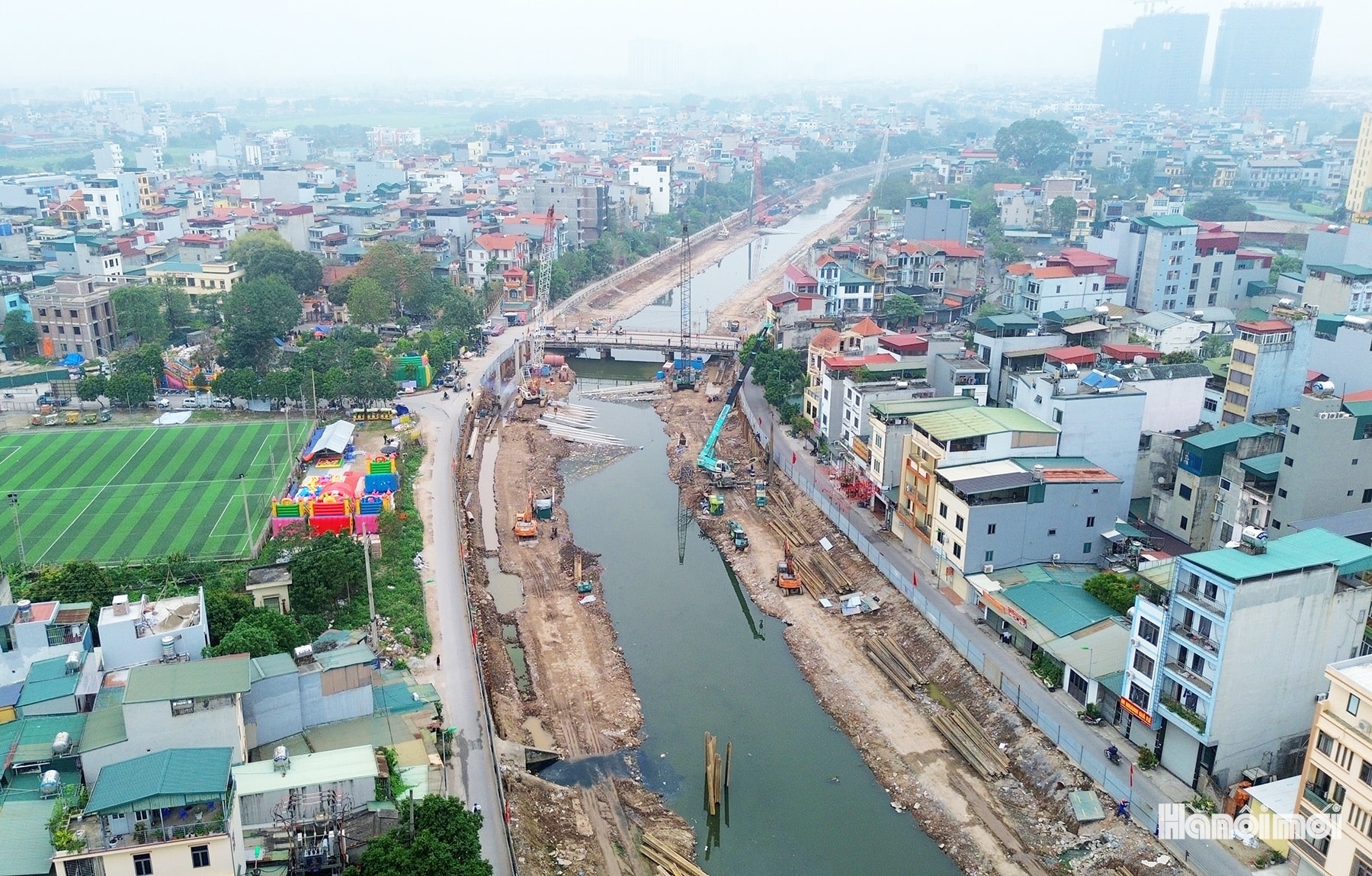
Small project, big pressure.
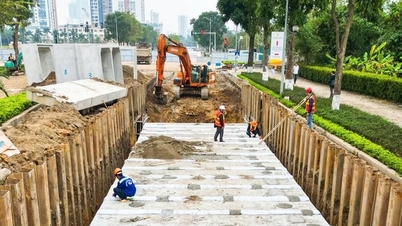
The completion of the underground water reservoir in the Hang Da market area, Hoan Kiem ward, marks a significant step in Hanoi 's efforts to combat flooding before the rainy season. With a capacity of 2,500 m³, a length of over 51 m, a width of nearly 15 m, and a height of 4.5 m, the structure is not particularly large compared to the entire urban drainage system. However, its significance lies in its location, the method of construction, and the message it conveys regarding urban management.
The intersection of Đường Thành, Bát Đàn, and Nhà Hỏa streets, along with neighboring streets like Phùng Hưng, has long faced significant pressure during periods of heavy rainfall. This area is the core of the old urban center, characterized by high building density, limited road width, and the difficulty of supplementing traditional drainage infrastructure. Under these conditions, placing an underground water reservoir beneath the urban surface is a viable solution: if expansion on the surface is not feasible, then underground storage is the only option.
According to Mr. Vo Phuong Nam, Deputy Head of the Technology and System Management Department, Hanoi City Technical Infrastructure Center, Hanoi Department of Construction, the project has completed the main components including the connecting sewer system, water collection manhole, reservoir structure, and forced pumping station. The operating procedure also shows that this is not simply a "water reservoir," but a technical link in the regulation system. Before rain, the sluice gates are closed, and the pumping station operates to lower the water level in the reservoir; after rain, the sluice gates are opened to direct water from the flooded area into the reservoir; when the external system stabilizes, the water is pumped back to the existing sewer network.
This operational approach shows that flood control thinking has begun to shift from addressing flooding at the point of impact to regulating flow over time. Rainwater is no longer seen as something to be quickly pushed away, but rather as a manageable volume: retained when necessary, released when conditions permit, avoiding immediate pressure buildup on an already overloaded drainage system.
However, it's also important to acknowledge that a 2,500m³ reservoir cannot solve the entire flooding problem in the city center, much less replace large-scale drainage projects. This project is valuable as a policy-technical experiment. If operated effectively, the underground reservoir model could open up avenues for supplementing drainage capacity in older urban areas where expanding retention ponds, drainage ditches, or large sewer lines faces land-related difficulties.
What is even more noteworthy is that the project was implemented under an emergency construction order, with a total investment of over 18 billion VND, applying Japanese underground reservoir technology. In the context of increasingly unpredictable extreme rainfall events, the preparation time is tight, and flood control infrastructure must be developed more quickly, but this does not mean temporary solutions. The key issue is that all emergency projects still need to be placed within a comprehensive plan, with operational data, post-rainy season evaluations, and mechanisms for scaling up if proven effective.
Rainwater management by watershed
The Hang Da underground reservoir is just one aspect of Hanoi's broader initiative: the development of the "Project for Addressing Flooding in Hanoi's Inner City Area, 2026-2030". The crucial point of the project is not simply to list additional constructions, but to clearly identify the biggest bottlenecks in the drainage system, thereby transforming proposals into concrete action plans.
According to Mr. Nguyen Duc Hung, Director of the Technical Infrastructure Management Center of the Hanoi Department of Construction, the current requirement is to improve management capacity, shifting from a passive to a proactive approach for each drainage basin. For each level of rainfall forecast, a specific operational scenario is needed: lowering the water level of regulating reservoirs before rain, regulating flow, operating pumping stations, deploying emergency response forces, and reassessing the situation after the rain. This is a significant change compared to the "deal with flooding as it occurs" approach, which always leaves drainage forces in a reactive state.
In modern urban management, flood control cannot simply be the job of drainage workers during a rainy night. It is an interdisciplinary, cross-basin problem involving urban planning, transportation, green spaces, retention ponds, irrigation, meteorological forecasting, and even enforcement discipline on each construction site. A flooded street may originate from a heavy rainstorm, but it can also be caused by clogged drains, blocked inlets, construction projects altering water flow, or the paving of surfaces with concrete, leaving no place for water to infiltrate.
Therefore, strengthening coordination between urban drainage and irrigation systems is an urgent requirement. Many river basins in Hanoi still depend on agricultural drainage systems, while the operational goals of irrigation and urban drainage are not entirely the same. Without clear coordination regulations, each heavy rainstorm can become a test of responsibility between the units. Only when regulations specifically stipulate the lowering of buffer water levels, operation of pumping stations, regulating sluices, and sluice gates will the system have the opportunity to demonstrate its practical capacity.
In the long term, experts believe that Hanoi needs to go beyond the goal of "rapid drainage." Professor Tran Duc Ha, former Director of the Institute of Water Supply, Drainage and Environment Research, argues that the capital city needs to shift to a mindset of "water retention and efficient water resource management," adapting to climate change... This approach is consistent with the trend of "sponge cities" or "porous cities" that many countries have adopted: increasing regulating lakes, underground reservoirs, permeable materials, green spaces, while reducing concrete surfaces.
In other words, flood control is not just about adding sewers, pumps, and reservoirs; it's about restoring the city's ability to absorb, retain, and regulate water. A sidewalk paved with permeable materials, a park capable of temporarily storing water, a properly operated regulating lake, or an underground reservoir like the one in Hang Da are all components of the same philosophy: living with water proactively, rather than simply coping after each rainstorm.
Hanoi is rushing with emergency orders, new construction projects, and flood control plans for the next phase. This urgency is necessary because people cannot continue to get used to the sight of streets turning into rivers during heavy rains. But more importantly, after these emergency projects, a long-term management capacity must be developed: better forecasting, clearer coordination, more proactive operation, and more responsible urban planning regarding rainwater. Then, the Hang Da underground reservoir will not only be a flood control project, but also a sign of a new way of thinking about the capital's urban infrastructure.
Source: https://hanoimoi.vn/tu-be-ngam-hang-da-den-tu-duy-moi-ve-chong-ngap-do-thi-1064095.html




![[Photo] General Secretary and President To Lam presides over a meeting on preparations for the review of one year of operation of the three-tiered government system.](https://vphoto.vietnam.vn/thumb/1200x675/vietnam/resource/IMAGE/2026/06/02/1780391821195_a1-bnd-4595-9717-jpg.webp)








































































Comment (0)