

Few people know that, just over an hour's drive from Hanoi , lies a landscape complex encompassing limestone mountains, mangrove forests, natural lakes, spiritual heritage, and rare ecosystems – a place often referred to as the "bay without waves" of Northern Vietnam.
This is the Van Long-Kim Bang-Tam Chuc cultural-ecological landscape, a linked area stretching between Ninh Binh and Ha Nam (formerly), which is gradually becoming a new highlight on Vietnam's green tourism map.
Unlike many bustling tourist centers, this region is appealing for its pristine beauty, cultural depth, and its ability to offer a truly immersive experience of "connecting with nature."
Preserving over 90% of wild white-buttocked langurs.
The most prominent feature of the area is the Van Long Nature Reserve – the largest wetland in the Northern Delta. Its calm, mirror-like surface reflects the majestic limestone mountain ranges, creating a scene that visitors liken to a "living ink painting."
Boat trips winding through rocky mountain ranges, water caves, and waterlogged meadows offer a rare sense of tranquility amidst the hustle and bustle of modern life.
Unlike many commercialized ecotourism destinations, Van Long retains its pristine and peaceful beauty. This is what makes it increasingly popular with international tourists, especially those seeking slow travel and sustainable nature experiences.
Van Long's uniqueness lies not only in its scenic beauty but also in its diverse ecosystem. It is home to the white-buttocked langur – an extremely rare primate species that once faced global extinction.
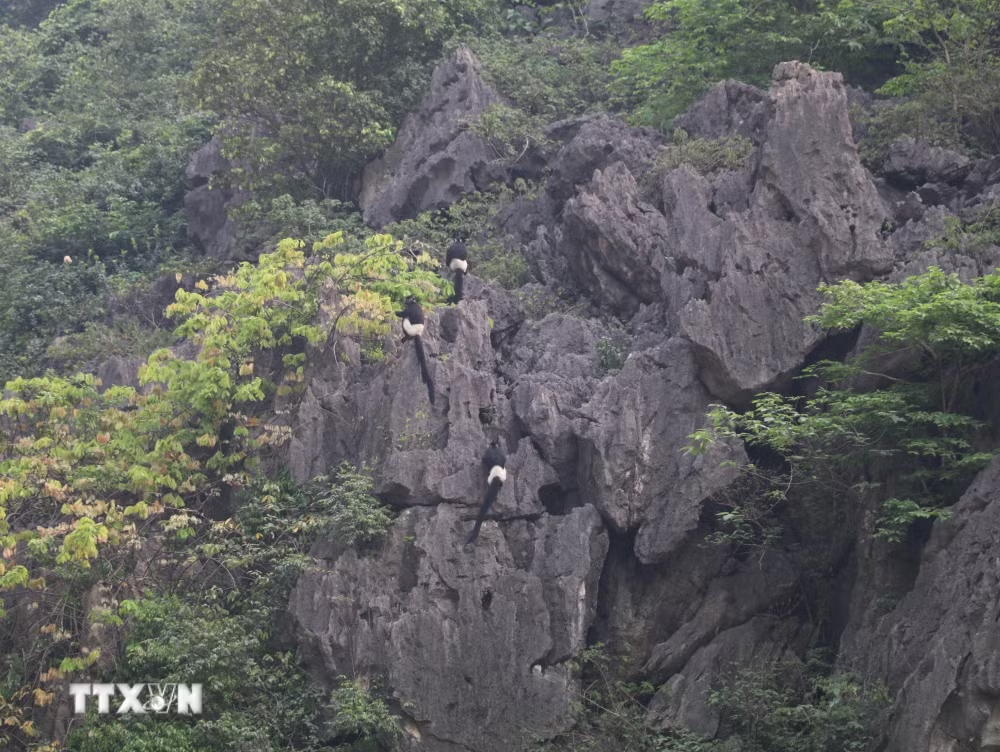
With over 90% of the wild white-buttocked langur population currently protected, this area has been identified by the international scientific community as a “conservation node” of crucial importance to the long-term survival and resilience of the species on a global scale.
In the Van Long Wetland Nature Reserve, approximately 40 individuals of the white-buttocked langur were recorded before 2000. To date, after many efforts, with the joint participation of various levels of government, domestic and international wildlife conservation organizations, local authorities, and the people, the number of white-buttocked langurs here has increased to over 250 individuals.
The population size at Van Long once again affirms its position not only as a place preserving a large population of white-buttocked langurs but also as a "gene source" for the species' recovery.
Besides Van Long, the Kim Bang limestone mountain forest area is home to the world's second-largest population of white-buttocked langurs, with an estimated 120-150 individuals.
Most recently, in the Dong Thai protected forest area, Dong Thai commune, experts also recorded the appearance of the third largest population with 37 individuals. The increase in both the number of individuals and the distribution range shows a positive recovery trend of the white-buttocked langur population in the wild.
Tam Chuc - Where nature meets spirituality
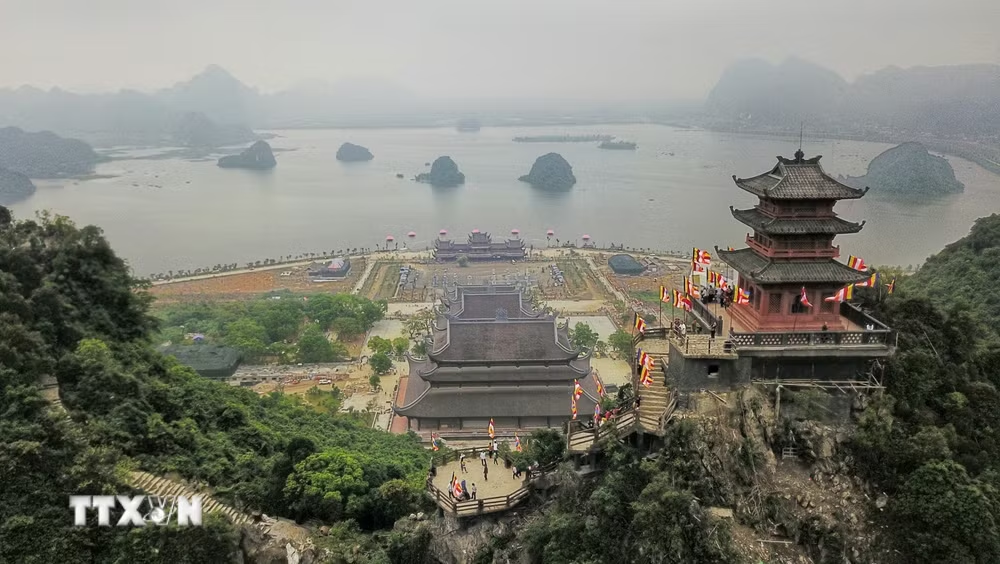
Leaving Van Long, the journey continues to a completely different space at Tam Chuc Tourist Area. Surrounded by a vast lake and towering limestone mountains, Tam Chuc impresses with its combination of natural landscapes and large-scale Buddhist architecture.
The landscape here is majestic yet serene. The paths winding through the lake, temples, and mountains create the feeling of stepping into an ancient Eastern painting. In the early morning or late afternoon, a light mist blankets the lake, making Tam Chúc appear mystical and attracting numerous photographers and nature-loving tourists.
Notably, Tam Chúc is not only developing spiritual tourism but also aiming for an eco-tourism model, focusing on health care and experiencing local culture – a trend that is becoming increasingly popular worldwide.
Kim Bang - a "green piece" with much untapped potential.
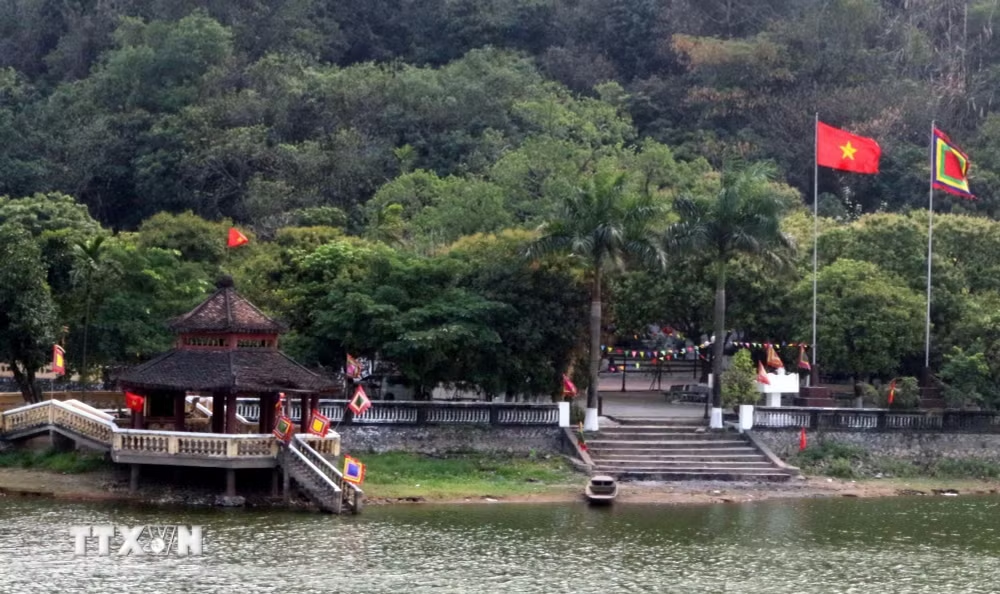
While Van Long and Tam Chuc are widely known, Kim Bang is considered a "hidden gem" of the entire region. It boasts a characteristic semi-mountainous landscape with limestone mountains, caves, lakes, and many ancient villages that still maintain their traditional way of life.
The ecological space in Kim Bang creates a natural buffer zone linking conservation areas and spiritual tourism destinations. This interconnectedness helps form a rare landscape corridor in the North – where nature, culture, and community life blend into a unified whole.
Many experts believe that if properly planned with a focus on green development, the Van Long-Kim Bang-Tam Chuc area could completely become a national-level eco-cultural tourism center, and even one with international value.
Experience slow living.
The most appealing aspect of the Van Long-Kim Bang-Tam Chuc landscape lies in the feeling of escaping the hustle and bustle. Visitors can enjoy rowing boats on the tranquil lagoon, listening to the birdsong, admiring the reflection of the rocky mountains on the lake's surface, or simply enjoying the peacefulness of nature.
In the context of the rising popularity of ecotourism and healing tourism, the Van Long-Kim Bang-Tam Chuc cultural-ecological landscape is considered a "treasure" with much untapped potential.
Perhaps it is precisely this pristine, tranquil, and unique character that is quietly making this region a name of particular interest to tourists in recent years.
Aiming to become a World Heritage Site
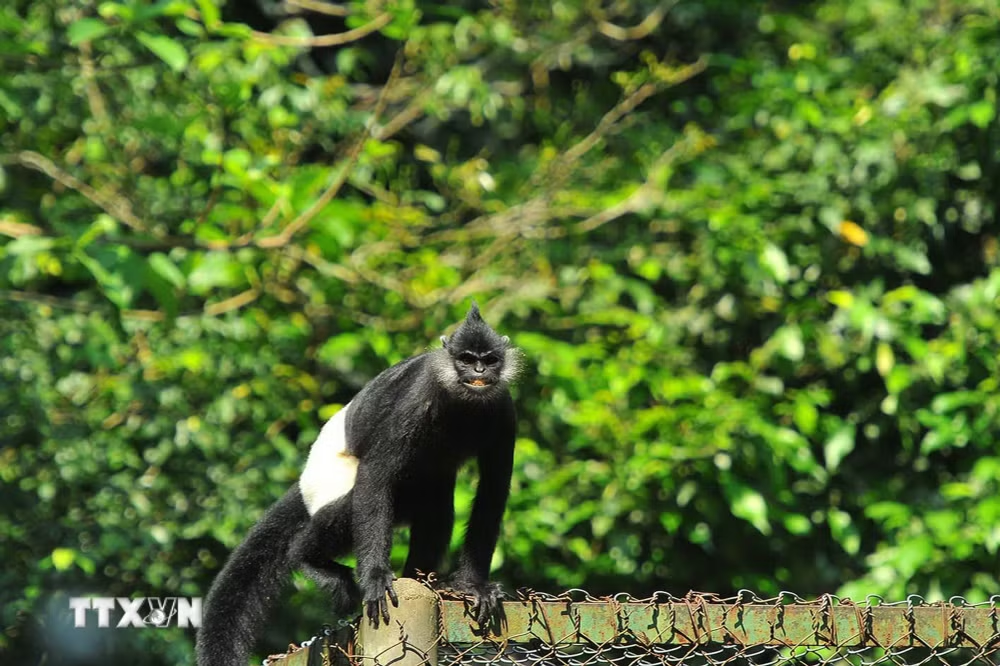
The recent inclusion of the "Van Long-Kim Bang-Tam Chuc White-buttocked Langur Cultural-Ecological Landscape" on the UNESCO World Heritage Sites' provisional list marks a strategically significant milestone in the roadmap towards official inscription in 2028.
This is not merely a procedural step within the framework of the 1972 Convention, but also a gradual process of strengthening the scientific, legal, and governance foundations to ensure the identification, protection, and sustainable promotion of the outstanding universal values of the nominated area.
Aiming for sustainable development, Ninh Binh is focusing its efforts on completing the dossier to request the United Nations Educational, Scientific and Cultural Organization (UNESCO) to recognize the "Van Long-Kim Bang-Tam Chuc White-faced Langur Cultural-Ecological Landscape" as a World Heritage Site.
In the journey towards World Heritage status, the "Van Long-Kim Bang-Tam Chuc White-buttocked Langur Cultural-Ecological Landscape" is not only a scientific dossier, but also a vivid expression of the aspiration to preserve the values of Vietnam's nature and culture.
It is a journey that demands perseverance, responsibility, and social consensus, where each step forward is linked to improving management capacity, strengthening the scientific basis, and spreading public awareness about heritage conservation.
In the context of the world facing major challenges of biodiversity loss and climate change, protecting an endemic ecosystem and the white-buttocked langur species is not only the responsibility of one nation, but also a practical contribution of Vietnam to the common efforts of humanity.
From the majestic limestone mountain ranges, seemingly quiet values are silently asserting their significance, proving that sustainable development can only be achieved when people respect, preserve, and live in harmony with nature.
With that vision, Vietnam is not just aiming for a title, but is gradually building a heritage-based development model, where natural and cultural values are preserved as core foundations for the future. And from this unique ecological and cultural space, a global message is being spread: protecting heritage today is protecting the survival opportunities of future generations.
Source: https://www.vietnamplus.vn/dieu-gi-danh-thuc-vung-dat-ngu-quen-giua-dong-bang-bac-bo-post1110385.vnp

![[Image] Hanoi's urban life under the challenge of a "scorching hot" environment](https://vphoto.vietnam.vn/thumb/1200x675/vietnam/resource/IMAGE/2026/05/25/1779706979265_nang-nong-t5-2026-minh-duy-7-4636-jpg.webp)
![[Image] Close-up view of the interchange connecting the two expressways and Long Thanh Airport.](https://vphoto.vietnam.vn/thumb/1200x675/vietnam/resource/IMAGE/2026/05/25/1779703378210_ndo_br_z7863716673926-224453a31600126cce10622af6290afd-4549-jpg.webp)














































































Comment (0)