

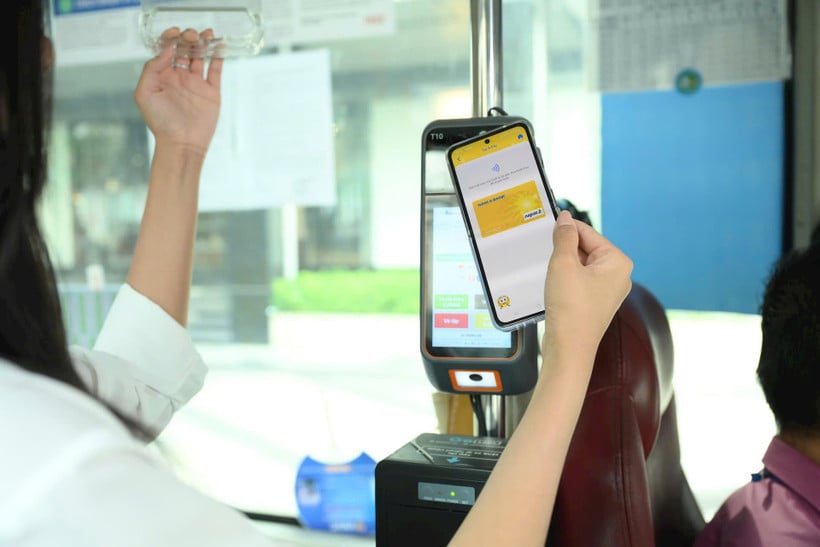
According to the National Comprehensive Financial Strategy to 2025, with a vision to 2030, the Government aims for a growth rate of 20-25% per year in cashless payment transactions. This goal reflects Vietnam's determination to rapidly advance into the digital economy , where digital payments play a crucial infrastructure role, connecting people, businesses, and the Government on a single modern technology platform.
Digital payments - the foundation of the digital economy.
In recent years, payment infrastructure in Vietnam has developed at an unprecedented pace. From bank cards, e-wallets, QR codes to digital banking and mobile banking, these have become an integral part of modern life. According to Tran Van Thanh, Deputy Head of the Digital Channel and Partner Development Department at Vietcombank , digital technology has become an essential foundation and an inevitable driving force for economic growth, with digital payments emerging as a leading sector, forming a modern financial ecosystem. The total value of cashless payment transactions in 2024 is projected to reach VND 295.2 trillion, 26 times the GDP; the number of transactions will reach 17.7 billion, a 56% increase compared to 2023. Payments via QR code alone are expected to increase by over 81% in the first quarter of 2025, a figure reflecting a significant shift in consumer behavior.
One of the highlights of Vietnam's payment infrastructure is the development of NAPAS, an intermediary unit connecting 68 banks, financial companies, and partners providing payment infrastructure for people to use. According to NAPAS Deputy General Director Nguyen Hoang Long, in September and October 2025, the NAPAS system processed an average of 35 to 36 million transactions per day, corresponding to approximately 70 million people using money transfer and payment services provided by NAPAS and its member units daily. Through this connection, it can reach one-third of Vietnam's population every day.
Previously, in 2024, the NAPAS system processed nearly 10 billion transactions; the projected figure for 2025 is 11 to 12 billion transactions. Not stopping at domestic operations, NAPAS is expanding its international cooperation. In 2025, the unit plans to complete cross-border payment connectivity using QR codes for Chinese tourists entering Vietnam, with the reverse direction to be implemented in 2026. The system is also promoting connections with Japan, South Korea, and Singapore, creating a foundation for Vietnam's payment infrastructure to reach the region and the world .
Lessons from leading countries show that: Chinese people have been using their phones to ride trains since 2017; Japan integrates train, bus, and everyday goods payments into a single app. In Vietnam, with a high mobile user rate and developed payment infrastructure, it is entirely possible to narrow the gap with advanced countries. Deputy Governor of the State Bank of Vietnam (SBV) Pham Tien Dung shared: “Digital payments must reach every citizen in every public service. If people still need to carry multiple cards to ride trains, it means we haven't fulfilled our responsibility.” Therefore, the Deputy Governor requested banks to cooperate in integrating existing payment methods into the public transportation system, aiming for a truly cashless city.
According to Khuất Việt Hùng, Chairman of the Board of Members of Hanoi Railway Company Limited, the Cát Linh-Hà Đông line is currently testing a new electronic payment system, allowing passengers to pass through the gate using their citizen ID card, Visa card, or QR code. The Hanoi Metro application also supports electronic tickets identified by facial recognition, ensuring safety, convenience, and modernity.
The legal framework must be one step ahead.
The latest data from the State Bank of Vietnam shows that in the first seven months of 2025, QR code transactions increased by 66.7% in volume and 159.6% in value compared to the same period; 87% of adults have bank accounts; and many credit institutions have recorded more than 90% of transactions conducted through digital channels. However, along with this growth come challenges regarding cybersecurity. "Therefore, for digital transformation to go far, the legal framework must be one step ahead," affirmed Pham Anh Tuan, Director of the Payment Department (State Bank of Vietnam).
In recent years, the State Bank of Vietnam has perfected the legal framework at many levels. Important laws such as the Law on Electronic Transactions 2023, the Law on Credit Institutions 2024, and the Law on Personal Data Protection 2025 have laid the foundation for digital banking, electronic identification, and secure data sharing.
Along with that, Decree No. 52/2024/ND-CP on cashless payments, Decree No. 94/2025/ND-CP on Fintech testing mechanisms, and Decision No. 316/QD-TTg on Mobile Money have contributed to the formation of a comprehensive, transparent, and flexible legal framework. Multi-layered security solutions have also been widely applied, notably the implementation of mandatory biometric authentication for large transactions and the application of Tokenization technology (card number encryption) to ensure absolute security for mobile transactions. In addition, the State Bank of Vietnam has piloted the SIMO system (fraud risk monitoring and prevention), supporting timely warnings and helping to stop/cancel suspicious money transfer transactions totaling over VND 1,500 billion as of early September 2025.
However, the story of digital transformation in payments is not simply about technology. Expert Nguyen Xuan Thanh (Fulbright University Vietnam) emphasized: “Technology is the driving force, but people and culture are the foundation. A smart, humane financial system does not rely solely on machines; it also depends on social trust and the participation of each individual citizen.”
Source: https://nhandan.vn/dinh-hinh-tuong-lai-thanh-toan-so-post915181.html





















![[Photo] Noi Bai airport staff diligently work in record-breaking heat of 71 degrees Celsius.](https://vphoto.vietnam.vn/thumb/402x226/vietnam/resource/IMAGE/2026/05/25/1779699478886_ndo_br_gen-h-z7863407074052-40b99dd232c409870148d3b23fcfd494-jpg.webp)












































































Comment (0)