

The Japan Chamber of Commerce and Industry in Vietnam (JCCI) has sent a document to the Prime Minister and relevant ministries and agencies regarding the adjustment of regional minimum wages in 2024.
A survey by JCCI on "The Status of Japanese Companies Investing Overseas," involving over 600 companies, revealed that more than 46% of businesses forecast revenue to "decline" or "remain stable" compared to 2022.
Regarding labor costs specifically, over 75% of Japanese businesses say that rising labor costs are the biggest risk when investing in Japan in the future.
According to JCCI, Japanese companies investing in Vietnam increased wages by 5.4% from 2020 to 2021, and 5.8% from 2021 to 2022, with an expected increase of 5.9% from 2022 to 2023. This increase rate is higher than in other ASEAN countries such as Thailand, Indonesia, and the Philippines.
Of the businesses that implemented salary increases in 2022, 96% did so between 2022 and 2023.
As a result of these wage increases, the average salary in Japanese manufacturing companies in northern Vietnam reached over 5.1 million VND (regions 1, 2, 3, and 4), significantly higher than the regional minimum wage of 4.68 million VND in region 1.
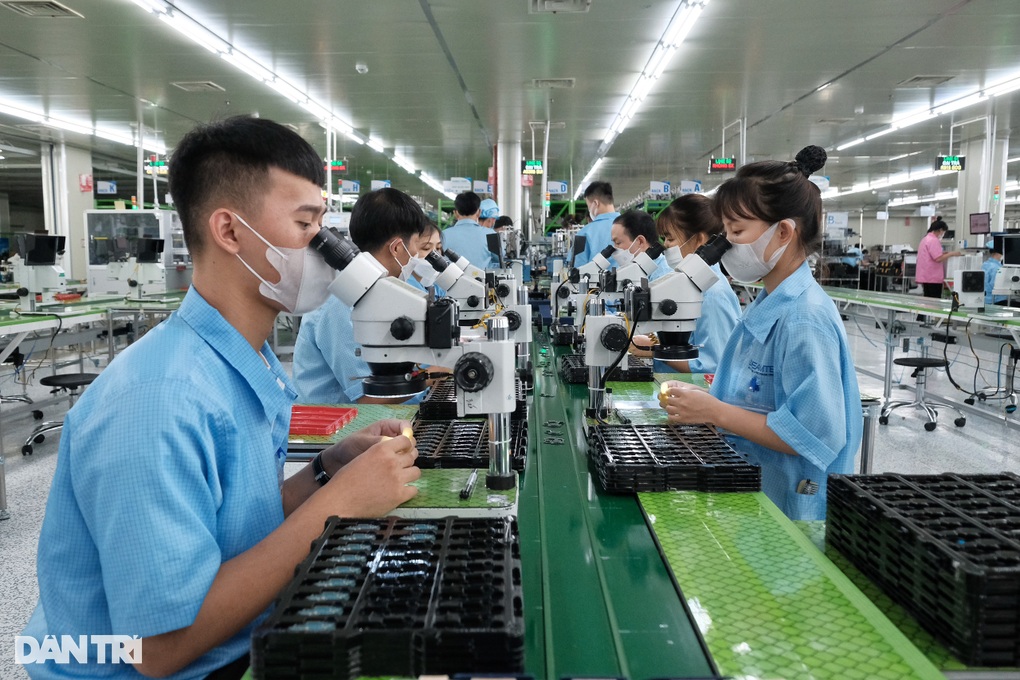
Workers' representatives want to increase the regional minimum wage to compensate for inflation (Illustrative image: Son Nguyen).
Therefore, JCCI recommends maintaining the regional minimum wage in 2023. However, the organization does not oppose adjusting the regional minimum wage from January 2024, but emphasizes the need to consider the adjustment level.
Since businesses already adjust wages themselves, a significant increase in the minimum wage would make it impossible for them to bear the burden of labor costs. This could easily lead to labor disputes in businesses that lack cost competitiveness.
Instead of making decisions based on indicators like the CPI, JCCI recommends that the National Wage Council conduct a factual investigation into the current wage levels and propose adjustments based on the actual situation.
According to JCCI, the government is developing a roadmap for adjusting the minimum wage and setting medium-term targets; however, the unpredictable nature of both domestic and international economies makes predictions difficult.
Therefore, the minimum wage should be determined based on economic indicators and annual economic trends.
Previously, at the conclusion of the first meeting held on the morning of August 9th, the National Wage Council agreed to hold subsequent meetings in the fourth quarter of 2023 instead of in July or August as is customary.
The Vietnam General Confederation of Labor believes that the minimum wage needs to be adjusted according to the consumer price index so that the real income of workers does not decrease. The union hopes that the minimum wage adjustment for 2024 will increase by 5-6%.
Workers' representatives share the difficulties faced by businesses. However, workers also need wage adjustments to compensate for inflation and improve their living standards to some extent.
According to Hoang Quang Phong, Vice President of the Vietnam Chamber of Commerce and Industry (VCCI), the consideration of wage increases should have a time lag and should be decided based on future economic and production indicators.
The reason for this proposal, according to the employers' representatives, is that businesses are facing difficulties. The highest priority for workers right now is to be employed, and businesses want to create as many jobs as possible. Many businesses, despite facing numerous challenges, are still struggling to maintain employment for their workers.
Source link



































































































Comment (0)