

 |
| Upgrading aluminum and glass door production equipment, partly thanks to industrial promotion funds, at a business in Thanh Thuy ward. |
Urgent need
Faced with increasingly stringent environmental requirements, transitioning to green production is no longer an option but a mandatory requirement for industrial enterprises. In industrial parks, many businesses have proactively invested in technological innovation to reduce raw material consumption, save energy, and limit emissions.
For example, at Gilimex Industrial Park, the Eon Industry Vietnam helmet manufacturing plant (phase 1), specializing in producing helmets for bicycles, skiing, and hockey, operates on a green and clean principle through a closed-loop, highly automated production line with strict control over environmental factors. The entire process uses precision plastic injection molding technology in a closed mold, where the plastic material is melted and shaped at high pressure, minimizing the release of gases and dust into the environment.
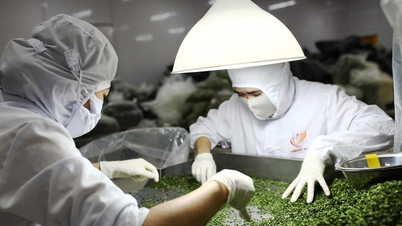
In Phong Dien Industrial Park, many construction material and food processing facilities are gradually replacing old machinery with high-tech equipment and clean production lines, thereby reducing dust and noise, and improving the efficiency of raw material use. A prime example is CP Vietnam Livestock Joint Stock Company - Hue Branch, specializing in seafood processing and animal feed production. In addition to its closed-loop production lines, the company has invested in wastewater treatment, solid waste management, and emission control systems in accordance with current standards.
Representatives from CP Vietnam Livestock Joint Stock Company - Hue Branch stated that, thanks to the application of a closed-loop production process, strict control of input materials, and ensuring food safety, the company is increasingly participating in the global supply chain. In 2025, the company's revenue is projected to reach VND 916.7 billion, creating jobs for 927 employees. In 2026, the company plans to recruit an additional 186 employees to meet its expansion plan, aiming for higher revenue than the previous year.
In Phong Dien Industrial Park, there is also the Dat Phuong Ultra-White Glass Factory, invested by Dat Phuong Glass Joint Stock Company. Currently, the factory is building a production line with a designed capacity of 400 tons of product per day (equivalent to 19.2 million m²/year), supplying construction glass and glass for solar panels from locally sourced quartz sand. The company's entire production line uses technology from Europe, the US, and Japan, operates on LNG fuel, and applies a recirculating wastewater treatment system, contributing to reducing environmental emissions.
Mr. Truong Van Minh, a representative of a wood processing enterprise in Thuy Phuong Industrial Cluster, said that investing in a new production line not only helps increase productivity by 1.5 to 2 times compared to the old line but also reduces electricity consumption by about 15-20%, while improving working conditions for employees.
Encouraging clean production
To support businesses in their green transformation, various levels and sectors in Hue City have implemented numerous policies, creating favorable conditions for businesses to access resources and advanced production technologies.
Currently, many large enterprises in sectors such as mechanical engineering, electrical and electronics, textiles, seafood processing, and food processing have proactively invested in quality control systems, labor management, efficient wastewater treatment, and energy saving. Simultaneously, they are implementing green factory models, aiming for a closed-loop supply chain with low emissions.
Many policies supporting businesses in accessing loan capital to upgrade machinery and equipment towards the application of advanced, environmentally friendly technologies have been issued by state agencies, including the industrial promotion program implemented annually by the Ministry of Industry and Trade. Through this program, many businesses receive partial financial support to invest in equipment upgrades and adopt clean production models. Simultaneously, key industries such as textiles, agricultural product processing, food processing, and electronics are gradually improving their production processes towards energy saving, emission reduction, and environmental friendliness.
According to the head of the Department of Industry and Trade, the unit has coordinated the implementation of many programs to support businesses, such as advising on the application of cleaner production, supporting the construction of green factory models, promoting digital transformation in production management and efficient energy use. At the same time, trade promotion and market connection activities have also been strengthened, helping businesses sell green products and gradually participate in sustainable supply chains domestically and internationally.
The development of eco-friendly industrial parks is a top priority for Hue City. Accordingly, the city prioritizes attracting projects that utilize modern, low-emission technologies and minimize the risk of environmental pollution. In line with its new development orientation, Hue City is building an image of a locality with "green, clean, and sustainable" industrial development, linked to the goal of green growth and adaptation to climate change.
"Promoting green transformation in industrial production not only helps businesses enhance their competitiveness but also makes a significant contribution to environmental protection and sustainable economic development," emphasized Mr. Dang Huu Phuc, Director of the Department of Industry and Trade.
Source: https://huengaynay.vn/kinh-te/doanh-nghiep-tung-buoc-chuyen-doi-xanh-165400.html




![[Photo] General Secretary and President To Lam presides over a meeting on preparations for the review of one year of operation of the three-tiered government system.](https://vphoto.vietnam.vn/thumb/1200x675/vietnam/resource/IMAGE/2026/06/02/1780391821195_a1-bnd-4595-9717-jpg.webp)

![Transforming from Resolution 57: [Part 2] Businesses Lead the Way](https://vphoto.vietnam.vn/thumb/402x226/vietnam/resource/IMAGE/2026/06/02/1780399668663_5332-dsc09931-2-235637_295-235639.jpeg)








![[INFOGRAPHICS] Development goals for rural crafts and industries in the period 2026-2030](https://vphoto.vietnam.vn/thumb/402x226/vietnam/resource/IMAGE/2026/06/02/1780393054323_1780392879.webp)















































Comment (0)