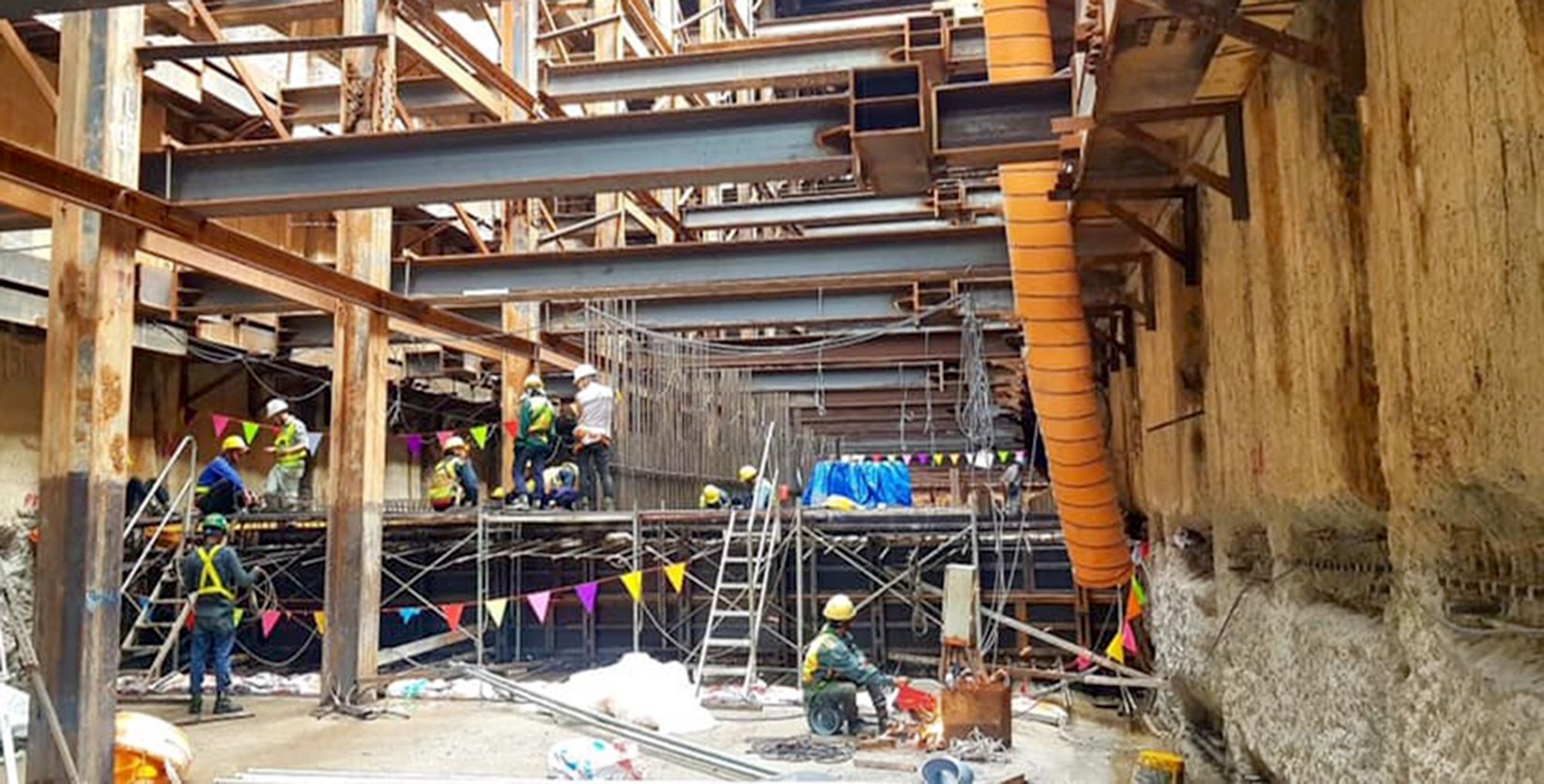
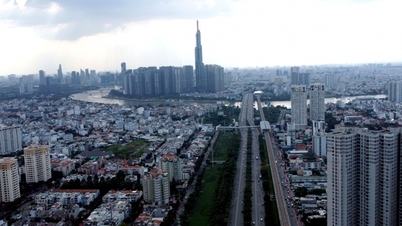
Cienco4 is confident in its capabilities and experience gained from participating in the Ben Thanh - Suoi Tien metro project, the Cat Linh - Ha Dong metro project, and many other large-scale transportation projects, and therefore can participate in most aspects of the high-speed rail project. (In the photo: Cienco4 participating in the construction of the Ben Thanh - Suoi Tien metro project).
"This is a very large project, requiring contractors, consultants, and equipment suppliers with real capabilities. Cienco4 is confident enough to participate in the project. With its capabilities and experience, Cienco4 aspires to participate in almost all aspects, from infrastructure construction to equipment," Mr. Huynh asserted. According to him, the company's advantage is its previous participation in the Ben Thanh - Suoi Tien and Cat Linh - Ha Dong metro projects, so it already has a management system and thousands of engineers and workers. A certain number of personnel are being sent for further training. Cienco4 also has several foreign partners such as China, Japan, and South Korea ready to provide professional support when needed. Mr. Pham Van Khoi, Chairman of the Board of Directors and General Director of Phuong Thanh Transport Construction and Investment Joint Stock Company (Phuong Thanh Tranconsin), said that, from a technical perspective, high-speed railways also have viaducts, tunnels through mountains, and roadbeds like expressway projects. The main differences lie in the stability of the bridge, the slope, and the fact that some safety structures require stricter and more precise
standards . Mr. Khoi stated that with a workforce of nearly 2,000 people, over 60% of whom are highly qualified personnel capable of mastering advanced technology and constructing large, technically complex bridges, the company is fully capable of meeting the requirements if given the opportunity to participate.
The Party and State of Vietnam have clearly stated their policy of building high-speed railways using advanced technology, but ensuring the simultaneous participation of domestic enterprises, aiming to master the technology. Their participation in the project will provide them with an opportunity to understand, adopt, master, and develop the technology in the future. Assoc. Prof. Dr. Tran Chung (Chairman of the Association of Vietnamese Road Transport Infrastructure Investors)
Phuong Thanh Tranconsin has proactively sent personnel for training in China, Japan, France, etc. The next step is to open a research institute and technology transfer center, inviting experienced international "chief engineers" to exchange expertise to better define the work items that can be participated in, the technologies that need to be researched and mastered, and the equipment that needs to be invested in. Identifying railway infrastructure investment as a new direction for the next 5-10 years, Deo Ca Group has also collaborated with universities to recruit and train high-quality human resources. The cooperation model includes ordering from sources and on-site training. "We conduct practical research on the railway and metro training process in advanced countries through reputable training institutions to select and 'import' programs and experts," said Mr. Nguyen Quang Vinh, General Director of Deo Ca Group. Proactively approaching the project, Trung Chinh Trading and Construction Co., Ltd. has also compiled a list of approximately 40 construction engineers to attend a railway engineering course at
Hanoi University of Transport; and continues to select engineers to study high-speed rail in several developed countries. In the consulting field, Mr. Pham Huu Son, Chairman of the Board of Directors of the Transport Engineering Design Consulting Corporation (TEDI), stated that about three years ago, TEDI identified the need to build a team of railway engineers. TEDI has completed two courses with nearly 100 engineers trained. By the end of 2025, the unit aims to train 300 engineers.
"Choosing the right contractor" is crucial. Based on lessons learned from the North-South Expressway Phase 2 project, the leadership of Phuong Thanh Tranconsin believes that for a high-speed rail project to be fast and efficient, the bidding process must be well-structured to allow contractors to maximize their capabilities. The direct contracting mechanism needs to be further considered to ensure the selection of the right and capable businesses. Based on practical experience and learning from models in several European countries, China, and Japan, the leader of Cienco4 Group affirmed that most infrastructure construction (excluding equipment) and stations other than central stations can be undertaken by large domestic transportation contractors. "Authorities need to select large, experienced contractors to represent them in major contracts. The direct contracting mechanism, as in the North-South expressway project, is an open approach that needs to be studied and implemented. Except for some main stations requiring the integration of multiple technical infrastructures, consideration should be given to selecting foreign companies with experience in technology, equipment, and operation as general contractors to ensure high accuracy," he said. According to Cienco4's leadership, the process of establishing criteria for selecting contractors and consulting firms, if it requires that "the enterprise has previously participated in a similar project," would be an obstacle for domestic enterprises, as Vietnam does not yet have a high-speed railway line. A representative from Deo Ca Group stated that many construction units involved in large packages of the North-South Expressway Phase 2 project
are mobilizing a large amount of human resources and equipment to complete the component projects ahead of schedule. It is predicted that after 2025, a significant amount of manpower, machinery, and equipment will remain unsold, requiring "continuing work." For the high-speed railway project, a mechanism is needed to facilitate the participation of these enterprises. This could include considering separating the project into two components. Component 1, which includes items from below the rails downwards, is similar in nature to road construction (bridges, roads, tunnels) and should be assigned to experienced domestic enterprises. Component 2, which includes locomotives, rolling stock, and signaling systems, should be considered for implementation by domestic enterprises in joint ventures with foreign companies. Having directly participated in a working group from
the Ministry of Transport to learn from and observe many projects in various countries, Mr. Tran Thien Canh, Director of the Vietnam Railway Department, believes that for the North-South high-speed railway project, domestic contractors can handle most of the construction work. "Like in China, in 2008, when they started building the first line, their motto was 'Don't wait for modern machinery and equipment to build high-speed railways.' Their method of mobilizing domestic enterprises is also very simple; as long as the enterprise has sufficient capacity to meet the requirements in terms of manpower and specialized equipment," Mr. Canh shared.
According to the Ministry of Transport, investing in the high-speed railway line will create a construction market worth approximately over 33 billion USD. Following the directives of the Government and the Prime Minister , the project is designed according to the following principles: ensuring the straightest possible alignment to reduce operating costs; avoiding level crossings to ensure the design speed and operational safety; and minimizing environmental impact and the impact on the areas the line passes through. Based on this, the Ministry of Transport proposes using three main types of structures along the line: bridge structures for approximately 60% of the line length, applied when the line passes through urban areas, densely populated areas, crosses rivers, and intersects with other structures; tunnel structures for approximately 10% of the line length, applied when passing through high mountainous areas; and earthworks structures for approximately 30% of the line length, applied when the line passes through sparsely populated areas, does not intersect with other structures, and has stable geological conditions. 


![[Photo] General Secretary and President To Lam presides over a meeting with the Central Organizing Committee.](https://vphoto.vietnam.vn/thumb/1200x675/vietnam/resource/IMAGE/2026/06/03/1780482764658_a1-bnd-4741-3342-jpg.webp)

![[Photo] First session of the 14th Congress of the Vietnam Trade Union](https://vphoto.vietnam.vn/thumb/1200x675/vietnam/resource/IMAGE/2026/06/03/1780465947883_ndo_br_img-3852-jpg.webp)

![[Photo] Secretary of the National Assembly Party Committee, Chairman of the National Assembly presides over the meeting of the Standing Committee and Executive Committee of the National Assembly Party Committee.](https://vphoto.vietnam.vn/thumb/1200x675/vietnam/resource/IMAGE/2026/06/03/1780480353201_ndo_br_bnd-2585-jpg.webp)

































![[Video] Sunset at Lap An Lagoon – Where the sun sets over the fishing nets](https://vphoto.vietnam.vn/thumb/1200x675/vietnam/resource/IMAGE/2026/05/31/1780192137701_beach-landscape-sea-water-nature-grass-745871-pxhere-com.jpeg)

























Comment (0)