

Every time the southern fishing season – the main fishing season of the year – begins, this traditional profession becomes bustling again, bringing with it the hope of bountiful catches.
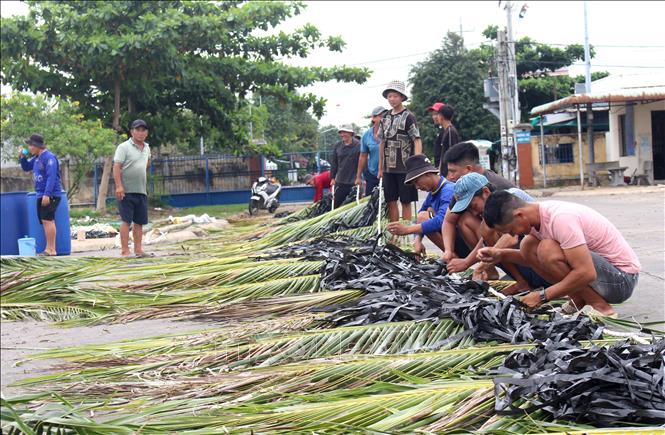
According to local fishermen, no one remembers exactly when the practice of using brushwood as a fishing net originated. They only know that, over many generations, this practice has become an integral part of the fishermen's lives and work in the area.
According to fisherman Bui Van Sa (61 years old) from Phu Thuy ward: Taking advantage of the habit of pelagic fish species that often seek shade to take shelter, local people have devised a way to create brushwood structures, or "houses," on the seabed to attract and keep schools of fish in the fishing grounds. Since then, this profession has been passed down from father to son as a valuable experience for making a living at sea.
A mangrove is constructed from very simple materials such as coconut fronds, bamboo, tamarind branches, split stones, anchor ropes, and buoys. After being woven into large bundles, the mangroves are lowered into sea areas with depths of 15-30 meters that have been carefully surveyed and selected by fishermen.
Underwater, the spreading branches and leaves form artificial reefs, providing shade and shelter for many aquatic species. On the surface, these reefs are marked with floating buoys, each bearing the national flag. The reefs are deployed for about 2-3 months, and when the rainy season reaches its peak, large schools of fish congregate around them. At this time, fishermen use lights to lure the fish away from their shelters before encircling them with nets for harvesting. Each reef lasts a long time; when the leaves rot, the fishermen simply repair them.
These days, at Phu Hai fishing port in Phu Thuy ward, the atmosphere is busier than ever. On the docks and in the boats, fishermen are busy preparing materials for the next fishing trip. Dozens of fishermen line up, sitting and weaving coconut, bamboo, stone cages, and branches to make makeshift fishing nets.
The fishing boat BTh 95924 TS, with a power of nearly 700 horsepower, owned by Mr. Bui Van Mien from Phu Thuy ward, has prepared all the necessary materials and is waiting to load enough brushwood to set sail. This trip, Mr. Mien's boat will carry about 10 bundles of brushwood to be deployed at sea, combining with existing brushwood to create a large-scale artificial reef. The cost of materials for each deployment of brushwood amounts to tens of millions of dong.
According to Mr. Bui Van Mien, this fishing activity usually starts from February to September in the lunar calendar, coinciding with the southern fishing season. Each fishing trip typically departs after the full moon night of each month, concentrating from the 17th to the 19th of the lunar month and fishing during the darkest days, lasting until around the 10th of the following month. The main source of income from this fishing method is economically valuable pelagic fish species such as mackerel, herring, yellowfin tuna, silverfish, and some types of squid...

“In the past, I followed my father to sea and learned the trade from him. My father, in turn, learned it from my grandfather. Several generations in our family have lived off the sea and been involved in this profession. Compared to many other fishing occupations, the initial investment is still lower, while if you work hard and stick with the job, the income is quite stable. If this fishing trip goes as expected and we catch 40-50 tons of fish, my brothers and I will earn tens of millions of dong,” Mr. Mien shared.
According to fisherman Le Van Phuong from Phu Thuy ward, a fisherman with many years of experience in the profession, building a fish trap is not simply a matter of dropping a few branches into the sea. For a fish trap to stand firm amidst the waves, the fisherman must carefully consider everything from material selection and structure to anchoring and choosing a suitable location that aligns with the current and migratory habits of the fish schools. Each fish trap can weigh several hundred kilograms, requiring considerable labor and practical experience.
"Now the boats are equipped with modern supporting equipment such as sonar and scanners, whereas before we only used this brushwood and relied on experience to fish," Mr. Phuong said.
As for fisherman Le Van Muoi from Phu Thuy ward, after many years working in various other fishing professions, he still chose to return to the traditional fishing method because of its stability and sustainability. According to him, this profession is more arduous but has less impact on the marine environment, helps maintain aquatic resources in the long term, and provides a decent income for workers.
What makes the traditional fishing method unique is that many fishermen liken it to self-farming. Instead of relying entirely on natural resources, the people proactively create a habitat, attracting aquatic life to a specific area before fishing. As a result, the fishing operation becomes more efficient and environmentally friendly.

However, the practice of using brushwood as a base for fishing is currently facing many difficulties. Each brushwood base is a valuable asset, requiring significant investment of effort and expense. The constant worry of fishermen is that the brushwood bases will be swept away or damaged by trawlers, causing significant economic losses.
In Lam Dong province, nearly 50,000 people are directly involved in seafood exploitation. Currently, fishermen in the province are busy preparing for the southern fishing season. Favorable weather conditions and the reappearance of many schools of fish are bringing hope for a bountiful harvest, giving fishermen more motivation to continue fishing.
According to the Department of Agriculture and Environment of Lam Dong province, in the first months of the year, despite difficulties in fishing activities due to erratic weather patterns and high fuel and material prices, fishermen in the province maintained stable fishing operations. Many offshore fishing vessels actively stayed at sea. Some fishing methods such as purse seine, gillnet, and squid fishing continued to achieve good results, contributing to increasing the province's total catch. In the first five months of 2026, the province's total seafood catch is estimated to reach approximately 94,000 tons, an increase of 3% (2.82% compared to the same period in 2025).
Source: https://baotintuc.vn/kinh-te/doc-dao-nghe-dung-nha-duoi-bien-don-mua-ca-nam-20260603143306976.htm
![[Photo] Secretary of the National Assembly Party Committee, Chairman of the National Assembly presides over the meeting of the Standing Committee and Executive Committee of the National Assembly Party Committee.](https://vphoto.vietnam.vn/thumb/1200x675/vietnam/resource/IMAGE/2026/06/03/1780480353201_ndo_br_bnd-2585-jpg.webp)

![[Photo] General Secretary and President To Lam presides over a meeting with the Central Organizing Committee.](https://vphoto.vietnam.vn/thumb/1200x675/vietnam/resource/IMAGE/2026/06/03/1780482764658_a1-bnd-4741-3342-jpg.webp)



















































![[Video] Sunset at Lap An Lagoon – Where the sun sets over the fishing nets](https://vphoto.vietnam.vn/thumb/1200x675/vietnam/resource/IMAGE/2026/05/31/1780192137701_beach-landscape-sea-water-nature-grass-745871-pxhere-com.jpeg)








![[Photo] General Secretary and President To Lam attends the 14th Congress of the Vietnam Trade Union](https://vphoto.vietnam.vn/thumb/402x226/vietnam/resource/IMAGE/2026/06/04/1780543339765_anh-man-hinh-2026-06-04-luc-10-22-07.png)



























Comment (0)