

In a Build-Transfer (BT) contract, the State and the investor don't just value a project and a plot of land. They value the time period between the two. Over time, capital costs increase monthly, land prices fluctuate, planning can change, and risks for each party silently accumulate before the contract closes.
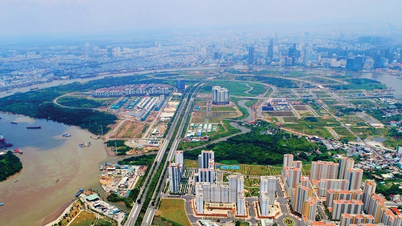
On April 29, 2026, Ho Chi Minh City commenced construction on four major projects with a total investment of approximately VND 142,000 billion, including the new Administrative Center in Thu Thiem, implemented by Sun Group under the Build-Transfer (BT) model. The city also approved a list of 33 land plots intended for payment for BT projects, many located in the city center and Thu Thiem. The BT issue has shifted from legal debate to questions about public assets. At what price will these land plots be valued, under what procedures, and who will benefit from the price increase after infrastructure completion?
The BT (Build-Transfer) model is returning due to real pressure. The medium-term public investment plan for 2026-2030 amounts to approximately 8.22 million billion VND. The budget can hardly cover all infrastructure needs. For projects that do not generate direct revenue streams, such as administrative centers, squares, or certain urban projects, PPP (Public-Private Partnership) projects with toll collection are difficult to operate. BT opens up another option: investors advance capital for construction, and the State reimburses them with land. This argument is convincing, especially when cities need infrastructure projects sooner.
But a rational reason alone is not enough to make a contract secure. With BT, risk is dispersed across three values that coexist within a single agreement.
First and foremost is the project cost. The initial total investment and the actual cost after final settlement can differ. The State Audit Office once recommended addressing over 5,200 billion VND from 29 BT projects, with issues related to total investment, investor selection, land allocation, and determination of actual implementation costs.
 The new legal framework has put BT (Build-Transfer) projects back on a tighter track. Decree 257/2025/ND-CP and related documents establish the mechanism for BT contracts, including payment with land funds, handling of discrepancies, and the role of auditing.
Then there's the land price. Land paid for under the BT (Build-Transfer) model is not a fixed amount of money. Land has location, planning, development rights, and expected value. A plot of land in Thu Thiem before infrastructure is complete will be different from what it is after the area becomes a new administrative, commercial, or service center. If the land price in the contract is lower than its real value, the difference will go out of the public sector. If the land price is set too high to mitigate the risk of loss, the investor's financial plan could be stifled.
BT investors don't just receive land. They bear the risks of construction, capital costs, land handover timing, the potential for land exploitation, and financial obligations associated with that land. A contract that the investor cannot ultimately fulfill will not deliver the project to the State. The principle of equal value in the new legal framework, if strictly implemented, must protect both public assets and the feasibility of the project.
The biggest challenge is time. Construction may begin sooner, while land may be handed over later. Between those two points, the real estate market can go up, down, or stagnate. Interest rates fluctuate. Regional planning is adjusted. The commercial value of the land doesn't remain constant throughout the contract's lifespan. A contract that locks in certain elements at the time of signing but allows others to fluctuate with the market puts both the government and the business on a long-term gamble.
If the market rises sharply, the profit margin may be higher for the investor than the amount the government calculated at the time of signing the contract. If the market corrects or the land is delayed, the investor's financial plan may be disrupted. In both cases, the unallocated risk will not disappear. It will simply wait until one party can no longer bear the burden.
The new legal framework has put BT (Build-Transfer) projects back on a tighter track. Decree 257/2025/ND-CP and related documents establish the mechanism for BT contracts, including payment with land funds, handling of discrepancies, and the role of auditing. But the document is only the starting point. The weight of BT lies in each specific contract. How are project costs audited? When is the land valued? How is the difference between the project value and the land fund handled? What documents allow the public, the People's Council, and the State Audit Office to read those calculations?
The list of 33 land plots in Ho Chi Minh City is a list of planned payments, not land that has already been allocated. Therefore, the current stage is the most crucial for forecasting. Before a land plot leaves the hands of the State, society needs to know how that land is being recorded, what mechanism is being used to determine its value, whether it will be auctioned, and who will be held responsible if the actual value later deviates significantly from the initial plan.
A city might get projects completed sooner thanks to the Build-Transfer (BT) model. But speed alone cannot offset costs. It shifts costs into other forms. Part of it is included in the total investment for the project. Part of it is included in land development rights. Part of it is included in the waiting time between construction, land handover, and operation. This BT test is not just about unlocking resources. It's also about the ability to accurately value three things simultaneously: the project, the land, and the time.
Ten years after completion, the true value of a Build-Transfer (BT) contract will be seen through urban life. Will the project serve the community better, will the land be utilized more efficiently, and will public resources create additional value for the community? If this is achieved, BT can become a reliable way to mobilize resources for a new phase of development.
Source: https://baodautu.vn/doi-dat-lay-ha-tang-bt-gia-cua-toc-do-va-ky-luat-phat-trien-d601172.html
![[Image] Hanoi's urban life under the challenge of a "scorching hot" environment](https://vphoto.vietnam.vn/thumb/1200x675/vietnam/resource/IMAGE/2026/05/25/1779706979265_nang-nong-t5-2026-minh-duy-7-4636-jpg.webp)

![[Image] Close-up view of the interchange connecting the two expressways and Long Thanh Airport.](https://vphoto.vietnam.vn/thumb/1200x675/vietnam/resource/IMAGE/2026/05/25/1779703378210_ndo_br_z7863716673926-224453a31600126cce10622af6290afd-4549-jpg.webp)

























































































Comment (0)