

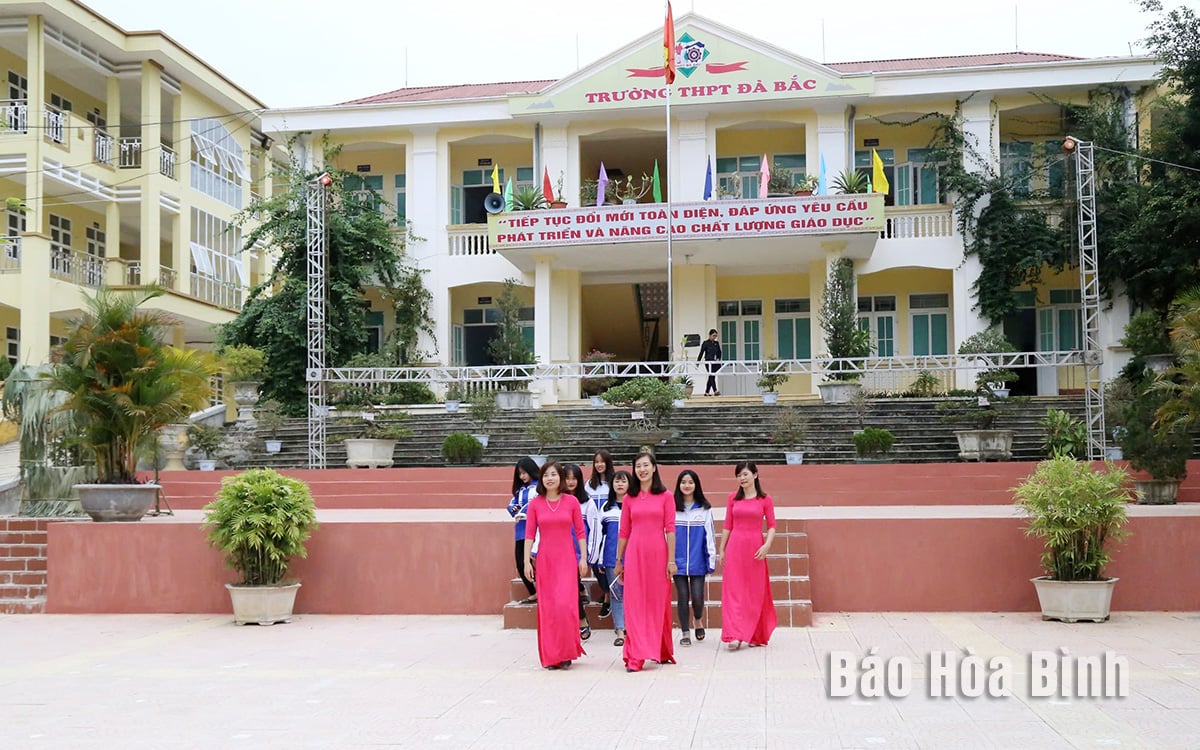
With a focus on caring for the education of ethnic minority communities, Hoa Binh province has concentrated resources on investing in school systems at all levels to meet the learning needs of students. (Photo taken at Da Bac High School, Da Bac district.)
In 1970, answering the call of the Party, Mr. Dinh Van Mung, from Ke hamlet, Hien Luong commune, enlisted in the army. Participating in many major campaigns, including the historic Ho Chi Minh Campaign of 1975, Mr. Mung was wounded several times. Returning to his hometown as a first-class disabled veteran, Mr. Mung continued to participate in production and community activities. In 1979, his family was one of the households that readily relocated their home and abandoned their fields to contribute to the construction of the Hoa Binh hydroelectric power plant. Mr. Mung is one of many ethnic minority people who were ready to fight and sacrifice for the South, for the national interest.
Comrade Ha Van Di, Director of the Department of Ethnic Minorities and Religions, stated: Hoa Binh has a rich history, cultural traditions, and a strong tradition of revolutionary struggle. As a province with a large ethnic minority population, accounting for 74.31% of the total population, many of these groups have long resided and live in concentrated communities in communes and towns. Throughout history, the ethnic minorities in the province have always been united, wholeheartedly following the Party and President Ho Chi Minh, and have made many contributions to the cause of national independence, national reunification, and the building and protection of the Fatherland. Many outstanding sons and daughters of the ethnic minorities have fought and sacrificed heroically.
Over the years, the Provincial Party Committee, the Provincial People's Council, and the Provincial People's Committee have led and directed the thorough understanding of the Party and State's viewpoints and guidelines on ethnic affairs, reforming the work of mobilizing the people and effectively implementing ethnic policies. Hoa Binh province has achieved many accomplishments in all areas of socio-economic development, especially in ethnic affairs, sustainable poverty reduction, new rural development, and building a team of ethnic minority cadres. The socio-economic situation, security and defense, Party building, and the political system have seen many positive changes; the appearance of rural areas inhabited by ethnic minorities in the province has improved significantly.
Thanks to policies and support programs from the province and district, many households have gradually changed their mindset and methods, striving to stabilize their lives. A prime example is the Mong ethnic group in the two communes of Hang Kia and Pa Co in the mountainous district of Mai Chau. Benefiting from Project No. 03-DA/TU of the Provincial Party Committee, many households have developed community tourism models linked to clean agriculture. To date, the lives of the Mong people have seen many positive changes.
Implementing the National Target Program for socio-economic development in ethnic minority and mountainous areas, the infrastructure system in ethnic minority regions has received significant investment, basically meeting the needs of production and people's lives. To date, the percentage of communes with paved or concrete roads leading to the commune center has reached 100%; the percentage of villages with hardened roads leading to the center has reached 95.7%; the percentage of rural residents using hygienic domestic water has reached 95.9%; the percentage of urban residents using clean water has reached 96%; and 100% of communes have access to the national power grid...
Cultural and social fields have received attention and made significant progress; the system of ethnic boarding and semi-boarding schools has been strengthened, expanded, and its quality gradually improved, creating favorable conditions for the educational needs of ethnic minority children. Social welfare policies have been implemented with attention; public health care has seen many positive changes; the system of provincial and district hospitals, regional polyclinics, and commune health stations has received investment in infrastructure and equipment, meeting the medical needs of the people.
The preservation and promotion of the cultural identity, language, writing system, customs, and traditional beliefs of the ethnic minorities are highly valued. Many traditional festivals have been revived; many models of traditional cultural villages and hamlets have been preserved and linked to tourism development. The unique cultural values of the ethnic groups are gradually becoming a resource for socio-economic development, especially tourism development. The fine traditional identity of the ethnic groups, along with the relics, archaeological sites, and artifacts of the Hoa Binh culture, are core conditions for the province to build a sustainable tourism environment, gradually creating unique and attractive tourism products to improve the quality and competitiveness of Hoa Binh tourism in the future.
Fifty years after the reunification of the country, the ethnic minority people of Hoa Binh province have always upheld the spirit of solidarity; the spirit of self-reliance, self-strength, and national pride, striving to compete in labor and production to escape poverty, rise to legitimate wealth, and build Hoa Binh into a rapidly and sustainably developing province.
Phuong Linh
Source: https://baohoabinh.com.vn/274/200726/Doi-moi-vung-dong-bao-dan-toc-thieu-so.htm


![[Photo] General Secretary To Lam attends the inauguration ceremony of Si Pa Phin multi-level boarding school.](/_next/image?url=https%3A%2F%2Fvphoto.vietnam.vn%2Fthumb%2F1200x675%2Fvietnam%2Fresource%2FIMAGE%2F2026%2F01%2F31%2F1769840655651_ndo_br_z7486540481209-f37c7e00a962aec2a061c64b7db569ef-jpg.webp&w=3840&q=75)


![OCOP during Tet season: [Part 3] Ultra-thin rice paper takes off.](/_next/image?url=https%3A%2F%2Fvphoto.vietnam.vn%2Fthumb%2F402x226%2Fvietnam%2Fresource%2FIMAGE%2F2026%2F01%2F28%2F1769562783429_004-194121_651-081010.jpeg&w=3840&q=75)


![OCOP during Tet season: [Part 2] Hoa Thanh incense village glows red.](/_next/image?url=https%3A%2F%2Fvphoto.vietnam.vn%2Fthumb%2F402x226%2Fvietnam%2Fresource%2FIMAGE%2F2026%2F01%2F27%2F1769480573807_505139049_683408031333867_2820052735775418136_n-180643_808-092229.jpeg&w=3840&q=75)



Comment (0)