

The orchard is full of ripe fruit, but sales are still slow.
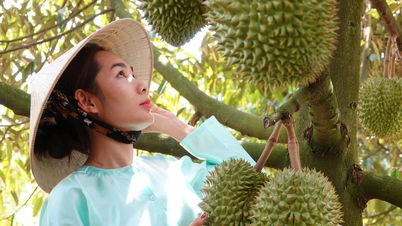
These days, many orchards in Dong Thap province are entering the peak durian harvest season. However, instead of the bustling atmosphere of previous years, many farmers share a common worry as the price of Ri6 durian has dropped to its lowest level ever due to export difficulties. Many households have to extend the time the fruit is left unharvested or sell in small quantities along the roadside to recoup production costs.
According to reports, the price of Grade 1 Ri6 durian currently ranges from 55,000 to 60,000 VND/kg, while lower-quality Ri6 durian is only 25,000 to 28,000 VND/kg. For Thai durian, Grade 1 durian is being purchased by traders at around 85,000 to 90,000 VND/kg, while lower-quality Thai durian is priced at 45,000 to 50,000 VND/kg.

The current sharp drop in prices is mainly due to delays in goods inspection, causing temporary bottlenecks in export progress. Photo: Provided by the interviewee.
Speaking to a reporter from the Industry and Trade Newspaper, Mr. Nguyen Van Hoa, a durian farmer in An Hoa hamlet, Cai Be commune, said that never before have durian growers faced such difficulties as they do now.
"The investment costs for a durian crop are currently very high, from fertilizers and pesticides to labor for care, all have increased sharply, while the selling price has plummeted, leaving many farmers with almost no profit," Mr. Hoa shared.
According to Mr. Hoa, at current prices, many households only have enough to cover their investment costs, not including the labor costs for months of care. Many farmers are also worried that if the situation continues, they will not have enough capital to reinvest for the next crop.
In an interview with the Industry and Trade Newspaper, Ms. Tran Thi Yen Thu, Director of Hong Sang Fruit Company Limited, stated that the images of durians being sold in piles at cheap prices recently mainly show substandard, worm-eaten, rotten, or tree-ripened fruit.
"It's impossible to say that if we can't export, we should just shift everything to domestic consumption, because the purchasing power of the domestic market is limited, especially with large quantities of goods that meet export standards. High-quality durians, if sold in markets, would also find it difficult to maintain a commensurate price due to various costs such as transportation, spoilage, and preservation. Meanwhile, domestic consumers would also find it difficult to absorb the large production volume in such a short time," Ms. Thu added.
According to Ms. Thu, the current sharp drop in prices mainly stems from delays in the inspection process, causing a temporary bottleneck in export progress. However, this is not a long-term problem. Once the inspection process is expedited and goods circulate stably again, procurement and export will gradually return to normal.
Untangle the testing bottleneck, tighten farming procedures again.
Speaking to the Industry and Trade Newspaper, Mr. Vo Tan Loi, Chairman of the Durian Association of Dong Thap province, said that durian consumption this year has decreased sharply, to only about half of what it was in 2024-2025. The biggest reason is the difficulty in exporting due to the tightening import standards of the Chinese market. In addition, the durian harvest season in the Mekong Delta coincides with the Monthong harvest season in Thailand, a type of durian favored by Chinese consumers for its consistent quality.
However, according to Mr. Loi, the biggest bottleneck currently lies in testing capacity. Many laboratories are currently overloaded, resulting in long waiting times for results, directly impacting export progress. Meanwhile, durian is a perishable product and cannot be preserved for as long as many other agricultural products.

Mr. Vo Tan Loi - Chairman of the Durian Association of Dong Thap Province. Photo: Provided by the interviewee.
Normally, the time it takes for a container of durian to travel from a warehouse in Vietnam to the border is only about 7 days. However, currently, just the sampling and waiting for test results takes about 4-5 days. After that, the goods undergo further inspection at the Vietnamese and Chinese border crossings, extending the total time to 10-12 days.
"Some laboratories can only process about 10 containers a day, but in reality, the number of trucks waiting can reach several dozen containers. Therefore, businesses are hesitant to purchase more, and goods are piling up right from the orchards," Mr. Loi added, noting that in the long term, the durian industry must undergo a comprehensive transformation to adapt to the new competitive environment.
In light of this situation, the Dong Thap Provincial Durian Association has petitioned relevant authorities to expand the testing laboratory system and has also proposed that China recognize more qualified Vietnamese testing facilities.
Following repeated requests from local authorities and businesses, the Ministry of Agriculture and Environment has asked testing laboratories to work overtime to expedite the processing of durian samples during the peak season. As a result, durian purchasing and export activities have begun to show more positive changes in recent days, although the congestion problem has not been completely resolved.
The association also believes that planning cultivation areas, controlling traceability, and building a strong linkage chain between farmers, cooperatives, and businesses will be decisive factors for Dong Thap's durian industry to maintain its export advantage in the future.
"For sustainable development, we must start with the farmers. The use of fertilizers and pesticides must follow the correct procedures and adhere to the permitted list, while also building a greener and cleaner farming environment," Mr. Loi emphasized.
After years of rapid growth fueled by official exports, the durian industry in the Mekong Delta is entering a more competitive phase, where quality, traceability, and the ability to meet market standards are decisive factors. This recent sharp price drop during the peak season not only highlights bottlenecks in inspection and export processes but also necessitates a complete restructuring of the entire production chain, from cultivation to consumption. As inspection difficulties are gradually resolved and production processes are tightened, the Dong Thap durian industry is expected to stabilize soon, allowing farmers to confidently continue cultivating this key crop.
Source: https://congthuong.vn/dong-thap-gia-sau-rieng-cham-day-giua-cao-diem-thu-hoach-456133.html
























![[Photo] Reception to welcome General Secretary and President To Lam and his wife on their State visit to the Philippines](https://vphoto.vietnam.vn/thumb/1200x675/vietnam/resource/IMAGE/2026/06/01/1780295488620_vna-potal-chieu-dai-chao-mung-tong-bi-thu-chu-tich-nuoc-to-lam-va-phu-nhan-tham-cap-nha-nuoc-toi-philippines-8798060-7855-jpg.webp)























































Comment (0)