

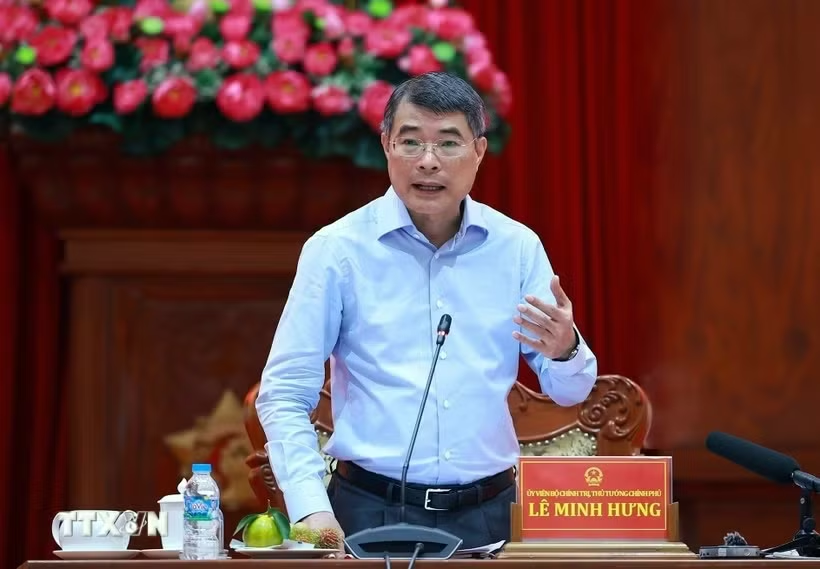
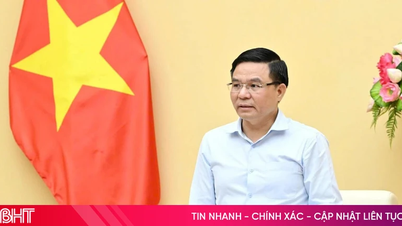
Continuing his working visit to several southern provinces, on the morning of May 27th in Dong Thap, Prime Minister Le Minh Hung chaired a meeting with the Standing Committee of the Dong Thap Provincial Party Committee to discuss the implementation of socio -economic development tasks and the goal of double-digit growth; disbursement of public investment capital; operation of the two-tiered local government; the implementation of Resolution 57; and addressing difficulties and obstacles faced by the locality.
Also attending were Central Committee members: Dang Xuan Phong, Minister and Head of the Government Office ; Do Thanh Binh, Minister of Home Affairs; Tran Hong Minh, Minister of Construction; Dao Hong Lan, Minister of Health; Hoang Minh Son, Minister of Education and Training; and leaders of several central ministries and agencies. Representing Dong Thap province were Provincial Party Secretary Ngo Chi Cuong; members of the Standing Committee; and leaders of several provincial departments and agencies.
Boosting infrastructure investment and improving the development environment.
According to the report from Dong Thap province at the meeting, economic growth (GRDP) in the first quarter of 2026 continued to increase by 6.14%, showing that the economy maintained its recovery and positive growth momentum. Total state budget revenue in the province in the first five months of the year exceeded 12.2 trillion VND, reaching 51.5% of the annual forecast and 107.8% compared to the same period last year.
The main sectors of the economy (agriculture, industry, services) continued to develop, with agricultural production reaching 3.47%, exceeding the target of 3.4%; the service sector increased by 7.57%; export turnover is estimated at approximately US$4 billion, an increase of nearly 10% compared to the same period; total retail sales of goods and consumer service revenue increased by 13.73%, higher than the national average; the industrial-construction sector maintained growth at 7.89%; disbursement of public investment capital in the first 5 months of the year is estimated at VND 2,008.8 billion, reaching 18.8% of the plan assigned by the Prime Minister and 17.4% of the plan assigned by the Provincial People's Council.
The province has completed the adjustment of the Provincial Planning for the period 2021-2030, with a vision to 2050, aiming to maximize development space and potential strengths; and is coordinating the implementation of many key transportation projects such as the My An-Cao Lanh expressway, the Cao Lanh-An Huu expressway, and the expansion of the Ho Chi Minh City-Trung Luong-My Thuan expressway. To date, 18 out of 26 key transportation projects have been completed.
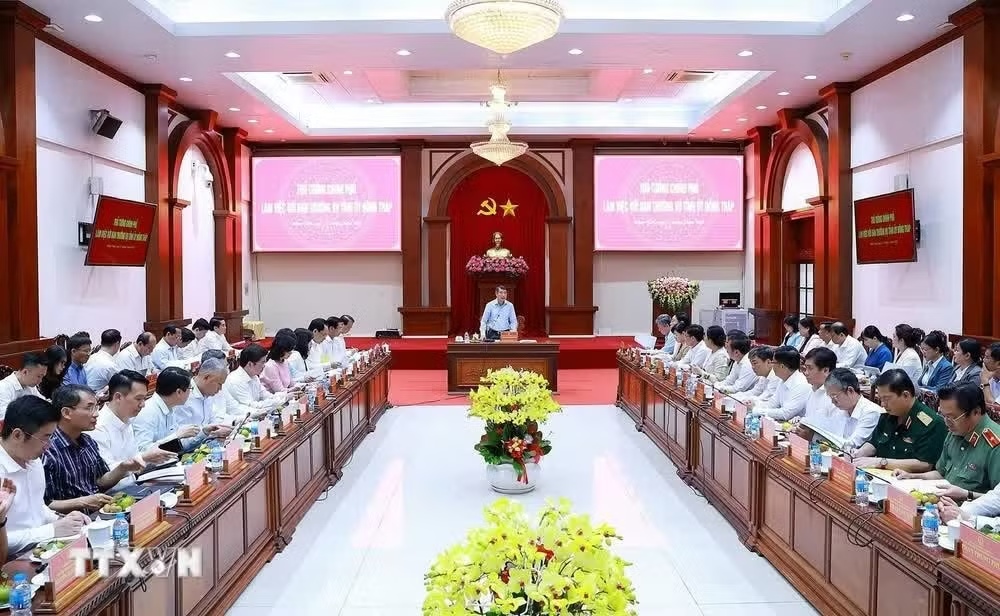
Meanwhile, the implementation of Resolution 57 of the Politburo on breakthroughs in science and technology development, innovation, and digital transformation has been focused on; administrative reform, reduction, and simplification of administrative procedures have continued to be promoted; the work of reviewing and resolving difficulties for stalled and long-standing investment projects has been focused on and directed, and 8 out of 12 projects with difficulties and obstacles on the database system of the Steering Committee 751 have been resolved.
Cultural, social, ethnic, religious, defense, security, and foreign affairs fields received focused guidance and implementation; social order and safety were ensured. Party building and the strengthening of the political system were prioritized; the capacity and fighting strength of Party organizations and members were enhanced.
During the working session, leaders from central ministries and agencies analyzed and clarified the province's potential, strengths, and achievements, answered questions and addressed concerns, while also pointing out existing shortcomings and limitations hindering the province's development. They also suggested solutions to overcome obstacles in areas such as public investment disbursement, innovation, digital transformation, the operation of the two-tiered local government system, and transportation infrastructure, thereby creating momentum to help Dong Thap province achieve even stronger development in the future.
Strongly innovate thinking, action, and management methods.
After listening to reports and discussions from ministries and agencies, Prime Minister Le Minh Hung, in his concluding remarks, basically agreed with and highly appreciated the preparations for the meeting by Dong Thap province; acknowledged and commended the outstanding efforts and results achieved by the Party Committee, Government, and people of Dong Thap province in the past; and affirmed that the results achieved by the province are on the right track in accordance with the spirit of the Resolution of the 14th National Congress of the Party.
Analyzing the limitations, difficulties, and challenges hindering the development of Dong Thap, the Prime Minister noted that although growth in the first quarter of 2026 showed positive developments, it did not meet the set plan; budget revenue remained low and unsustainable; the economic structure shifted slowly, with agriculture still accounting for the largest proportion and low added value; and per capita GRDP remained low compared to the national average. Furthermore, slow disbursement of public investment was a major bottleneck for the province's development, especially for key central government projects; the inter-regional transportation system was not synchronized, hindering logistics and attracting large investments; attracting large-scale investments remained limited; the processing industry and high-tech industry had not developed commensurate with their potential; and there was a lack of leading enterprises in the processing industry and high-tech agriculture. Human resources were also limited and did not meet the requirements.
Calling for a strong shift in thinking, action, and management methods, the Prime Minister emphasized that Dong Thap province needs to proactively propose specific policies and mechanisms suitable to the local situation; and update them into the local action program based on assigned key tasks. The province should develop a growth program and scenario, assign members of the Standing Committee to be responsible for specific areas, and strengthen supervision, monitoring, and evaluation of results in a substantive manner.
The Prime Minister noted that Dong Thap must urgently issue a plan for the effective implementation of the provincial planning, continuing to update and supplement it within its authority; focus on completing solutions to address obstacles for infrastructure projects; thoroughly handle surplus and unused public assets such as houses and land; develop a comprehensive and modern cultural and social infrastructure; and build a medium-term public investment plan for the period 2026-2030 ensuring compliance with socio-economic accounting requirements and evaluating investment efficiency before capital allocation.
The Prime Minister urged Dong Thap to define a new growth model based on science and technology, innovation, digital transformation, as well as the province's potential, competitive advantages, and available resources; to promote the development of ecological and modern agriculture, linked with deep processing, brand building, meeting domestic market demands and boosting exports; and to develop the coastal region into a multi-sector marine economic center adapting to climate change.
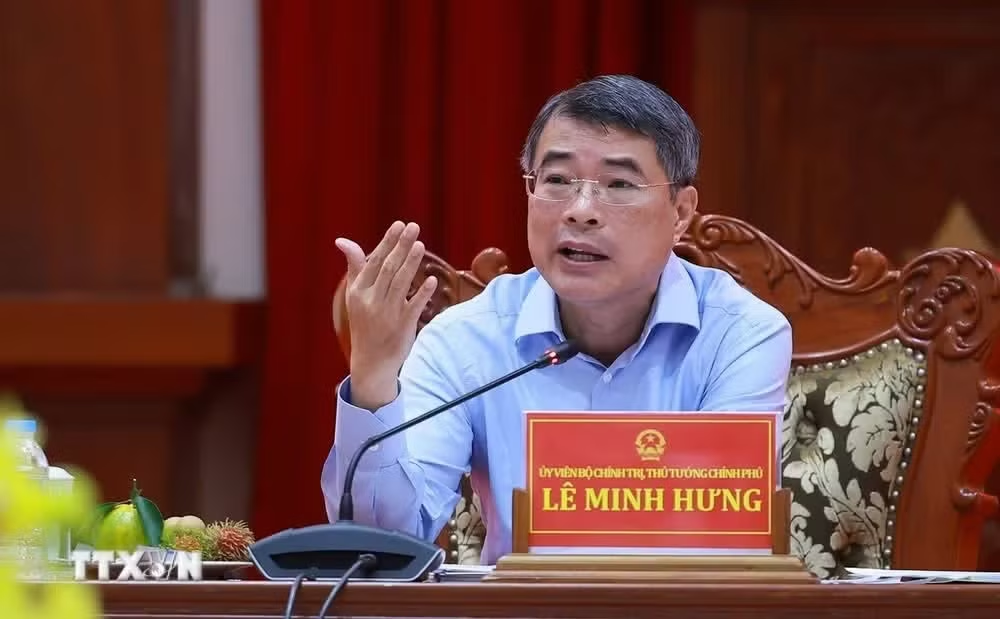
The Prime Minister emphasized the need to accelerate the development of the processing industry; develop industrial zones along the Tien and Hau rivers into processing centers for agricultural and aquatic products; and expedite investment in the Tan Kieu, Song Hau 2, Hoa Tan, Cao Lan II, and Cao Lan III industrial parks. He stressed the importance of developing regional logistics, building large logistics centers, and transforming the province into a hub for transshipment, warehousing, and distribution of goods connecting the Mekong Delta region with Ho Chi Minh City and export markets. He also called for the development of border trade, maximizing the effectiveness of the two international border gates and other auxiliary border crossings. Furthermore, he highlighted the need to develop eco-tourism, agricultural tourism, and rural tourism, especially focusing on distinctive local products with established brands.
In addition, according to the Prime Minister, Dong Thap needs to focus on removing difficulties and obstacles, accelerating the allocation and disbursement of public investment capital in 2026; proactively reallocating capital from slow-disbursement projects to projects with good disbursement potential and a need for additional capital; speeding up land clearance progress, especially for important national key projects in the area such as the Ho Chi Minh City-Trung Luong-My Thuan expressway expansion, and the Dong Tam-National Highway 1 interchange; and urgently addressing outstanding and long-standing projects to maximize resources for development.
Noting that the Central Government will soon conduct a review of one year of operation of the two-tiered local government apparatus, the Prime Minister requested the province to ensure the smooth operation of the model, improve the effectiveness of public service implementation, especially in arranging, assigning, training, and fostering commune-level officials in a number of fields; accelerate the progress of arranging, managing, and using public assets and surplus offices to ensure efficiency and economy; be proactive and flexible in organizing the apparatus and arranging personnel to suit the needs and practical situation of each locality, ensuring progress without causing disruption; and reorganize public service units in the fields of education and health.
Regarding the implementation of Resolution 57 of the Politburo on breakthroughs in science and technology development, innovation, and digital transformation, the Prime Minister noted the need to strengthen resource mobilization, focus on developing human resources for science and technology, innovation, and digital transformation; promote vocational training linked to business needs; attract science and technology personnel; cooperate with major universities in the region; and support young people in innovative entrepreneurship.
The head of the government also requested the province to effectively implement social welfare, ethnic, and religious policies; build social housing; organize regular health check-ups or free screenings for people at least once a year, with a plan for disease treatment and classification of which groups will receive state support; focus on implementing the construction of 6 multi-level boarding schools in border communes; and at the same time, prepare well the conditions for management and operation to ensure efficiency and prevent waste; and carefully study the demand for rental housing to implement appropriate projects in Dong Thap province.
The Prime Minister also emphasized that the province must focus on Party building and building a unified, cohesive, honest, democratic, proactive, and effective administrative system; and building a professional, clean, dedicated, and people-serving staff.
Regarding the province's proposals and recommendations, after listening to the discussions and responses from leaders of ministries and agencies at the meeting, the Prime Minister basically agreed in principle and instructed ministries, agencies, and localities to continue studying the content of the recommendations to coordinate handling and proactively implement tasks within their authority; and to promptly report and propose to competent authorities any issues beyond their authority.
Earlier that morning, Prime Minister Le Minh Hung and the Central delegation also visited and offered incense at the tomb of Deputy Scholar Nguyen Sinh Sac - the father of President Ho Chi Minh - at the Nguyen Sinh Sac historical site in Cao Lanh ward, Dong Thap province.
Source: https://cand.vn/dong-thap-phai-khai-thac-hieu-qua-du-dia-phat-trien-moi-post812086.html
![[Photo] The courage of new recruits of Brigade 144 on the training ground.](https://vphoto.vietnam.vn/thumb/1200x675/vietnam/resource/IMAGE/2026/05/27/1779881651341_anh-man-hinh-2026-05-27-luc-18-32-52.png)
![[Photo] The heat at the fireworks display site on the opening night of the Da Nang International Fireworks Festival 2026](https://vphoto.vietnam.vn/thumb/1200x675/vietnam/resource/IMAGE/2026/05/27/1779889741485_ndo_br_z7872039145157-fecaba5112f39e8352544099d7ef4738-5140-jpg.webp)







































![[Photo] The courage of new recruits of Brigade 144 on the training ground.](https://vphoto.vietnam.vn/thumb/402x226/vietnam/resource/IMAGE/2026/05/27/1779881651341_anh-man-hinh-2026-05-27-luc-18-32-52.png)



















Comment (0)