

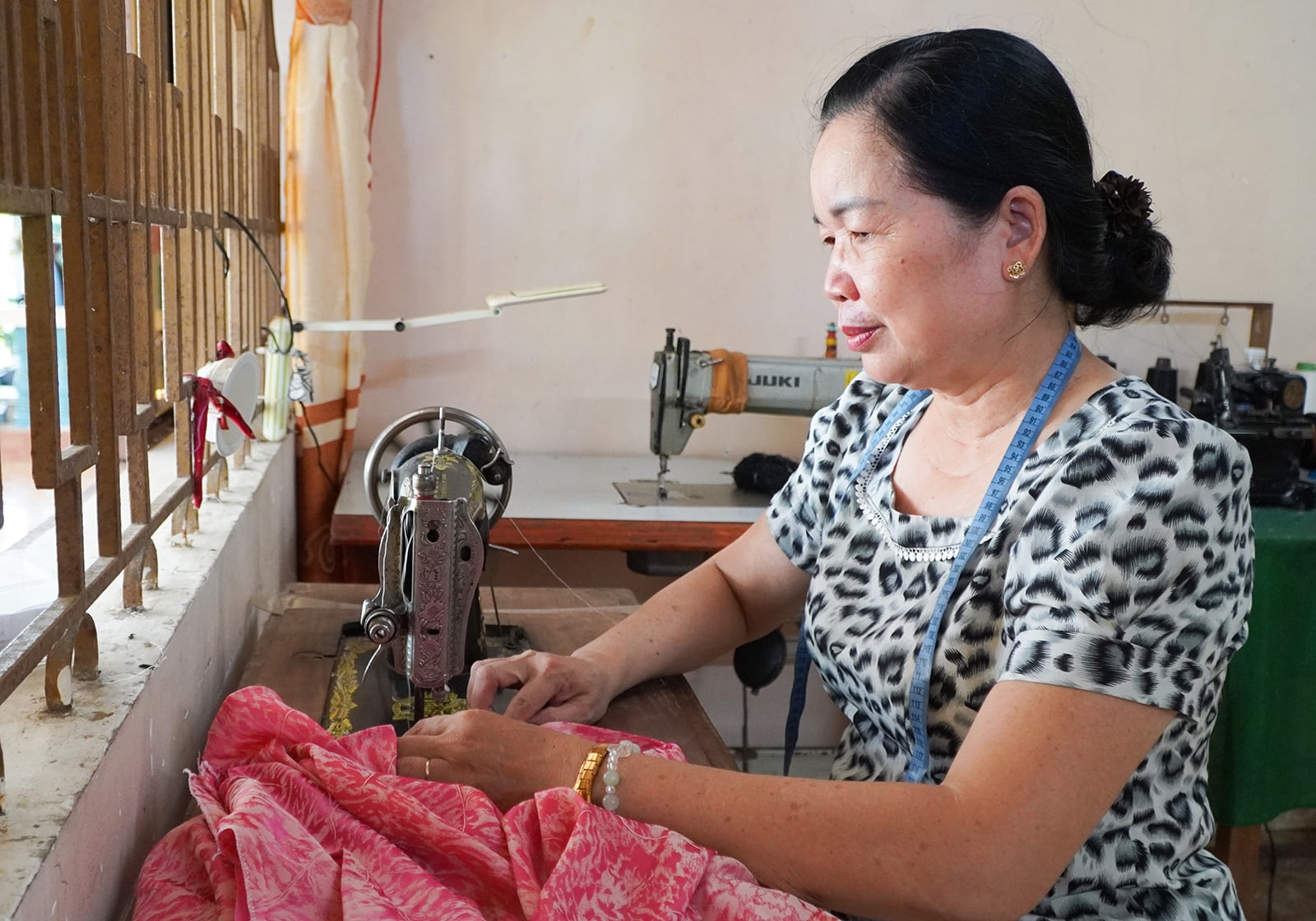
Ms. Nguyen Thi Kim Anh sews clothes to earn extra income. Photo: THU OANH
In previous years, in the Catholic hamlet of Thanh Loi, many women relied solely on a few acres of rice paddies for their livelihood. After the rice harvest, they would work as laborers, shelling cashew nuts or doing sewing to supplement their income. At times, when rice prices dropped and livestock farming failed, many households struggled to afford their children's education. However, thanks to loans from the Social Policy Bank and the support of local women's organizations, many women have been able to plan their businesses, expand their livelihoods, stabilize their lives, and provide their children with a proper education.
At 57 years old, Ms. Nguyen Thi Kim Anh, residing in Thanh Loi hamlet, still maintains the habit of waking up early to work in the fields, then taking the time to sew clothes for her neighbors. Ms. Kim Anh recalls that in the past, her family mainly lived off farming, with unstable income, and with three children successively going to university, the family's finances became even more strained. "When I struggled to pay for my children's tuition, I worked hard and received support from the Social Policy Bank to borrow capital, which helped me overcome the difficulties," Ms. Kim Anh recounted.
With borrowed capital and savings, her family gradually expanded their production. Besides rice farming, she also raised breeding pigs and sewed traditional Vietnamese dresses and outfits for people in the Catholic neighborhood to supplement her income. “To have some income, I went to vocational training. I joined any suitable class the women's association offered,” Mrs. Kim Anh said with a gentle smile when mentioning the classes on growing organic vegetables, livestock farming techniques, or making coconut fiber brooms organized by the local authorities. Her three children have all graduated from university and have stable jobs.
Not far from Ms. Kim Anh's house, Ms. Vu Thi Tuyet Anh (36 years old) also experienced a period of hardship and financial struggle when she first started her own family. Many years ago, her family was classified as near-poor and received a 40 million VND loan from the Social Policy Bank. With the capital in hand, she and her husband invested in raising breeding pigs and bought more land for production to improve their income. Every day, she also takes on cashew nut shelling jobs, which, although hard work, helps her family earn extra money for her children's education. According to Ms. Tuyet Anh, the most valuable thing about policy loans is that they give people opportunities to do business instead of having to borrow money at high interest rates. "Once you have capital, you have to know how to plan and work hard to improve your life," she shared.
Not only has she been involved in helping members access capital, but for many years, Ms. Pham Thi Kim Lien, Head of the Women's Association in Thanh Loi Hamlet, has also been familiar with the difficult circumstances of each household in the hamlet. Having been involved in the Association's work and credit since 2009, she is currently the Head of the Savings and Loan Group, with outstanding loans exceeding 1 billion VND for approximately 43 households. Recalling her early days in the work, Ms. Lien said: “Back then, transportation was difficult, and many households lived far away. I had to drive until late at night to collect principal and interest on time. It became a habit. I would visit and encourage households in need. The important thing was to maintain the group's reputation so that people could continue to receive support in the future.”
For Ms. Lien, maintaining the credibility of the loan group is not simply about collecting interest on time, but also about ensuring that many poor women continue to have access to capital for their businesses. Behind each loan lies the education of their children and the livelihood of their entire family. Whenever a family faces difficulties due to crop failure or losses in livestock farming, she proactively visits and encourages them to keep striving. Ms. Lien also proactively proposed opening many vocational training classes for local women, such as industrial sewing, broom making, flower arranging, sprout cultivation, and livestock farming techniques. Thanks to this, many women have found jobs in factories or are self-employed at home to increase their income.
Ms. Lien is also a prime example of overcoming hardship and achieving success in the local area. Besides farming and livestock, her family also grows lilies and marigolds to sell during Tet (Lunar New Year), with thousands of pots sold each year. "The women here are very hardworking. As long as they have capital and a skill, they can do it," Ms. Lien shared.
Ms. Lam Thi Tuyet Nhung, Vice President of the Women's Union of Thanh Dong commune, said that nearly 1,500 female members in the locality are borrowing capital from the Social Policy Bank, with a total outstanding debt of over 62 billion VND. The capital is focused on programs for poor and near-poor households, job creation, students, clean water, and environmental sanitation. The overdue debt rate is currently only 0.6%. “The good news is that many women, after accessing capital, have planned their businesses, raised their children, and gradually stabilized their lives. Currently, there are only 11 poor women's households in the commune. Many households that were previously in difficult circumstances have now become relatively well-off,” Ms. Nhung said.
Source: https://baoangiang.com.vn/dong-von-nho-vun-dap-mai-nha-a487116.html



![[Photo] Standing Committee member of the Party Central Committee Tran Cam Tu working with the Central Inspection Committee](https://vphoto.vietnam.vn/thumb/1200x675/vietnam/resource/IMAGE/2026/05/28/1779969579668_ndo_br_bnd-2495-jpg.webp)










































































Comment (0)