

 |
People walk past a countdown clock to the 2026 World Cup in Guadalajara, Mexico, on March 24. Photo: Reuters . |
Ahead of the opening of the 2026 World Cup on June 11th, the anticipation surrounding the biggest football tournament on the planet has not generated the tourism effect that was initially expected.
Last year, FIFA President Gianni Infantino described the 2026 World Cup as the equivalent of “104 Super Bowls,” with a projected global audience of up to 6 billion people. FIFA also expects the tournament to generate approximately $30.5 billion in economic benefits for the three host nations: the United States, Mexico, and Canada.
However, according to Fortune , the reality in the US is showing less than vibrant signs.
A new report from the American Hotel and Lodging Association (AHLA) indicates that nearly 80% of the more than 200 hotels surveyed in 11 US host cities are reporting lower bookings than initially expected. The report suggests that projected economic growth from the World Cup “may not meet expectations.”
The hotels surveyed are located in New York, Los Angeles, Boston, Seattle, San Francisco, Houston, Dallas, Miami, Philadelphia, Atlanta, and Kansas City.
Some sources claim that FIFA created an “early demand signal” by booking a large number of hotel rooms in advance, then adjusting the bookings in March. At that point, FIFA activated the cancellation clause and cut thousands of rooms in several host cities to match actual demand.
 |
The match between the Japanese and Australian national football teams in the 2026 World Cup qualifiers at Saitama Stadium 2002, Saitama, Japan, on October 15, 2024. Photo: Issei Kato/Reuters . |
FIFA stated that the adjustments were "standard practice" for a large-scale event and were made in accordance with the agreement with the hotel partner.
However, accommodation professionals in the US believe the problem lies not just in the number of rooms available.
Most hotels surveyed cited lengthy visa procedures for international guests, geopolitical tensions, and rising travel costs as the main reasons why demand has not surged as predicted.
Indeed, cost is becoming a major barrier for fans. Data cited by Fortune shows that tickets for many games in the US have exceeded $1,000 , while tickets for the finals at MetLife Stadium (New Jersey) were at one point listed at nearly $33,000 .
Besides football ticket prices, travel costs have also risen sharply. Analysis by Deutsche Bank shows that the price of intercontinental airfare once increased from around $167 to over $400 in just a few weeks. Even train fares from New York to MetLife Stadium were controversial due to their high increase before being adjusted downwards.
Against this backdrop, some hotels in the U.S. describe this year's World Cup as "an insignificant event" for the local hospitality industry, according to a report by the American Hotel & Lodging Association (AHLA).
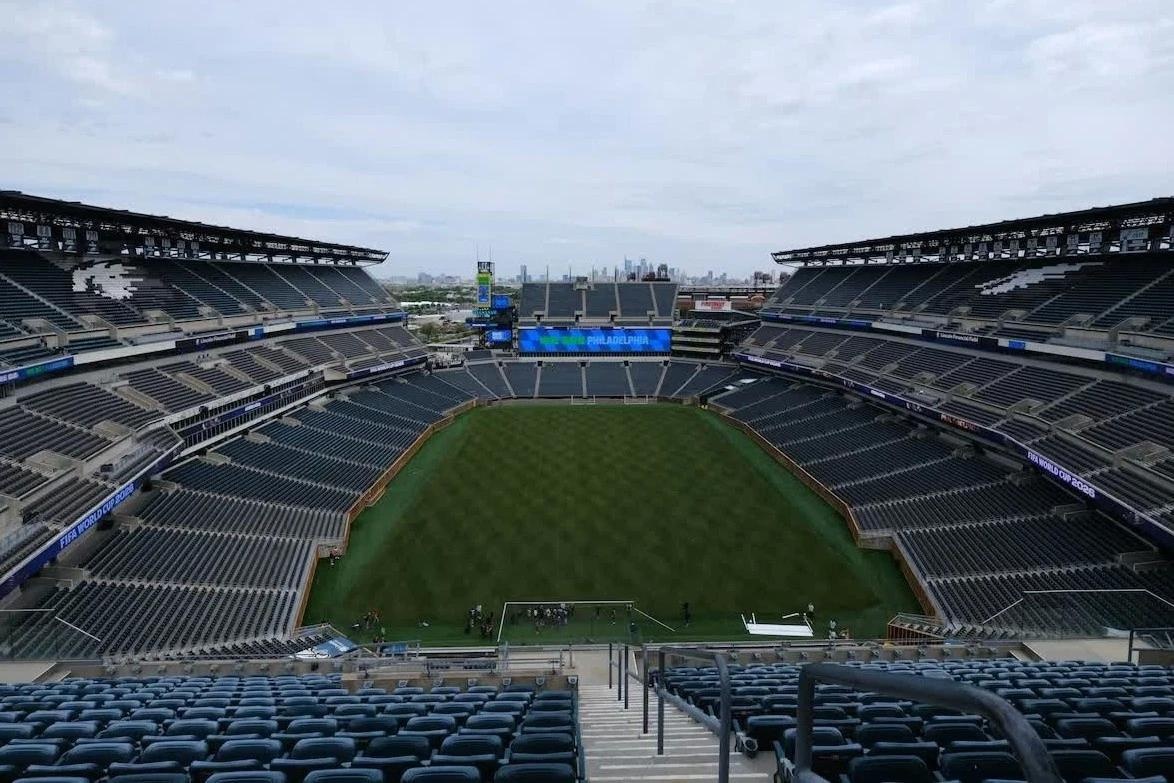 |
A panoramic view of Lincoln Financial Field stadium in Philadelphia, Pennsylvania, USA, ahead of the 2026 World Cup, May 13. Photo: Reuters . |
However, not all forecasts are pessimistic.
According to Oxford Economics , the World Cup could still bring a certain increase in GDP for host cities during the summer, while also creating short-term jobs in the hospitality and entertainment sectors.
Lisa Delpy Neirotti, director of the Sports Management program at George Washington University, argues that the World Cup certainly has an economic impact, but initial expectations are often raised too high.
"Everyone likes big numbers. It makes people excited and confident. While reality often doesn't live up to expectations," she observed.
According to experts, even when tickets are almost sold out, the market can still see a wave of last-minute bookings. This could benefit the tourism and hospitality industries at the last minute.
However, the gap between initial expectations and current developments suggests that the 2026 World Cup in the US may not generate the strong tourism boost that FIFA had predicted.
Source: https://znews.vn/du-lich-my-cho-mai-chua-thay-loi-ich-tu-world-cup-post1655015.html

![[Image] Nearly 125,000 Hanoi students completed the Literature exam for the 10th grade entrance exam.](https://vphoto.vietnam.vn/thumb/1200x675/vietnam/resource/IMAGE/2026/05/30/1780117233041_ndo_br_thiet-ke-chua-co-ten-2-png.webp)




























































































Comment (0)