

As usual, on the 4th day of the first lunar month, at the Keo Pagoda National Special Monument in Vu Tien commune, Hung Yen province, the local authorities hold a spring festival to welcome a large number of visitors from all over to admire the scenery and worship Buddha and the Saints. This is a traditional regional festival that still retains the simple charm of the rice-farming people of the Red River Delta.
A unique ancient Vietnamese temple.
Keo Pagoda (Than Quang Tu), located in Vu Tien commune, Hung Yen province, is one of Vietnam's most representative ancient pagodas. Situated beside the tranquil Red River, the pagoda possesses an ancient and majestic beauty amidst the fertile plains.
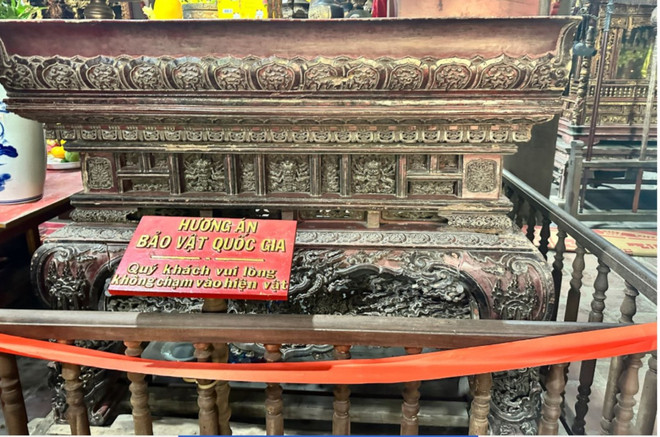
With its outstanding historical, architectural, and cultural value, Keo Pagoda was ranked as a Special National Monument by the Prime Minister in 2012; the Keo Pagoda Festival was recognized as a National Intangible Cultural Heritage in 2017; and the Keo Pagoda altar was recognized as a National Treasure in 2021.
Keo Pagoda, also known as Than Quang Temple, is a historical and cultural relic comprising two architectural complexes: a Buddhist temple and a shrine dedicated to Saint Duong Khong Lo, a great master of the Ly Dynasty who contributed to the construction of the pagoda.
According to historical records, Zen Master Dương Không Lộ was from Giao Thủy village, Hà Thanh prefecture (now Giao Thủy district, Nam Định province), and his family were fishermen. He became a monk at the age of 29. In 1060, he traveled to India to practice Buddhism.
Legend has it that he once cured King Ly of an illness, and was therefore appointed National Preceptor. Later, King Ly renamed the temple Than Quang Temple. Today, the temple still retains the name Than Quang Temple, but it is commonly known as Keo Temple because it is located in Keo village (Duy Nhat commune, Vu Thu district, former Thai Binh province).
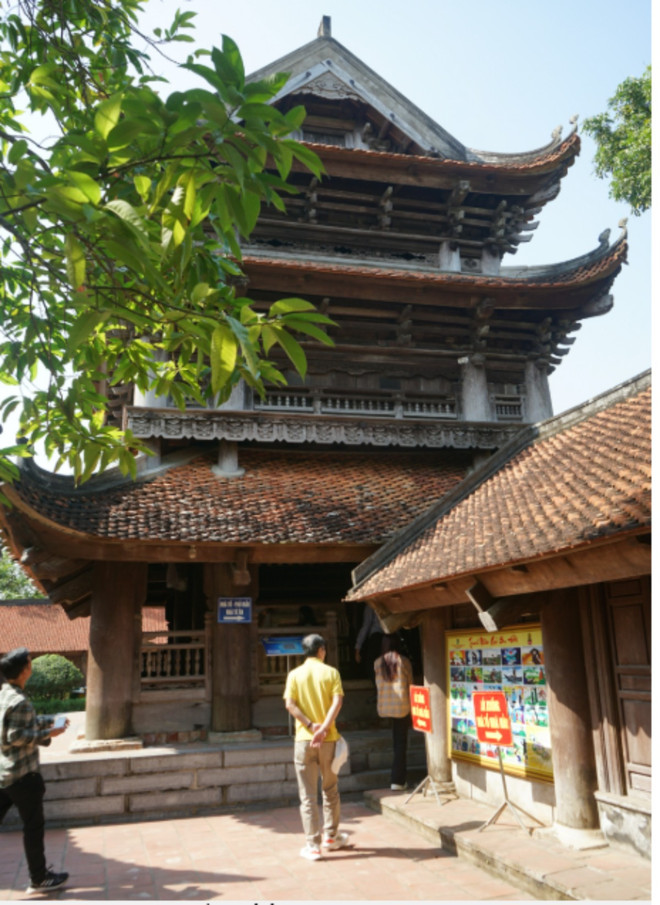
Having existed for nearly 400 years, and undergoing numerous renovations and restorations, Keo Pagoda still retains its unique ancient Vietnamese architectural style dating back to the Le Trung Hung period (17th century), with its gracefully curved roofs, sturdy ironwood columns, and tiled roofs. Currently, Keo Pagoda comprises 17 structures with 128 rooms, including main architectural works such as the triple gate, the Buddha temple, the Saint's hall, corridors, the monks' quarters, and the bell tower.
The most distinctive architectural feature is the 11.04-meter-high wooden bell tower with three tiered roofs and 12 gracefully curved eaves. The first floor houses a 1.2-meter-high stone chime; the second floor holds a 1.3-meter-high, 1-meter-diameter bronze bell cast in 1686; and the top floor houses two smaller bells cast in 1796. In 2012, Keo Pagoda was classified by the State as a Special National Monument.
The highlight of the historical site is the wooden bell tower with its stacked roof. For a long time, it has been a cultural symbol of Thai Binh, the land of rice.
Not only famous for its exquisite architecture, sculpture, and fine art, Keo Pagoda also preserves many precious artifacts, including an exquisitely carved wooden altar, which was recognized as a National Treasure in 2021, affirming the special value of the site in the national cultural heritage. All of these factors have contributed to the great value and influence of the annual Keo Pagoda festival.
A place where the cultural essence of the Northern Delta region converges.
The Keo Pagoda Festival is one of the major festivals in the Northern region of Vietnam, and was recognized as a National Intangible Cultural Heritage by the Ministry of Culture, Sports and Tourism in 2017.
Visitors to the festival are delighted to learn that two festivals are held here each year: the Spring Festival (on the 4th day of the first lunar month) and the Autumn Festival (in mid-September of the lunar calendar), both commemorating the merits of Saint Khong Lo and praying for national peace and prosperity, favorable weather, and abundant harvests. Although the timing differs, both festivals share the spirit of honoring ancestors, praying for national peace and prosperity, bountiful harvests, and a prosperous new year for all.
To organize the festival, the villagers meticulously prepare offerings in advance, including familiar local products such as sticky rice, wine, fruits, and banh chung (traditional Vietnamese rice cakes). All these offerings are carefully selected by the villagers, who choose reputable individuals with complete families, clean records, and prosperous businesses to carry out the village's assigned tasks.
Besides offerings, the people also prepare for other activities taking place during the festival, ensuring that the festival is organized thoughtfully, solemnly, and rich in traditional identity. From the preparation stage to the main event, all activities are carefully coordinated by the local government and the organizing committee, ensuring the preservation of long-standing spiritual and cultural traditions.
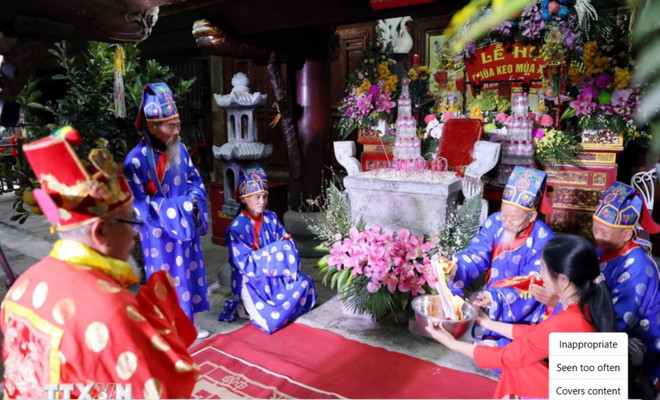
The ceremonial activities include: the opening ceremony; the inauguration ceremony; the incense offering ceremony; and the activities of the ceremonial groups at the Gia Roi temple. In addition to traditional sacrificial rituals, the ceremony also includes restored and preserved rituals such as puppet shows and spirit medium performances.
The Keo Pagoda Festival combines the characteristics of both an agricultural festival and a historical festival. It features folk cultural and artistic activities intertwined with religious rituals, most notably the procession of the sacred palanquin, which expresses reverence and remembrance of the merits of the deities and ancestors of the village. Through these rituals, the villagers pray for the blessings and protection of the deities, hoping for a bountiful harvest, a peaceful and prosperous life, and good fortune.
Besides the ceremonial part, there is a vibrant festival with many unique cultural, artistic, and sporting activities such as: betel leaf folding competition, traditional boat dance, singing festival, lantern festival, folk games like fire-making and rice-cooking competition; lion dance; duck catching in the lake; singing festival; chess; blindfolded drum beating; climbing the corn bridge; and the first writing of the year... The first writing of the year is a very meaningful activity, reflecting the tradition and moral principle of remembering one's roots and respecting teachers. This is also an opportunity for future generations to show their respect for their ancestors, emphasizing the importance of learning and valuing intellect among the Vietnamese people.
The festival concludes with the ritual of paying homage to the deity, a special ceremony unique to the Keo Pagoda festival. The dance performed during this ritual is an ancient dance, performed using both rowing and frog-catching movements. The vigorous and decisive movements are directed towards the altar, as if to express to the deity the boundless gratitude of the villagers towards him.
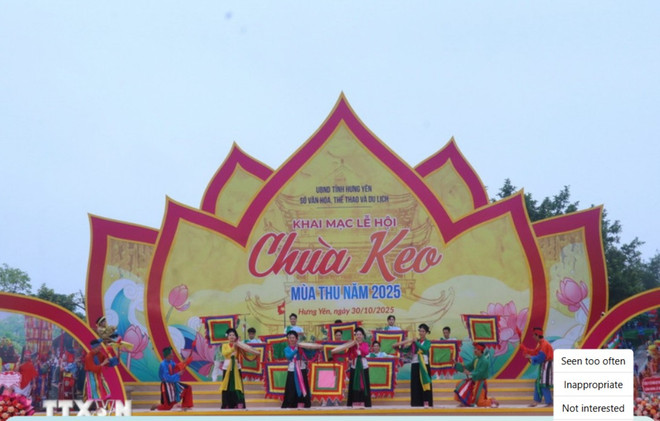
The Keo Pagoda Festival holds significant cultural and spiritual value, serving not only as an occasion to show reverence to ancestors but also as a chance to preserve the age-old cultural traditions of the nation. Many unique activities, sacred rituals, and solemn ceremonies held within the festival framework highlight the beauty of traditional culture, strengthening solidarity and close ties among members of villages, hamlets, and families; at the same time, conveying dreams and aspirations for a prosperous and happy life, and educating the younger generation to cherish what their ancestors left behind and strive to build a prosperous and happy life.
Through the festival, visitors can immerse themselves in the sacred atmosphere of the ancient temple, experience the beauty of folk culture in the Red River Delta region, and cultivate pride and awareness in preserving and promoting the unique cultural heritage of Hung Yen province.
Preserving and safeguarding the beauty of traditional festivals.
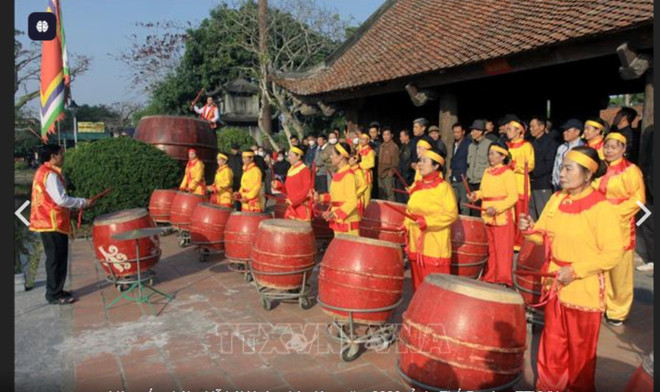
Over the years, thanks to the efforts of various units and localities, the Keo Pagoda National Special Monument has been preserved intact, and the pagoda grounds have been invested in and renovated to be spacious, bright, green, clean, and beautiful.
Aware of its responsibility towards heritage of exceptional value, a symbol of local culture and tourism, Hung Yen province consistently invests in elevating festivals, spreading and promoting the cultural, artistic, architectural, and sculptural values of the relics.
Preserving and developing tourism related to the Spring Festival at Keo Pagoda requires a parallel and harmonious approach, balancing the preservation of tradition with the needs of modern tourism.
First and foremost, conservation efforts must focus on preserving the original state of architecture, landscape, and traditional rituals. Processions, ceremonies, and folk performances should be maintained according to proper rituals, avoiding excessive commercialization that could erode cultural values. At the same time, local authorities need to strengthen public awareness campaigns to educate residents and tourists about environmental hygiene, protecting historical sites, and practicing civilized behavior during festivals.
Furthermore, developing tourism related to the Keo Pagoda Spring Festival needs to be linked to promoting the pagoda's image, building distinctive tourism products, and applying digital technology in introducing the historical site. Investing in infrastructure, parking facilities, and appropriate service areas will enhance the visitor experience while still ensuring the pagoda's solemn atmosphere.
The Hung Yen Provincial People's Committee has identified the future planning of Keo Pagoda as an important task aimed at preserving and promoting the value of the relic, gradually transforming it into a cultural, religious, and scenic center of the province and the Red River Delta.
When conservation goes hand in hand with sustainable development, the Keo Pagoda Spring Festival will continue to promote its historical and cultural values, contribute to boosting the local economy, and spread the traditional national identity.
Source: https://www.vietnamplus.vn/du-xuan-tray-hoi-chua-keo-post1094395.vnp
![[Photo] General Secretary and President To Lam and his wife begin their official visit to Thailand.](https://vphoto.vietnam.vn/thumb/1200x675/vietnam/resource/IMAGE/2026/05/27/1779881249412_anh-man-hinh-2026-05-27-luc-18-10-51.png)
![[Photo] The courage of new recruits of Brigade 144 on the training ground.](https://vphoto.vietnam.vn/thumb/1200x675/vietnam/resource/IMAGE/2026/05/27/1779881651341_anh-man-hinh-2026-05-27-luc-18-32-52.png)




























![[Photo] The courage of new recruits of Brigade 144 on the training ground.](https://vphoto.vietnam.vn/thumb/402x226/vietnam/resource/IMAGE/2026/05/27/1779881651341_anh-man-hinh-2026-05-27-luc-18-32-52.png)
















Comment (0)