

The exhibition not only contributes to honoring the nation's tradition of valuing education but also spreads the ideological value that "Talented people are the lifeblood of the nation," a value that remains relevant in today's era.

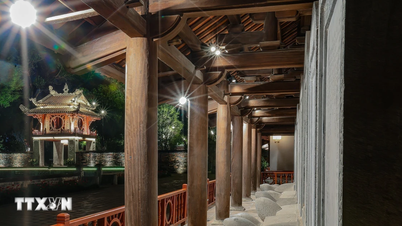
The exhibition consists of two main parts. The first part, titled "Quoc Tu Giam - Vietnam's First National School," introduces the history of its formation, development, and typical values of the Temple of Literature - Quoc Tu Giam.
The exhibition highlights the roles of three kings who made significant contributions to the establishment and development of the National Academy: Ly Thanh Tong, Ly Nhan Tong, and Le Thanh Tong. These kings laid the foundation for the examination-based education system, valuing the training and utilization of talent to build a prosperous nation.
The second part, themed "Famous Figure Than Nhan Trung (1419-1499)", focuses on introducing the life, career, and outstanding contributions of this renowned doctor of philosophy who valued talented individuals. Than Nhan Trung was a prominent official, teacher, and poet during the early Le Dynasty.
He passed the imperial examination with the highest rank (Hội nguyên), earning the title of Third-Class Doctor of Literature in the Kỷ Sửu year of 1469. He also held the position of Quốc Tử Giám Tế tửu - the highest position in the Quốc Tử Giám at that time.
In his role, he was directly involved in training talented individuals, teaching the princes, and contributing to the development of the country's education system. Not only was he an exemplary teacher, but Than Nhan Trung was also entrusted by King Le Thanh Tong with compiling the first doctoral inscription erected at the Temple of Literature during the Le Dynasty.

This also marks the beginning of the system of 82 famous doctoral steles that exist today - a valuable documentary heritage that has been inscribed by UNESCO as a World Documentary Heritage.
Through his famous saying, "Talented people are the lifeblood of the nation," Than Nhan Trung affirmed the exceptionally important role of talented individuals in the prosperity of the country. This idea not only reflects the strategic vision of the feudal dynasty regarding education and human resource training but also becomes a consistent value in the Vietnamese tradition of valuing learning and respecting talented people.
According to the organizers, the exhibition aims not only to introduce the history of the Imperial Academy and the life of the renowned figure Than Nhan Trung, but also to contribute to educating about the tradition of studiousness, arousing national pride, especially among the younger generation.
The values of a studious spirit, respect for teachers, and the aspiration to nurture talent continue to spread in the context of the country's focus on developing high-quality human resources.

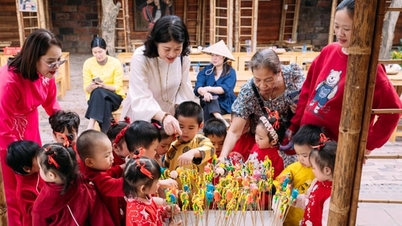
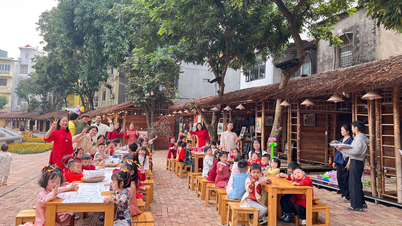
Besides the exhibits, the exhibition also organizes many educational activities and heritage experiences for visitors, such as learning about Confucian scholarly books, binding books with traditional dó paper, experiencing old-fashioned classrooms, grinding ink, and printing calligraphy…
These activities help the public, especially students, to get closer to traditional educational spaces, thereby gaining a better understanding of the history of examinations and the learning culture of their ancestors.

Organizing the exhibition in the hometown of the renowned figure Than Nhan Trung also signifies connecting the cultural heritage of Thang Long - Hanoi with localities rich in scholarly traditions.
This activity also contributes to bringing heritage closer to the community, breathing new life into traditional cultural and educational values in contemporary life.
Source: https://baovanhoa.vn/van-hoa/dua-di-san-quoc-tu-giam-den-gan-hon-voi-cong-chung-229212.html



![[Image] Hanoi's urban life under the challenge of a "scorching hot" environment](https://vphoto.vietnam.vn/thumb/1200x675/vietnam/resource/IMAGE/2026/05/25/1779706979265_nang-nong-t5-2026-minh-duy-7-4636-jpg.webp)












































































Comment (0)