


According to the Da Nang Museum, the temple dedicated to Lady Than Ha Xu (also known as the Lady's Shrine or Mausoleum) was built 241 years ago, in 1785. The temple consists of three sections, with a yin-yang tiled roof and walls constructed of brick and mortar. Previously, the temple was located close to the Han River.
Due to a historic flood, the Han River's water level rose and overflowed into the temple, causing the structure to deteriorate rapidly. In addition, the tremors from the explosion at the US-backed South Vietnamese ammunition depot during the war against the US (now part of the An Don Industrial Zone) severely damaged the temple.
By 1971, the villagers had mobilized and raised funds to restore and rebuild the Ba Than Ha Xu temple as it stands today. The head of the temple's ceremonial committee is Mr. Nguyen Huu Hoang, who is nearly 70 years old. He recounts that the Ba Than Ha Xu temple is a place of worship for the ancestral figure Ba Than, who contributed to the reclamation and development of the land on the right bank of the Han River.
In the past, the name of this revered ancestor was used to name the land on the right bank of the Han River, called Ba Than (or Ha Than) region. Because this region was vast, the ancients divided it into four smaller regions: Ba Than Upper Region, Ba Than Middle Region, Ba Than Lower Region, and Ba Than Rear Region. After Ba Than passed away, the villagers of Ba Than Rear Region erected a temple to worship her year-round.
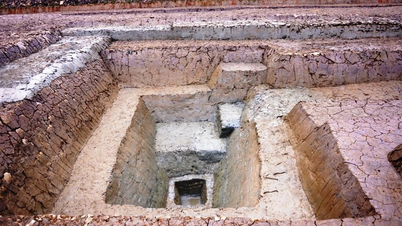
“Within the temple grounds, there is also an ancient Cham well. Next to the well is an ancient banyan tree. Currently, the worship practices in the temple also show a blend of Cham and Vietnamese elements,” Mr. Hoang said.
In 2022, the temple was classified as a city-level historical relic by the People's Committee of Da Nang City. Mr. Hoang said that this place was originally located in the vicinity of An Hai Citadel, symmetrical to Dien Hai Citadel on both banks of the Han River, two key defensive positions along Da Nang Bay of the Nguyen Dynasty during the early resistance against the French.
During the resistance war against the US, this location was chosen by revolutionary forces as a base for troops, to hide weapons and food, to shelter cadres, and as a springboard for main army units and local militia to ambush enemy troops and attack many enemy bases in the inner city of Da Nang.
The name of Lady Than has been given to the land on the right bank of the Han River. The Lower Lady Than Temple is one of the religious and cultural centers of the An Hai village community. It is a cultural symbol, a place where interwoven layers of history converge and reflect.
Source: https://baodanang.vn/duoi-bong-tram-nam-3325570.html

![[Photo] General Secretary and President To Lam and his wife, along with General Secretary and President Xi Jinping and his wife, attending a tea party.](https://vphoto.vietnam.vn/thumb/1200x675/vietnam/resource/IMAGE/2026/04/15/1776245678527_vna-potal-tong-bi-thu-chu-tich-nuoc-to-lam-va-phu-nhan-cung-tong-bi-thu-chu-tich-nuoc-tap-can-binh-va-phu-nhan-du-tiec-tra-8702812-9829-jpg.webp)
![[Image] Overview of the Tam Trinh-Giai Phong connecting road section after land clearance is completed.](https://vphoto.vietnam.vn/thumb/1200x675/vietnam/resource/IMAGE/2026/04/15/1776245679644_ndo_br_dji-0195-jpg.webp)
![[Photo] Capturing each moment at the "People We Meet" photography exhibition.](https://vphoto.vietnam.vn/thumb/1200x675/vietnam/resource/IMAGE/2026/04/15/1776245695648_1-8944-jpg.webp)
![[Photo] General Secretary and President To Lam and General Secretary and President Xi Jinping meet with youth from both countries.](https://vphoto.vietnam.vn/thumb/1200x675/vietnam/resource/IMAGE/2026/04/15/1776245687540_vna-potal-tong-bi-thu-chu-tich-nuoc-to-lam-va-tong-bi-thu-chu-tich-nuoc-tap-can-binh-gap-go-thanh-nien-hai-nuoc-8702371-jpg.webp)
![[Image] Current status of the land area of over 5.5 hectares that Ho Chi Minh City is considering reclaiming.](https://vphoto.vietnam.vn/thumb/1200x675/vietnam/resource/IMAGE/2026/04/15/1776245690095_1-3102-8409-jpg.webp)












































































Comment (0)