

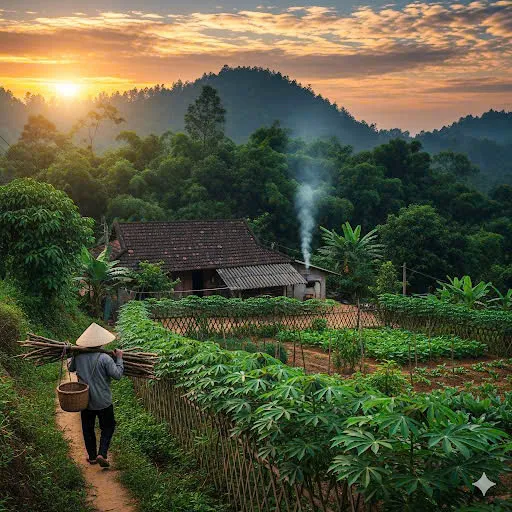
My house is at the foot of the mountain, its dark brown tiled roof blending in with the trees. A wisp of smoke drifts from the small kitchen. I know my mother has returned from the garden and has just started the fire to cook dinner. I wonder what she'll cook this evening. A pot of braised fish with pickled vegetables, or some braised pork belly with lots of ripe olives, cooked until tender, slightly charred, and incredibly fragrant. My rumbling stomach begins to grow while the forest becomes noisy with the first gusts of wind carrying a hint of chill.
I remember the seeds that had just sprouted on the ground. They were always fresh and tender, trembling weakly but also endlessly proud. They pushed through the heavy soil to emerge when the cool rain fell from the sky.
I often followed my parents out to the garden. I was still a child, and my mother would say, "Put on your sandals, or there will be thorns in the garden." But I didn't want to wear sandals because I loved the feeling of the damp, soft garden soil gently caressing my feet. My father would strike the first blow with the hoe, and my older brother would sing. He always sang whenever he went into the garden. The garden seemed like our whole wonderful world . Our garden connected to the forest, separated only by a row of cassava plants. The trees in the garden and in the forest were all overgrown, the only difference being that the forest trees grew without any order. They grew freely, reached freely, cast shade freely, and the squirrels with their fluffy tails ran, jumped, and climbed freely.
I squatted down under a very large sapodilla tree and gazed at the seedlings. The spring breeze brushed against my ears and cheeks. I had always thought that every tree in the garden, every leaf, every flower, knew joy and sorrow.
My brother suddenly stopped singing, sat down beside me, and whispered:
Hey, I just saw a flock of red birds.
I spun around:
- Really?
He raised one hand to his mouth, and with the other, he pointed to what he saw. Wow, there were hundreds of them! They were red. All of them were red. They perched on the tree branches like ripe fruit.
I saw Dad wave, and we tiptoed back home, leaving the garden to the flock of birds. We would sit on the porch, my brother and I, silently watching the birds perch heavily on the budding treetops. Every year we waited for this moment together. My father said: "A good place attracts birds." That meant we were living in a "good place."
My father returned from the Dien Bien Phu battlefield, bringing with him the lifestyle, mindset, and discipline of a soldier. We were raised by a soldier. He always spoke about the value of peace. “Be grateful for being born and raised in peace, my children. Be grateful to our country for allowing us to admire its beautiful nature.”
Years passed, we left, and occasionally brought our parents back. The old house was gone, but my brother had a very large garden right by the river, where he grew vegetables and fruits, and raised fish, chickens, and ducks... Three generations of his family lived there. From the forest near the house, I took my children to the river. This river felt so familiar, as if it had always flowed within me, or as if I had always been immersed in it throughout the years. As the old saying goes, "proximity to the market is best, proximity to the river is second." Indeed, even now, life for those living beside rivers is always pleasant, peaceful, quiet, and harmonious. In the fenced garden, a few ducks were dipping their beaks into a puddle of water. My brother said that there had been heavy rain upstream a few days ago, and the water level had risen significantly. These ducks had drifted on the river, washed ashore in the puddle near the garden, and were now staying there. They were probably someone's flock of ducks from way up upstream that had been swept away by the water during the night.
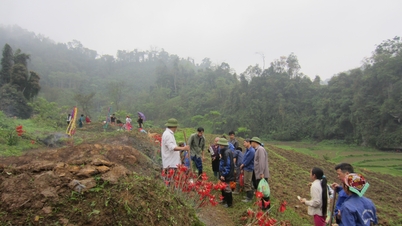
Beside the garden was the river at dusk, with all its timeless beauty. Here, on this river, on this bank, on the other, everything felt familiar, even the Hmong women burning their fields. Of course, they were probably the daughters, even granddaughters of the women of yesteryear, but somehow I felt they were the same Hmong women of the past. For decades, the Hmong had lived behind the mountains, far from the town, far from the Kinh people, and had to travel by boat to cross the river. That day, when I passed by, I saw them tying a sling to a cool branch, with a sleeping child inside. My brother and I would occasionally go there to glean cassava for feed. We would leave in the early afternoon, dig up the cassava, and bring it back to the foot of the mountain so we could cross the river and get home in time, by which time the sun had already set. And even so late, the child still stirred in the sling hanging from the branch. From within the sling, its round eyes looked out, its mouth smacking. Then, when it grows up, before long, its first steps will also be those of climbing mountains.
Back then, I used to stand on the hill behind my house and look across, seeing the mountain ranges one after another, each higher than the last, with no end in sight. Throughout the summer, the sun blazed fiercely from morning till evening. Each Man person, when going to work in the fields, would cut a palm frond. They would plant the frond in the ground to provide shade, moving it wherever they went. They would shade the east side in the morning and the west side in the afternoon. The fronds constantly shifting reminded me of ants carrying food too large for their bodies. I thought this because I couldn't see the people, only the fronds constantly changing positions on the red slopes. When the sun set and the grass had dried, they would gather it into piles and begin burning it. As dusk fell, the red flames blazed across the slopes. Occasionally they would paddle across the river in their rafts, carrying a few things – chickens, eggs, or fish they caught, or corn, potatoes, and cassava… to sell quickly and then buy oil, salt, MSG, and soap. They rarely smiled, had difficulty communicating in Vietnamese, were honest and simple, and didn't know how to bargain.
I asked my nephew to take me across the river. He busily pulled out the boat. And we went upstream and crossed to the other side while the sun had already set, but it would still be light for a long time. In the old days, his father took me across the river on a raft; now he takes his younger siblings across in a motorboat. I don't see my childhood in my children, and perhaps it would be difficult for them to find themselves here, in the present but steeped in their mother's childhood memories. But somehow we still connect, the children of today and the children of forty years ago.
We were silent, partly because the boat's engine was too loud for the quietness of the river nestled beneath the high cliffs, and partly because we didn't want to utter a word.
I used to believe that the river had feelings, sometimes it was angry, but mostly it was gentle. I even believed it had a heart—a wet, warm heart that one day might fit snugly in my hand, wriggling like a little fish and splashing water. Of course, I left later. I left the river and knew it would always be noisy in the summer, quiet when the cold winter days swept their chill across the dry rocks. But what I imagined most was a child on that dry riverbed hugging some cassava roots, looking downstream.
The Mán women haven't returned yet, the fires are still burning brightly, and the fragrant smell of smoke wafts from the burnt bean stalks.
Source: https://www.sggp.org.vn/duoi-nhung-ngon-nui-post811928.html

![[Photo] National Assembly Chairman Tran Thanh Man working with the Standing Committee of the Economic and Financial Committee](https://vphoto.vietnam.vn/thumb/1200x675/vietnam/resource/IMAGE/2026/05/20/1779249584387_ndo_br_1-jpg.webp)
![[Photo] General Secretary and President To Lam presides over a meeting on assessing national development resources.](https://vphoto.vietnam.vn/thumb/1200x675/vietnam/resource/IMAGE/2026/05/20/1779253785852_a1-bnd-2943-8519-jpg.webp)































![[Workers' Month 2026] Spreading love on the Vinh - Dong Hoi frontline: Nearly 1 billion VND spent on caring for the lives of workers.](https://vphoto.vietnam.vn/thumb/402x226/vietnam/resource/IMAGE/2026/05/20/1779237885217_img_8650.jpeg)

































Comment (0)