Following restructuring and mergers of units, Vietnam Railways Corporation has achieved initial results with a streamlined organizational structure and revenue growth…
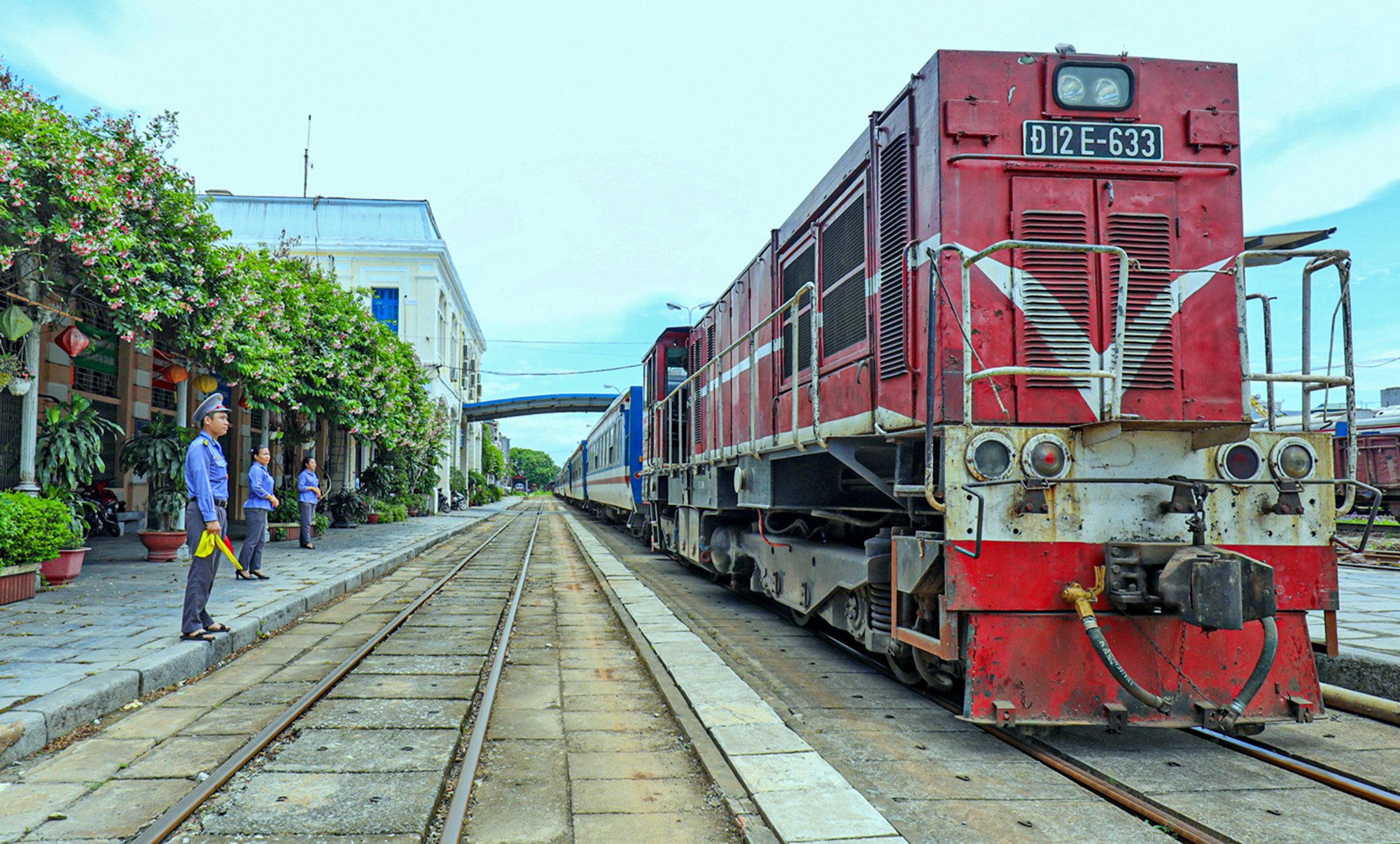
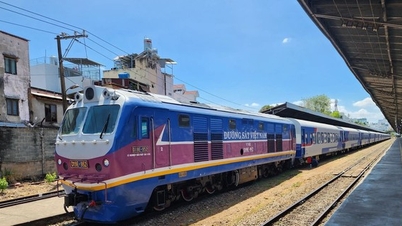
"It's stressful and hard work, but the income is higher. " Sharing with a reporter from Giao Thong Newspaper before the Thong Nhat passenger train heading south on a late afternoon at the end of the year, Mr. Nguyen Thanh Trung, a train driver at the Hanoi Locomotive Enterprise, said: "The train crew on duty today pulled the train all the way to Da Nang. It's very stressful because there are so many level crossings and unauthorized access points across the railway."
The restructuring and merger of units and enterprises under the Vietnam Railways Corporation have initially been successful, with many units performing well and employees' incomes increasing. Photo: Ta Hai.
Two years ago, when I worked at the Yen Vien Locomotive Depot, the train crews only had to travel short distances. Since January 2023, the Yen Vien Locomotive Depot merged with the Hanoi Locomotive Depot, and the train crews have been assigned to all routes, including long-distance trains. "I've been with the Yen Vien Locomotive Depot for over 27 years. When the merger happened, many other train drivers were worried. Before, we mainly worked on local trains, about 100-150km. But here, we have to pull trains all the way to Da Nang , which is much harder. In return, the income has improved, averaging about 10 million VND per month, so the crews are more at ease with their work," Mr. Trung confided. Mr. Truong Quang Toan, Deputy Head of the Vehicle Management Department of the Vietnam Railway Transport Corporation, stated that he officially "stepped down" from his position effective November 1, 2024 – the date the company commenced operations after the merger of the Hanoi Railway Transport Corporation and the Saigon Railway Transport Corporation. Prior to this, he held the position of Head of the Vehicle Management Department at the Hanoi Railway Transport Corporation. This reorganization and reassignment of duties affects not only him but also many other leading officials in both companies. Previously, when the two companies were separate, they had to rent carriages from each other, which involved more complicated procedures. Now, carriages can be easily mobilized wherever needed, without distinguishing between the units whose carriages belong to which company. "I myself have learned a lot from my colleagues and from the leadership and management methods of the former Saigon Railway Transport Corporation," Mr. Toan shared. Many benefits, but also many concerns. In an interview with Giao Thong Newspaper about the effectiveness after two years of merger, Mr. Nguyen Ngoc Thang, Director of Hanoi Locomotive Enterprise, shared that many people had concerns before the merger. When the Yen Vien and Hanoi locomotive enterprises merged, naturally some departments and divisions with the same functions and tasks would be reduced to one, leading to an excess of deputy department heads. At the same time, after the merger, the total number of employees reached 1,030. To ensure sufficient work and stable income for this number of workers, the two units had previously developed plans and prepared thoroughly, especially focusing on ideological work. A year before the merger, neither unit appointed any new staff; if a head of department resigned, their deputy took over. After the merger, regulations, mechanisms, and policies were reviewed and adjusted to suit the workers in all departments, from repair to train driving. During the implementation process, timely adjustments were made to address any arising difficulties and shortcomings. Within just six months, the merged enterprise's operations stabilized, especially the morale of the workers, eliminating the distinction between "Yen Vien" and "Hanoi." Regarding the Railway Transport Joint Stock Company, Mr. Do Van Hoan, Chairman of the Board of Directors, stated that despite being newly operational, the benefits are clearly visible: reduced intermediate layers, concentrated resources in terms of infrastructure and machinery. Specifically, 5 departments, 3 branches, and one rolling stock factory were eliminated. The planned workforce of 4,744 people, compared to the merger plan presented in 2022, resulted in a saving of 619 people (a reduction of 11.52%), and compared to the pre-merger period, a saving of 133 people (a reduction of 2.73%). "Most encouragingly, after the merger, production and business activities are doing very well. Revenue is expected to grow by about 18% compared to the same period in 2023," Mr. Hoan said. Initial Success Looking back at the restructuring and merger of units and enterprises under the Vietnam Railway Corporation over the past two years, Mr. Dang Sy Manh, Chairman of the Board of Members of the Vietnam Railway Corporation, said that this has been initially successful. Mr. Manh said that before proposing and submitting the plan for arranging the subordinate units to the competent authorities, the corporation had clearly recognized the shortcomings and overlaps. This was most evident with the two railway transport companies in Hanoi and Saigon. In terms of model, each company had many branches with similar functions. For example, at one station area, each company had to arrange a team for passenger transport, a team for freight transport, and establish branches in key areas. The unit has proposed to the competent authorities a plan for the arrangement and restructuring of the three project management, locomotive, and transportation sectors. The three project management boards were merged into one, commencing operations on December 1, 2022. Five locomotive enterprise branches were merged and restructured into three branches, commencing operations on January 1, 2023. Two transportation joint-stock companies were merged into the Railway Transportation Joint Stock Company, commencing operations on November 1, 2024. Following the restructuring of these units, the organizational structure has been streamlined; the workforce has been reorganized more efficiently, reducing indirect labor and cutting costs. For example, the locomotive sector has seen preliminary savings of 134 billion VND per year compared to before. Since 2022, after many years of being affected by the Covid-19 pandemic, railway transportation has begun to turn a profit.
Following the merger, the Railway Project Management Board reduced 6 departments, resulting in cost savings: a 15% reduction in total management costs/total revenue; average income for the first 11 months of 2024 reached VND 25.5 million/person/month, an increase of 214.81% compared to before the merger.With 3 locomotive factory branches, 12 departments, 1 locomotive station, and 2 locomotive driver teams were reduced. Cost savings in 2023 included a reduction of VND 134 billion, with a planned reduction of VND 30 billion in 2024. Average income compared to before the merger includes: Indirect labor: nearly VND 9.6 million/person/month (an increase of 13.65%), direct labor: over VND 10.6 million/person/month (an increase of 23.51%).At the Vietnam Railway Transport Joint Stock Company, the average salary for employees is over 10.8 million VND/month, an increase of 29.14%.



![[Photo] General Secretary and President To Lam meets with National Assembly delegates from ethnic minorities.](https://vphoto.vietnam.vn/thumb/1200x675/vietnam/resource/IMAGE/2026/04/20/1776696701056_a1-bnd-8331-3342-jpg.webp)
![[Image] National Assembly discusses the implementation of the socio-economic development plan.](https://vphoto.vietnam.vn/thumb/1200x675/vietnam/resource/IMAGE/2026/04/20/1776696707422_ndo_br_img-20260420-185419-jpg.webp)





















































































Comment (0)