

Last week, the state of New Jersey subpoenaed FIFA, requesting information and an investigation into ticket costs at MetLife Stadium, the venue for the final on July 19th.
On May 27, New York State Attorney General Letitia James and her New Jersey counterpart Jennifer Davenport confirmed the opening of a joint investigation. In a statement, they said that ticket prices set by FIFA were significantly higher than in any previous World Cup, raising suspicions of ticket supply manipulation and misleading seating arrangements for the 2026 World Cup.
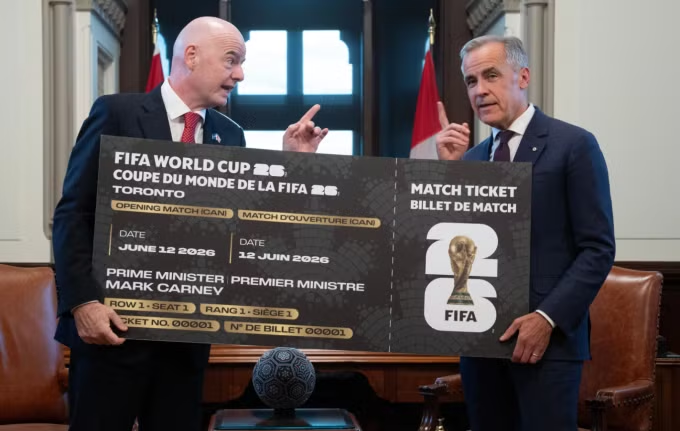
The state of California has also reportedly sent a request for clarification to FIFA regarding the transparency of the seating chart used in ticket sales. Authorities will examine whether fans were misled during the ticket purchasing process for the tournament held in the US, Canada, and Mexico.
FIFA has not yet issued an official comment. Earlier, President Gianni Infantino attracted attention when he said that those who bought tickets for the final match for more than $2 million might be "personally brought a hot dog and a can of Coca-Cola by him."
Sports lawyer Alexander Rojas stated that FIFA cannot take this development lightly, as US state attorneys general have considerable power in the field of consumer protection. According to him, although FIFA is an international organization, when selling tickets in the US, they must still comply with consumer protection laws like any other business. The fact that the World Cup is being held in New York and New Jersey makes it even more difficult for FIFA to remain uninvolved in the investigation.
The 2026 World Cup will be the biggest World Cup in history, with 48 participating teams, up from 32 previously. The organizers have promoted it as the "most accessible" tournament for fans.
However, legal experts suggest that the investigation's findings could lead to corrective actions, including potential refunds, credits, or a requirement for transparency in ticket classification. They also noted that a last-minute change to the seating plan is unlikely, but financial compensation is a more realistic scenario.
Controversy also erupted regarding seating arrangements. Some fans accused FIFA of altering seat assignments between ticket categories after sales opened, resulting in them not receiving the seats they had initially expected.
New York consumer protection officials warned FIFA could be in violation of the law if allegations of misleading information are proven. Meanwhile, US lawmakers have also demanded clarification on how tickets were sold and seating was allocated.
According to experts, the focus of the investigation is not on whether FIFA has the right to sell tickets at high prices, but rather whether consumers were misled by misleading information or artificial scarcity. Analysts suggest that FIFA may choose a settlement rather than prolonging the legal dispute, in order to avoid damaging its image ahead of the 2026 World Cup.
Source: https://baohatinh.vn/fifa-nguy-co-phai-hoan-tien-ve-world-cup-2026-post311588.html





























![[Photo] Reception to welcome General Secretary and President To Lam and his wife on their State visit to the Philippines](https://vphoto.vietnam.vn/thumb/1200x675/vietnam/resource/IMAGE/2026/06/01/1780295488620_vna-potal-chieu-dai-chao-mung-tong-bi-thu-chu-tich-nuoc-to-lam-va-phu-nhan-tham-cap-nha-nuoc-toi-philippines-8798060-7855-jpg.webp)

































































Comment (0)