

 |
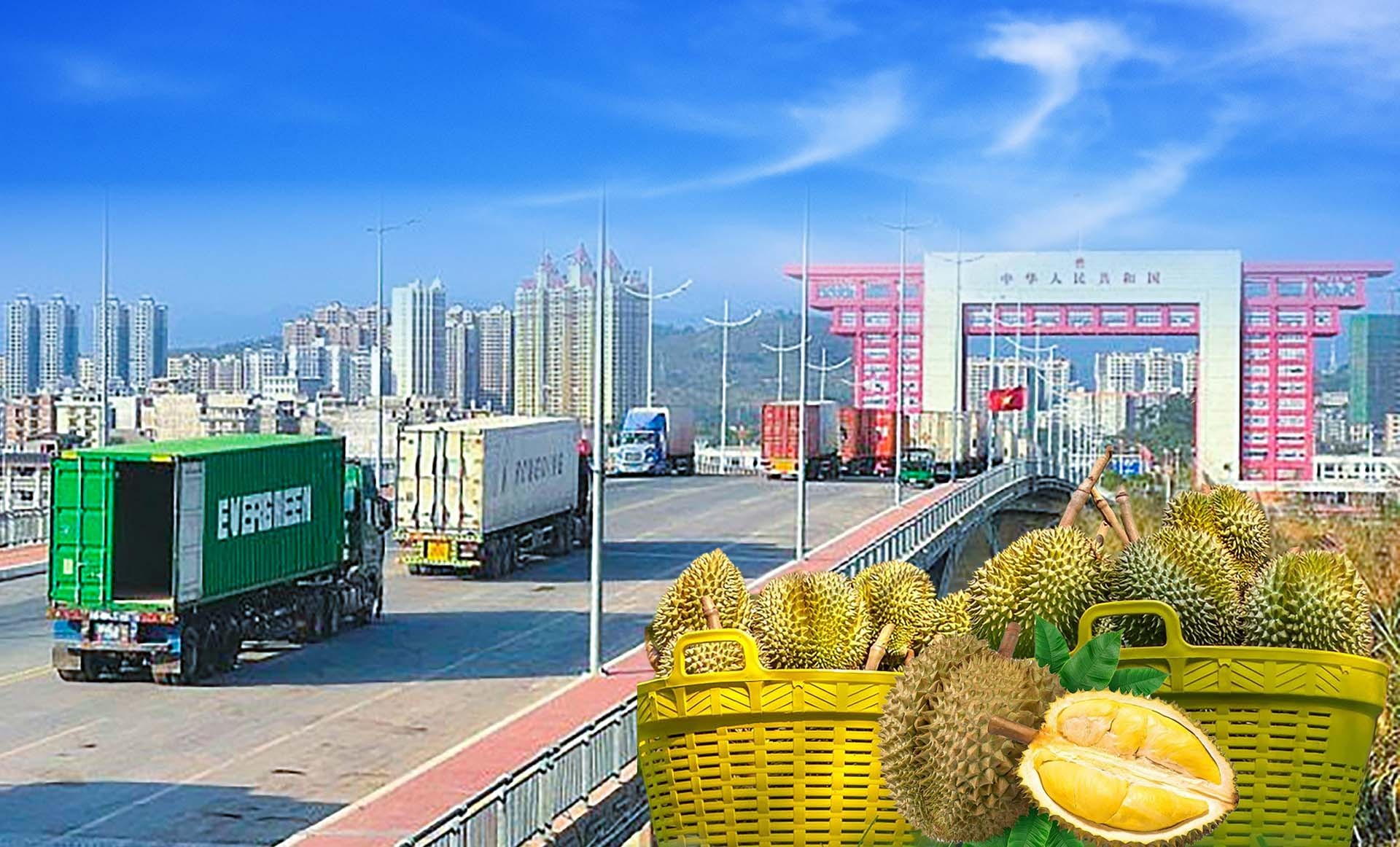
| Vietnamese durian exports to China account for 95% of the country's total export value of this product group. (Photo: LC) |
How would you assess bilateral trade between Vietnam and China in recent times?
In the overall picture of Vietnam's foreign trade, China has always been one of the most important trading partners. Vietnam has also become, and continues to be, one of China's leading trading partners in the world and the region.
Geographical advantages, complementary economic structures and import/export goods, combined with a relatively complete legal framework for trade (both are members of two free trade agreements, including the ASEAN-China Free Trade Agreement and the Regional Comprehensive Economic Partnership), have been the driving force behind the continuous growth of bilateral trade over many years.
In 2004, China officially became Vietnam's largest trading partner. Twenty years later, that position remains, with Vietnam becoming China's largest trading partner in ASEAN and its sixth largest trading partner globally in 2022.
According to Vietnamese statistics, in 2022, bilateral trade reached US$175.56 billion. Of this, exports to China totaled US$57.7 billion; imports from China totaled US$117.8 billion. China is the largest source of goods and the second largest export market for Vietnam.
According to Vietnamese statistics, in 2022, bilateral trade between the two countries reached US$175.56 billion. Of this, exports to China totaled US$57.7 billion; imports from China totaled US$117.8 billion. China is currently Vietnam's largest source of goods and its second largest export market.
In the first eight months of 2023, despite the challenging global economic climate, Vietnam's exports to China still reached US$36.6 billion, an increase of 2.37%; the trade deficit was US$32.2 billion, a decrease of 30.49% compared to the same period.
With the world's second-largest population and economy, China has a huge demand for imported processed foods, beverages, agricultural products, and tropical seafood from Vietnam.
Meanwhile, with Vietnam's increasing involvement in regional and global production and supply chains, industrial and manufactured goods such as electronics, telephones, electrical cables, metals, textiles, and footwear have become key product groups and drivers of export growth to the billion-person market.
Conversely, with its central role in regional and global production chains, dubbed the "world's factory," China is a crucial source of raw materials for domestic and export industries such as chemicals, textiles, leather and footwear materials, machinery and equipment, etc.
For over a year, Vietnamese durian has been primarily exported to China, accounting for 95% of the country's total durian export value. According to you, what should Vietnam do in the coming years to make durian more accessible to Chinese customers?
Thanks to the efforts of relevant ministries and agencies, the two countries have signed numerous protocols on plant and animal quarantine for many types of Vietnamese agricultural products, opening up opportunities for access and "official" export to the Chinese market of Vietnam's strong agricultural products such as durian, bananas, sweet potatoes, etc.
This contributes to creating new growth opportunities for Vietnam's fruit and vegetable exports, especially durian – a high-value fruit highly favored by Chinese consumers.
China is a country committed to developing a high-quality trade system. Accordingly, in recent years, its authorities have continuously strengthened measures to strictly control the quality and origin of goods imported from around the world (including Vietnam), especially items related to human health such as food and agricultural products.
In my opinion, China is not an "easy" market as some domestic businesses mistakenly believed in the past. Therefore, to continue maintaining and expanding sustainable exports of fruits and vegetables, including durian, to the Chinese market, businesses, people, local authorities, and domestic management agencies need to:
Firstly, proactively comply with regulations regarding growing areas, packaging facilities, quality standards, packaging and labeling, traceability, business registration, etc., of the Chinese market; and at the same time, strictly manage the use of registered growing area codes and packaging facility codes when exporting to this market.
Secondly, organize planting and production areas according to market signals; avoid situations where planting area increases indiscriminately, leading to oversupply and compromised product quality when grown in unsuitable soil conditions.
Thirdly, focus on brand building, trade promotion, and deeply penetrating the Chinese domestic market.
 |
| Mr. To Ngoc Son, Deputy Director of the Asia-Africa Market Department (Ministry of Industry and Trade), at the Zhejiang International Trade Exhibition 2023 - the 11th Zhejiang Export Commodities Fair in Vietnam. (Photo: Tin Tuc Newspaper) |
In the coming period, the Ministry of Industry and Trade will also closely coordinate with the Ministry of Agriculture and Rural Development and other relevant ministries, sectors, and localities to accelerate the negotiation and signing of the Plant and Animal Quarantine Protocol with China, aiming to open the market for Vietnamese agricultural products that have the capacity to produce and export to this market.
At the same time, we should encourage China to increase the number of border crossings authorized for importing agricultural and aquatic products; and strengthen the dissemination and guidance on regulations and standards of the Chinese market to Vietnamese localities and businesses.
What should Vietnamese businesses do to increase export turnover in the billion-person market?
China is the world's leading consumer market, a market that most businesses worldwide aspire to conquer. To maximize the potential of this market and increase bilateral trade in a more balanced way, Vietnamese businesses need to leverage advantages in terms of the legal framework for trade, geographical location, and similar consumer culture.
From a conceptual standpoint , China's development of high-quality trade with increasingly stringent requirements and standards is an inevitable and irreversible trend. Given this reality, businesses have no choice but to proactively and seriously comply with the regulations and standards of this market for imported goods.
In terms of action, businesses need to shift quickly and strongly towards exporting through "official" channels via international and bilateral border gates; minimizing and eventually stopping "unofficial" exports - which pose many risks.
It is necessary to coordinate with Chinese import businesses to diversify the border crossings for import and export goods, and diversify transportation methods (sea, rail) to reduce the risk of congestion at land border crossings.
Furthermore, businesses are proactively and actively seeking opportunities to bring their goods to domestic markets in China. With a large population and ever-growing potential, each locality in China can be equivalent to the market size of an entire country. Meanwhile, many Vietnamese businesses have yet to deeply explore, or even access, the potential of these inland regions of China.
Simultaneously, it is necessary to study the export of goods to the Chinese market through modern distribution systems, especially cross-border e-commerce.
For its part, in the future, the Ministry of Industry and Trade will continue to coordinate with Chinese partners to organize more trade and investment promotion activities in the industrial sector to create more opportunities for connection and trade between the business communities of the two countries, thereby further expanding the scale and improving the quality of bilateral trade.
Thank you, sir!
Source
![[Photo] Admire the coral "masterpiece" amidst the million-year-old heritage of Dak Lak province.](https://vphoto.vietnam.vn/thumb/1200x675/vietnam/resource/IMAGE/2026/05/31/1780221235105_anh-man-hinh-2026-05-31-luc-16-53-27.png)
![[Photo] The General Secretary, President and his wife begin their state visit to the Philippines.](https://vphoto.vietnam.vn/thumb/1200x675/vietnam/resource/IMAGE/2026/05/31/1780230559452_anh-man-hinh-2026-05-31-luc-19-28-11.png)
![[Image] Hanoi Police officially crowned champions of V-League 2025/2026](https://vphoto.vietnam.vn/thumb/1200x675/vietnam/resource/IMAGE/2026/05/31/1780244769054_ndo_br_039d561b692be875b13a-jpg.webp)
![[Photo] Solemn bathing ceremony and Buddha procession in Hue](https://vphoto.vietnam.vn/thumb/1200x675/vietnam/resource/IMAGE/2026/05/31/1780228263543_1-jpg.webp)


















![[Video] Sunset at Lap An Lagoon – Where the sun sets over the fishing nets](https://vphoto.vietnam.vn/thumb/340x192/vietnam/resource/IMAGE/2026/05/31/1780192137701_beach-landscape-sea-water-nature-grass-745871-pxhere-com.jpeg)








































![[Photo] Admire the coral "masterpiece" amidst the million-year-old heritage of Dak Lak province.](https://vphoto.vietnam.vn/thumb/402x226/vietnam/resource/IMAGE/2026/05/31/1780221235105_anh-man-hinh-2026-05-31-luc-16-53-27.png)


































Comment (0)