

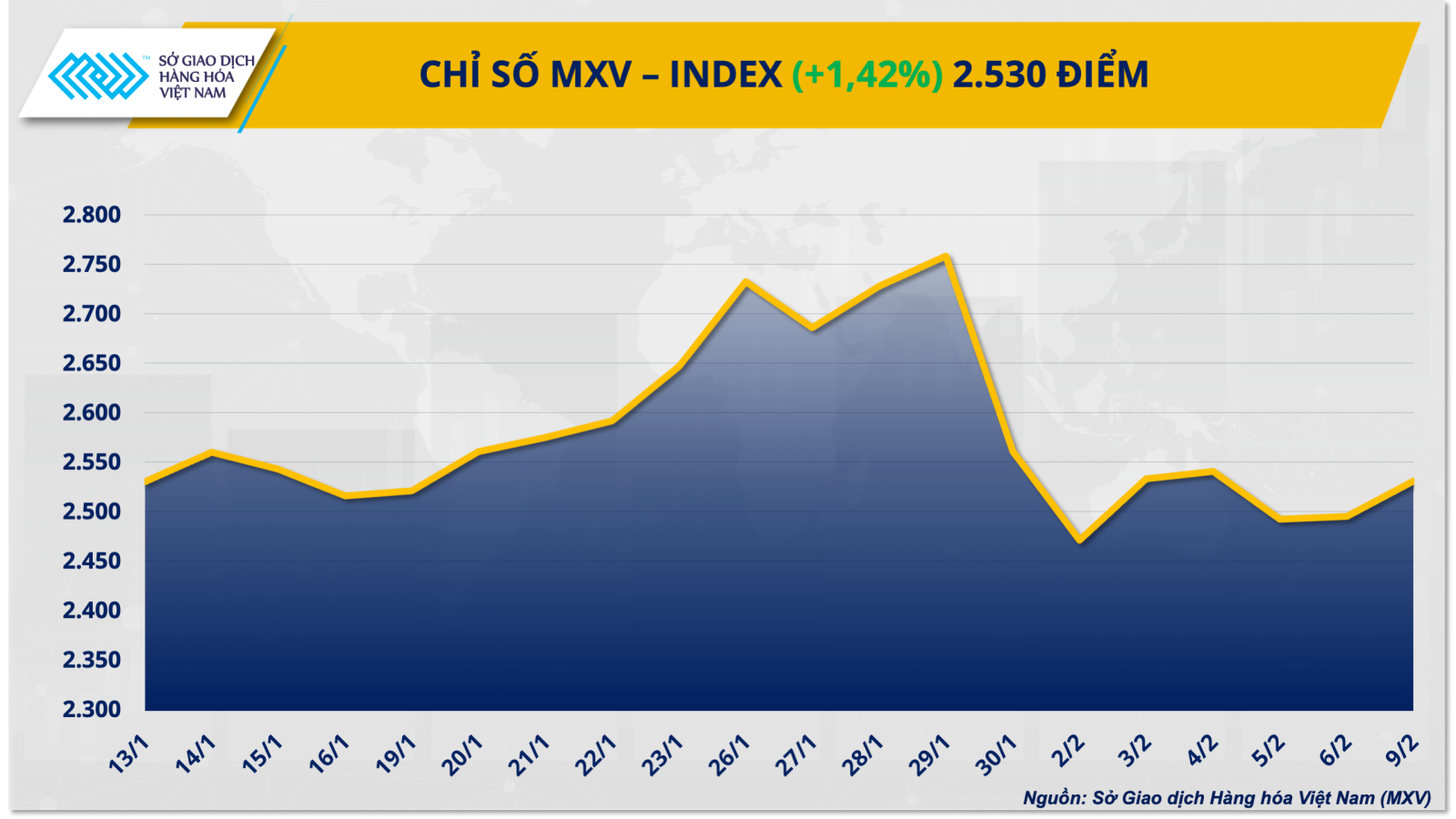
Silver became the focal point as its price surged nearly 7%, extending its bullish momentum. Conversely, agricultural commodities, particularly wheat, saw mixed results, amid continued pressure from large supply prospects from Russia and Kazakhstan on recovery expectations. At the close, buying pressure dominated, pushing the MXV-Index up more than 1.4% to 2,530 points.
Silver prices surged amid a weakening US dollar.
Closing the first trading session of the week, the metals market saw gains across all 10 commodities in the group. Silver, in particular, became the focus of investor attention, recording a nearly 7% increase in the session, bringing the price back to $82.23 per ounce. Year-to-date, despite experiencing a deep correction, COMEX silver prices have still recorded an increase of approximately 16% year-to-date, indicating continued interest in this commodity.
According to the Vietnam Commodity Exchange (MXV), the weakening of the US dollar, coupled with market expectations of further monetary policy easing in the US, has been a crucial factor supporting silver prices during the session.
Yesterday, the Dollar Index (DXY) recorded its second consecutive day of decline, falling to 96.88 points. The weakening of the USD has directly increased the attractiveness of commodities priced in this currency, especially silver, to international investors.
In addition, pressure on the US dollar also comes from China's recent move to recommend that financial institutions limit their holdings of US Treasury bonds. This move is seen by analysts as a clear signal of a trend toward asset diversification and a gradual reduction in dependence on the greenback on a global scale.

In addition, the market's focus this week is on key US macroeconomic reports, including employment and inflation data. These are crucial variables that will determine the Federal Reserve's (Fed) policy direction.
Earlier, the president of the San Francisco Fed branch had left open the possibility of one or two more interest rate cuts to support a weakening labor market. Meanwhile, many forecasts suggest that consumer inflation in the US will end its upward trend by mid-year and overall inflation will soon return to a downward trend. The combination of a sluggish labor market and easing inflationary pressures has opened up room for monetary easing, thereby increasing the attractiveness of non-yielding assets such as precious metals.
However, a cautious sentiment still prevails in the precious metals market. Following the sharp decline at the end of January, coupled with the CME's move to raise margin requirements, most investors are now tending to stay on the sidelines and wait for more concrete signals.
Data from the U.S. Commodity Futures Trading Commission (CFTC) shows that Managed Money (investment funds and institutions) have narrowed their net long positions to their lowest level since February 2024. As of the week ending February 3, their net long position was only 4,983 contracts.
Along with the withdrawal of speculative capital, investment flows through ETFs have also been unfavorable. Since the beginning of last week (February 2nd), the volume of physical silver held by global ETFs has decreased from over 29,500 tons to just over 29,000 tons.
Returning to the domestic market, following global trends, the price of silver in Vietnam on the morning of February 10th recorded an increase of over 2% compared to the previous session. Specifically, 999 pure silver in Hanoi and Ho Chi Minh City fluctuated between 2.574 and 2.609 million VND/ounce (buying price - selling price). In addition, the price of silver bars for investment and storage purposes also rose to 2.964 - 3.056 million VND/ounce.
Supply pressures are pushing wheat prices lower.
In contrast to the bullish momentum in the metals sector, the agricultural commodities market faced widespread selling pressure yesterday, with 6 out of 7 commodities closing in the red. Specifically, Chicago March wheat futures saw a slight decrease of nearly 0.2%, falling to $194.2 per ton. Similarly, Kansas wheat also adjusted downwards by 0.5%, retreating to $194.28 per ton.

According to MXV, wheat prices are currently being driven by a supply-demand imbalance heavily skewed towards supply, particularly intense competition from the Black Sea region.
Firstly, the positive crop outlook in Russia and Kazakhstan is putting pressure on global prices. Russian Deputy Prime Minister Dmitry Patrushev recently confirmed that, as of early February, approximately 97% of the country's winter wheat crop is developing well, significantly higher than the 87% recorded at the same time last year.
With a stable cultivated area of 20 million hectares, Russia is expected to maintain its position as the world's largest supplier in the 2025-2026 crop year. At the same time, the Russian Ministry of Agriculture 's decision to maintain a 0% export tax for five consecutive weeks is seen by analysts as a decisive move to boost sales and compete directly with the US and EU for market share.
In addition, Kazakhstan also reported a wheat production of 19.3 million tons for the 2025 crop year – the second highest level in history – further increasing the abundance of wheat flowing from the Central Asian region.
Secondly, the FAO raised its global supply forecast. The United Nations Food and Agriculture Organization (FAO) has just revised its forecast for world wheat production upwards by 7.3 million tons, to 834.7 million tons, thanks to improved yields in Argentina, Canada, and the EU. This also contributed to a cooling of the global food price index last month.
Conversely, while demand is positive, it lacks the momentum to drive a significant increase. Data from the US Department of Agriculture (USDA) shows very promising US wheat exports. Export inspections last week exceeded 580,000 tons, a sharp increase from the previous week. Total US export commitments for the 2025-2026 crop year have reached nearly 22 million tons, completing 90% of the annual plan. However, this positive demand news is temporarily overshadowed by investor caution regarding the massive supply of cheap wheat from the Black Sea.

Amidst historically low global wheat prices, Vietnamese businesses have rapidly increased imports. Data from the General Department of Customs shows that wheat imports in January reached approximately 674,880 tons, valued at over $175 million. This dramatic 126.5% increase in volume compared to the previous month clearly reflects a strategy of accumulating goods at favorable prices to meet the recovering demand for animal feed production.
Source: https://baotintuc.vn/thi-truong-tien-te/gia-bac-tang-vot-7-lua-mi-chiu-suc-ep-tu-nguon-cung-bien-den-20260210100927038.htm

![[Photo] Solemn bathing ceremony and Buddha procession in Hue](https://vphoto.vietnam.vn/thumb/1200x675/vietnam/resource/IMAGE/2026/05/31/1780228263543_1-jpg.webp)

![[Photo] Admire the coral "masterpiece" amidst the million-year-old heritage of Dak Lak province.](https://vphoto.vietnam.vn/thumb/1200x675/vietnam/resource/IMAGE/2026/05/31/1780221235105_anh-man-hinh-2026-05-31-luc-16-53-27.png)
![[Photo] The General Secretary, President and his wife begin their state visit to the Philippines.](https://vphoto.vietnam.vn/thumb/1200x675/vietnam/resource/IMAGE/2026/05/31/1780230559452_anh-man-hinh-2026-05-31-luc-19-28-11.png)























![[Video] Sunset at Lap An Lagoon – Where the sun sets over the fishing nets](https://vphoto.vietnam.vn/thumb/340x192/vietnam/resource/IMAGE/2026/05/31/1780192137701_beach-landscape-sea-water-nature-grass-745871-pxhere-com.jpeg)










































![[Photo] Admire the coral "masterpiece" amidst the million-year-old heritage of Dak Lak province.](https://vphoto.vietnam.vn/thumb/402x226/vietnam/resource/IMAGE/2026/05/31/1780221235105_anh-man-hinh-2026-05-31-luc-16-53-27.png)





































Comment (0)