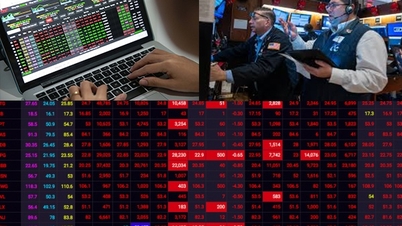
The global commodities market experienced a volatile trading session with clear divergence among different commodity groups. While world oil prices reversed course and fell as geopolitical tensions eased, cotton prices, conversely, continued to surge, reaching their highest level in 23 months. At closing, selling pressure dominated, pulling the MXV-Index down 0.45% to 2,943 points, ending an 11-session winning streak.
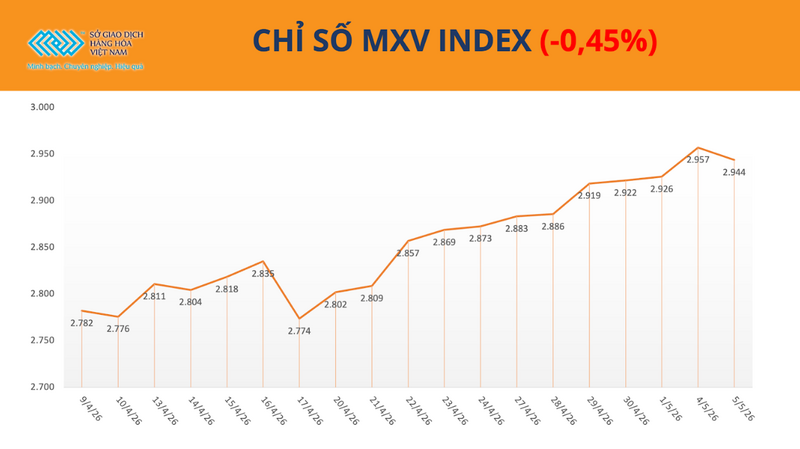
MXV-Index
Oil prices fell across the board.
According to the Vietnam Commodity Exchange (MXV), the crude oil market experienced a significant correction yesterday after positive signals from the US and Iran helped alleviate concerns about supply disruptions in the Middle East.
Earlier, oil prices fluctuated on May 4th as the market reacted to news of escalating tensions in the Strait of Hormuz – a vital global energy shipping route. However, as the parties returned to the negotiating table, the market quickly adjusted its expectations regarding supply risks.
In this context, buying pressure weakened as many investors holding previously long positions tended to take profits to protect their gains, causing oil prices to quickly correct. This is a common reaction in the futures market, where long positions are closed after a sharp increase, increasing selling pressure and pulling prices down in the short term.
At the close of trading, Brent crude oil prices fell nearly 4%, dropping below $110 per barrel; while WTI crude oil also fell by about 3.9%, settling below $102.3 per barrel.

WTI and Brent oil price trends. Source: MXV
Amidst volatile global oil prices, several domestic policies are being adjusted to simplify procedures and facilitate business operations. Recently, the Government issued Resolution 19/2026/NQ-CP aimed at decentralizing, reducing, and simplifying administrative procedures and business conditions in 10 sectors under the Ministry of Industry and Trade , with petroleum being a sector experiencing notable changes.
The resolution suspends certain procedures for reissuing, amending, and supplementing certificates of eligibility for petroleum general agents; and simplifies procedures for primary traders, distributors, agents, and retail outlets. Notably, business conditions for the service of leasing ports, storage facilities, and transporting petroleum products have also been abolished.
These adjustments are expected to help reduce administrative barriers and create more favorable conditions for the domestic petroleum business.
Cotton prices are rising due to concerns about supply shortages.
In contrast to the energy sector, industrial raw materials closed yesterday's session in positive territory (except for RSS3 rubber). Notably, cotton led the group's gains, extending its upward trend over the past two months and reaching its highest level in almost two years.
The main driving force comes from a combination of rising input costs and supply risks. Specifically, persistently high oil prices have driven up the production costs of polyester—a synthetic fiber—leading many manufacturers to switch to cotton as an alternative.
In addition, rising fertilizer costs are putting pressure on agricultural production. In the US, West Texas – the largest cotton-growing region – is currently entering the planting season, but as many as 86% of farmers cannot afford the full cost of fertilizer, raising concerns about a potential drop in yields next season.

Percentage of farmers unable to afford the total amount of fertilizer needed. Source: MXV
Weather conditions also continue to be unfavorable, with drought affecting approximately 98% of the US cotton growing area. Due to its high dependence on seasonality and natural conditions, cotton prices typically react strongly to supply risks, especially in the early stages of the season.
Given these supporting factors, July cotton futures continued to rise by 2.27% during the session, bringing the total increase since the beginning of the month to over 16%, currently trading around $1,869.5 per ton. This development indicates that market capital flows are reflecting expectations of a supply shortage in the near future, thereby pushing futures contract prices higher.
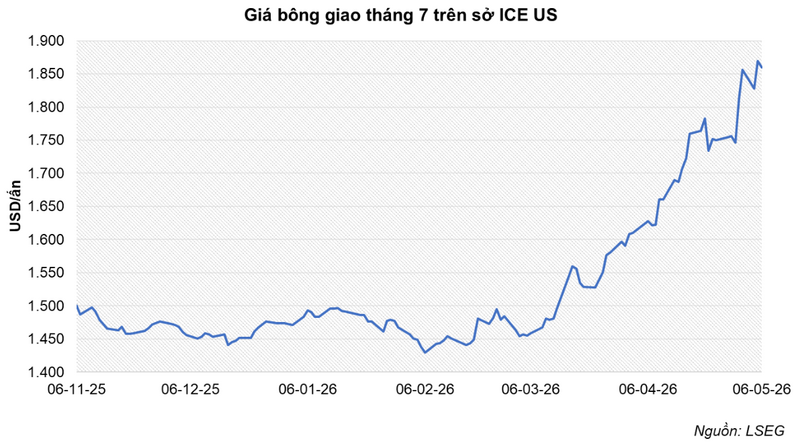
Cotton prices for July delivery on the ICE US exchange. Source: MXV
In Vietnam, cotton imports from the beginning of the year to mid-April reached over 516,000 tons, a decrease of 4% in volume and 11.7% in value compared to the same period last year. In the context of volatile prices, using forward trading instruments can help businesses be more proactive in managing price risks, especially for input materials like cotton.
Source: https://congthuong.vn/gia-dau-the-gioi-dong-loat-giam-455321.html






![[Image] Close-up view of the interchange connecting the two expressways and Long Thanh Airport.](https://vphoto.vietnam.vn/thumb/1200x675/vietnam/resource/IMAGE/2026/05/25/1779703378210_ndo_br_z7863716673926-224453a31600126cce10622af6290afd-4549-jpg.webp)
![[Image] Hanoi's urban life under the challenge of a "scorching hot" environment](https://vphoto.vietnam.vn/thumb/1200x675/vietnam/resource/IMAGE/2026/05/25/1779706979265_nang-nong-t5-2026-minh-duy-7-4636-jpg.webp)


































































































Comment (0)